
Solar
Home Solar Panels in California: A 2026 Homeowner’s Guide
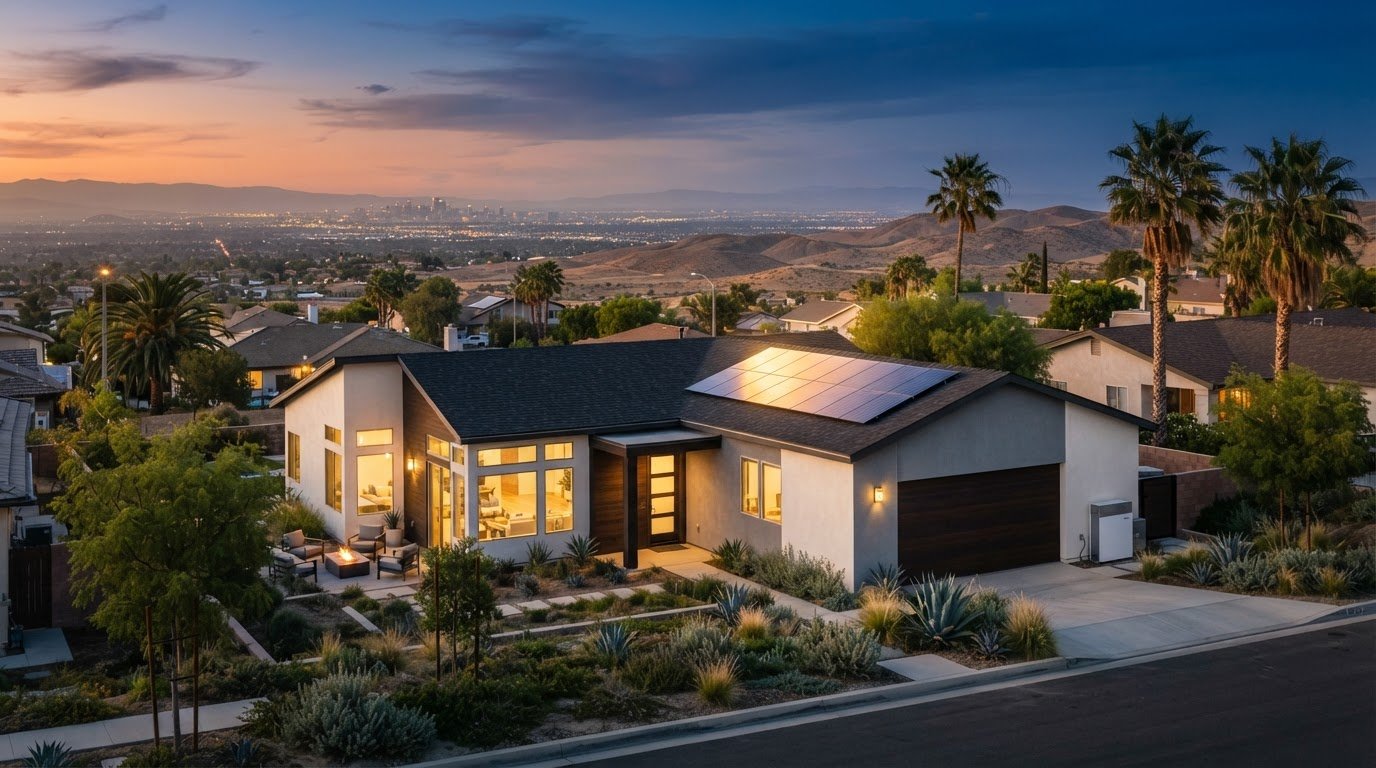
What if the right solar plan for your California home depends less on sunshine and more on who sends your electricity bill? When you’re considering home solar panels California utility rules can affect the value of electricity you export, so the same system may work differently across service areas.
It’s reasonable to want clear answers before changing your roof or choosing equipment. Your utility’s billing rules, your roof’s condition and sun exposure, and when your household uses electricity all matter. PG&E, SCE, and SDG&E customers follow a different solar billing framework from LADWP customers, which has its own rules. For systems installed in 2026, the federal residential clean energy credit is no longer available.
This guide explains the California-specific factors to check, how to assess your roof and electricity use, and what to compare when considering solar-only or solar-plus-battery options. You’ll also find practical questions to ask about project coordination, ownership, and leasing before speaking with a local provider. The goal is to help you take a clear first step, not rush into a decision.
Key Takeaways
- Before evaluating home solar panels California, identify the utility serving your address and check which billing rules apply.
- Assess roof orientation, shade, usable space, and condition, then consider whether roof work may be needed before installation.
- Review electricity use by season and time of day to understand how well solar may match your household’s needs.
- Compare proposals using the same production assumptions and ask how each treats electricity sent back to the grid.
- For Los Angeles homeowners, HelioCore coordinates residential solar projects from consultation and engineering through permitting, inspections, and utility permission to operate.
Table of Contents
- Home solar panels in California: what homeowners should understand first
- California solar billing: check LADWP and utility rules before sizing a system
- Will home solar panels suit your California home without a battery?
- How to evaluate home solar proposals in California: a homeowner checklist
- Home solar panels in Los Angeles: what HelioCore can manage for you
Home solar panels in California: what homeowners should understand first
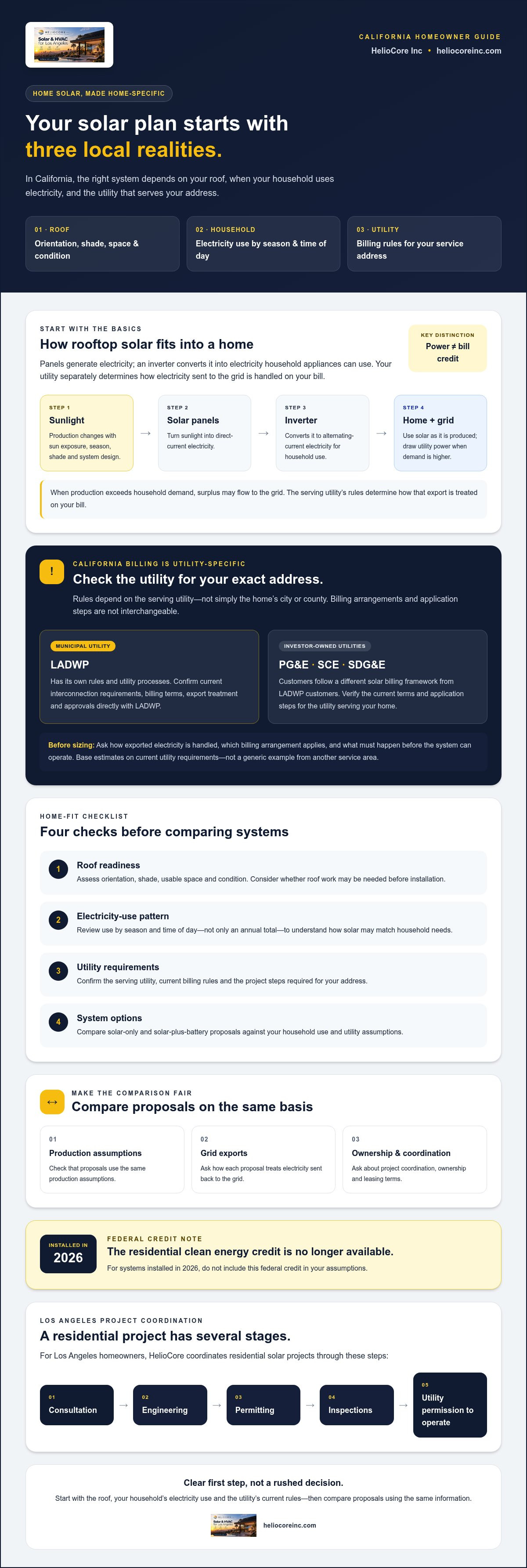
A rooftop solar system uses panels to turn sunlight into electricity for your home. Producing electricity and receiving a utility bill credit are separate matters: panels generate power, while your utility determines how electricity sent to the grid is handled on your bill.
That distinction is a useful starting point when considering home solar panels California homeowners may install. A system’s fit depends on more than sunny weather. Roof orientation, shade, usable space, and condition all affect the design, as do household electricity use and the utility serving your address. For a high-level look at the state’s solar history and policy context, see Solar power in California.
How do rooftop solar panels supply electricity to a California home?
Solar panels generate direct-current electricity from sunlight. An inverter converts it into alternating-current electricity that household appliances can use. Production varies with sun exposure, season, shade, and system design, so output won’t be identical every day.
In a grid-connected home, solar power can supply the house while the system is producing. If household demand exceeds solar output, the home can draw electricity from the utility. This may happen after sunset, during low-production periods, or when appliances use more power than the panels are generating. Solar panels alone don’t mean a home stops using utility electricity.
Why does the serving California utility matter?
California homeowners don’t all follow one solar billing program. LADWP is a municipal utility, while PG&E, SCE, and SDG&E are investor-owned utilities. Their billing arrangements and project application steps aren’t interchangeable. The rules depend on the utility serving a specific address, not simply on the home’s city or county.
Ask how the utility handles electricity exported to the grid, which billing arrangement applies to a new system, and what steps are required before it can operate. Check current requirements directly with the serving utility before relying on export credits or application timelines in your financial assumptions. A proposal should state its assumptions and identify the utility rules it uses.
Keep the first evaluation practical:
- Check the roof. Note shade, orientation, available area, and any likely roof work.
- Review household use. Look beyond an annual total to when and how electricity is used.
- Confirm the utility. Verify billing rules and project requirements for your address.
These checks turn a broad question about solar into a home-specific assessment. Start with the roof, your household’s electricity use, and the utility’s current rules. Then compare proposals using the same information.
California solar billing: check LADWP and utility rules before sizing a system
Solar power used in your home and solar power sent to the grid are treated differently on your bill. Using your own solar electricity can reduce how much power you draw from the utility at that moment. If your panels produce more than your home needs, surplus electricity may flow to the grid, and the utility’s rules determine how that export is handled.
California solar billing depends on the serving utility, so verify current details before sizing a system. The utility for your specific address determines which billing terms, export credits, and application steps to investigate. Don’t assume a program or credit described for one service area applies to another. The CPUC’s California Solar Consumer Protection Guide is a useful resource for understanding consumer protections and reviewing a solar proposal.
What should LADWP customers verify before going solar?
Start with the LADWP account and service address. Confirm LADWP’s current interconnection requirements, billing terms, and treatment of exported electricity. Ask which forms or approvals are needed and how the utility determines that a system can operate. Base your estimates on current terms, not an installer’s generic example or another utility’s program.
LADWP has its own utility processes. SCE program names, rates, and application guidance shouldn’t be treated as a substitute for LADWP information.
How do California investor-owned utility rules differ from LADWP?
Investor-owned utilities such as SCE have their own solar information and application processes. PG&E and SDG&E may also have separate tariffs, paperwork, and timelines. Even homes in the same broader region may follow different utility rules. Confirm every 2026 billing or program detail with the source for the utility serving the home.
Use this comparison to organize your questions, rather than relying on assumed rates or credits:
| What to check | LADWP | Investor-owned utility, such as SCE |
|---|---|---|
| Billing terms | What current billing arrangement applies to this address? | Which current tariff or solar billing plan applies? |
| Export treatment | How are surplus exports credited or otherwise accounted for? | How are exports treated under the applicable plan? |
| Project steps | What interconnection forms, reviews, and approvals are required? | What application steps and permission are required? |
| Timing | What current processing steps and timelines should be expected? | What current processing steps and timelines should be expected? |
For homeowners considering home solar panels California, checking the utility makes proposal comparisons more meaningful. Ask each provider to state the rules and assumptions behind its estimate. Los Angeles homeowners can also discuss residential solar project coordination with HelioCore while evaluating the steps for their address.
Will home solar panels suit your California home without a battery?
A battery isn’t automatically required for a useful solar system. The right setup depends on your roof, household electricity patterns, utility export rules, and what you want the system to do. Solar electricity used at home, surplus electricity sent to the grid, and electricity stored for later are separate parts of the decision.
When evaluating home solar panels California homeowners should look beyond general sunshine and request a site-specific assessment. A sunny region doesn’t show how much usable roof area a particular home has or how shade affects production throughout the day.
Which roof and household factors affect solar suitability?
A site review should consider the roof’s orientation, shade, condition, and usable area, along with the home’s electrical needs. Trees, nearby buildings, roof features, and the timing of future roof work can affect the proposed design. If you expect to replace the roof or make major home upgrades, mention that early so the plan can account for the work and any changes in electricity use.
Household use matters just as much. Review bills or usage records by season and time of day. An annual total can hide patterns such as higher demand in hot months or heavy evening use after solar production has fallen. Discuss planned additions, such as an electric vehicle or new heating and cooling equipment, so the assessment reflects likely future needs as well as current routines.
Ask the provider to explain the assumptions behind its production estimate. A useful proposal connects the roof and system design to expected household use and the utility’s treatment of exported electricity. It shouldn’t promise a particular bill reduction: results depend on the design, utility rules, and how the home uses power.
When might a home battery be worth considering?
Start with your goal. If you want stored solar electricity available for later use, ask how a battery could fit your usage pattern and the utility’s export rules. If backup power matters, ask what the proposed battery setup is designed to support. These are related but distinct reasons to consider storage, and the right answer depends on your priorities.
Export terms can influence whether storing surplus electricity makes sense, but they don’t make a battery essential for every home. LADWP customers can check current details through LADWP solar programs. Compare the utility’s rules with your goals before choosing solar-only or solar-plus-battery.
HelioCore installs battery storage, including Tesla Powerwall systems. Consider storage alongside the solar design, not as a required component. Ask what a battery would do for your home and why the proposed setup matches your needs.
How to evaluate home solar proposals in California: a homeowner checklist
A useful proposal explains how the system fits your home, utility, and electricity use, rather than simply listing equipment or projecting an outcome. Review each bid in the same order. This makes it easier to identify different assumptions and ask focused follow-up questions before choosing an installer.
What should a California solar proposal explain clearly?
Check that each proposal describes the system design, equipment categories, estimated production, and utility context in plain language. Ask what assumptions the estimate uses for roof shade, household electricity use, and exported energy. If proposals use different assumptions, ask each installer to explain them and compare estimates on the same basis.
Review responsibilities, too. The proposal should say who handles engineering, permits, inspections, installation, and utility coordination, including steps required before the system can operate. Ask for clear explanations of exclusions, contingencies, and what happens after installation. For general consumer questions about providers and contracts, consult the California Public Utilities Commission’s California Solar Consumer Protection Guide.
How can homeowners compare solar installers without focusing only on price?
Compare the full scope of work and how each installer manages the project. Ask who your main contact will be, how utility questions are handled, and how schedule changes are communicated. Review the written documentation and confirm that it assigns responsibility for each project step.
Before signing, verify the contractor’s credentials and licensing through the California Contractors State License Board, and confirm current requirements for the work. A proposal that clearly explains its assumptions and responsibilities gives you more to evaluate than a headline estimate alone.
Use this homeowner checklist:
- 1. Utility: Confirm the utility serving the address and the billing terms assumed in the proposal.
- 2. Usage: Check that the design reflects household electricity use, including when demand occurs.
- 3. Roof assessment: Review the assumptions about shade, roof condition, orientation, and usable space.
- 4. Design assumptions: Compare estimated production using consistent information about the home and system.
- 5. Equipment: Confirm the proposed equipment categories and ask why they suit the design.
- 6. Project responsibilities: Identify who coordinates engineering, permits, installation, inspections, and utility permission to operate.
For homeowners weighing home solar panels California, clear project responsibilities matter at every step. If you’re in Los Angeles, review the Los Angeles solar installation homeowner guide as you prepare questions about coordination and proposal scope.
Home solar panels in Los Angeles: what HelioCore can manage for you
Understanding utility rules and household fit is only part of a solar decision. The project also involves system design, permitting, installation, inspections, and utility coordination. For Los Angeles County homeowners, HelioCore manages residential solar projects through these stages, including in the LADWP service area. Confirm current availability for your specific city and address.
What happens when HelioCore manages a residential solar project?
The process starts with a consultation to understand the home, electricity use, utility, and project goals. HelioCore then develops custom engineering for the system and coordinates the steps needed to move the project forward, including permitting, installation, and inspections.
Utility coordination is part of completing the project, not an afterthought. HelioCore manages the process through the utility’s permission to operate, which is required before the system can operate under the utility’s process. Clear responsibility for these steps can reduce the paperwork and follow-up a homeowner needs to track. Ask how the proposed design reflects current utility requirements and what project updates to expect along the way.
Each home needs a plan based on its own roof, energy use, and utility account. A project in the LADWP service area may involve different requirements from a home served by another provider, so check that the proposal identifies the applicable utility and explains the coordination involved.
How can Los Angeles homeowners explore a solar system that fits?
Bring the questions that matter to your household: Which utility serves the address? What does the roof assessment show? When does the home use the most electricity? Is battery storage a priority, or is the focus on solar generation? These details make the conversation about system design specific to your home rather than one-size-fits-all.
HelioCore offers direct purchase and Palmetto lease options. Compare them once the project design and household needs are clear, and ask how each option fits your ownership preferences and project responsibilities. Battery storage is a separate choice to discuss in light of your goals and utility context, not a requirement for every solar installation.
Choosing home solar panels California homeowners can feel confident about starts with a clear assessment and a project plan they understand. If you’re ready to review your home’s utility, roof, usage, and storage goals, talk with HelioCore about home solar.
Take the next step with a clear solar plan
For home solar panels California homeowners should start with three essentials: the utility serving the home, the roof’s suitability, and when the household uses electricity. Those details shape system design and how exported power is treated. A battery may support storage or backup goals, but it isn’t automatically right for every household.
As you compare proposals, look beyond the equipment list. Check that each provider explains its production assumptions, utility context, and responsibility for project steps. A clear plan makes it easier to understand your options without rushing the decision.
HelioCore coordinates residential solar projects from consultation and engineering through permitting, installation, inspections, and utility permission to operate. Los Angeles homeowners can discuss direct ownership or Palmetto lease options, and consider Tesla Powerwall storage if it fits their goals.
Talk with HelioCore about home solar to explore what may suit your roof, utility, and household. Start with a conversation about your home’s needs and project options.
Frequently Asked Questions
Is home solar worth it in California?
It can be a good fit for some households, but California sunshine alone doesn’t determine value. Consider your electricity use, roof conditions, utility billing rules, and proposed system design. Review when your home uses power and how the utility treats electricity sent to the grid. For home solar panels California homeowners are evaluating, a property-specific proposal is more useful than a broad estimate. Los Angeles and Palmdale residents should confirm the utility serving their address.
Do California home solar panels work during a power outage?
Standard grid-connected solar systems generally shut down during an outage unless they’re configured with approved backup equipment. A battery may support selected circuits or broader household needs, depending on the system design. If you’re in Los Angeles or Palmdale and outage protection matters, ask the installer which appliances can run, how backup is configured, and what limitations apply. Confirm equipment and utility requirements for your specific home before relying on backup power.
Do I need a battery with solar panels in California?
No, a battery isn’t necessary for every homeowner. Storage may support backup-power goals or let you use more solar electricity at home, while utility export rules can affect its value. The right choice depends on your utility, household usage timing, system design, and priorities. Compare solar-only and battery options using current assumptions for your address. Los Angeles and Palmdale homeowners can ask whether storage fits their goals rather than treating it as a standard requirement.
How do I know whether my home is suitable for solar panels?
Start with a roof assessment that considers shade, orientation, condition, and usable space. Then review household electricity use and planned changes, such as adding a heat pump or electric vehicle. A site-specific design should estimate production using your home’s actual conditions, not just California’s general sunshine. Ask the installer to confirm your serving utility and explain assumptions that affect system size or expected exports. This process applies to homes in Los Angeles and Palmdale alike.
What is the difference between LADWP solar rules and SCE solar rules?
LADWP and SCE are separate utilities, so their applications, billing arrangements, and export-credit details may differ. Don’t assume a rule or program for one applies to the other. First identify the utility serving your property, then verify its current requirements and ask how they affect the proposal. This is especially useful for Los Angeles homeowners comparing LADWP guidance with information they may see about SCE or other utilities.
How long does it take to install home solar panels in California?
Project timing varies with the home, system design, permitting, installation scheduling, inspections, and utility review. Installation is one stage; utility approval and permission to operate may come later. Ask the contractor for a project-specific schedule that names each stage and who manages it. Homeowners in Los Angeles and Palmdale should confirm current local and utility processing expectations instead of relying on a statewide estimate or an older timeline.
Can I lease home solar panels in California instead of buying them?
Some homeowners can compare leasing with direct ownership, though options and terms depend on the provider and project. Review the payment structure, contract length, maintenance responsibilities, transfer conditions, and how the arrangement fits your utility billing. HelioCore offers direct purchase and Palmetto lease options for residential solar projects. Los Angeles and Palmdale homeowners can ask about availability for their address, then compare the agreement with their household priorities before choosing.