
Solar
LADWP True-Up Billing for Solar: What Los Angeles Homeowners Should Know in 2026

Will LADWP send you a solar true-up bill, or does it handle solar credits differently? It’s a common question, especially if you’ve heard how annual true-ups work with other California utilities. For homeowners searching “ladwp true-up billing solar,” the key distinction is that LADWP has its own Net Energy Metering program. The investor-owned utilities’ NEM 3.0 rules do not automatically apply to LADWP customers.
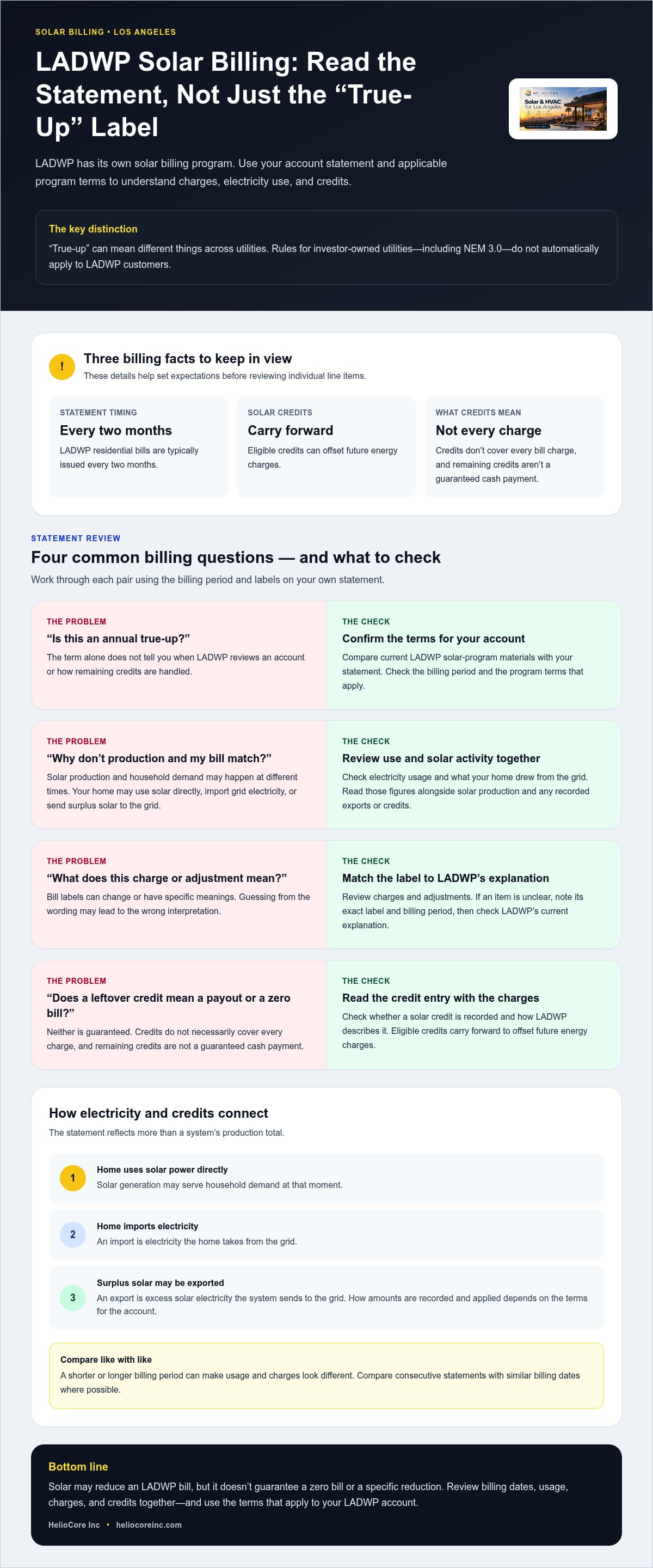
LADWP carries eligible solar credits forward to offset future energy charges, but those credits don’t cover every charge on your bill. Remaining credits aren’t a guaranteed cash payment, either. LADWP residential bills are typically issued every two months, so the timing can look different from the monthly statements you may have seen elsewhere.
This guide explains what “true-up” means in the LADWP context, how to review electricity imports, solar credits, and other charges, and what to consider before choosing a system or solar plan. Solar may reduce your LADWP bill, but it doesn’t necessarily eliminate it. Start by reading your utility statement and understanding the terms that apply to your account.
Key Takeaways
- “True-up” can mean different things across utilities. Understand what ladwp true-up billing solar means for your account before expecting an annual bill or settlement.
- LADWP has its own solar billing program. Don’t assume rules for other California utilities apply to your home.
- Review your statement’s billing dates, solar activation status, electricity use, and credit entries to identify what needs clarification.
- Compare current LADWP program and rate information with your account statement, then review how your solar agreement handles payments and utility charges.
- Solar may lower your LADWP bill, but it doesn’t guarantee a zero bill or a specific reduction.
Table of Contents
- What Does LADWP True-Up Billing Mean for a Solar Home?
- How LADWP Solar Billing Connects Home Use, Solar Production, and Credits
- LADWP True-Up vs. Net Metering: Which Billing Details Actually Apply?
- How to Check an LADWP Solar Bill and Resolve a True-Up Question
- Plan for LADWP Solar Billing Before Choosing a Home Solar Arrangement
What Does LADWP True-Up Billing Mean for a Solar Home?
Solar articles use “true-up” to describe different utility billing arrangements. That can make it sound as if every solar customer gets the same annual bill, follows the same schedule, or receives the same treatment for leftover credits. They don’t. For ladwp true-up billing solar, start by separating the general meaning of the term from the rules that apply to your LADWP account.
What does solar true-up usually refer to?
A true-up is a periodic review or settlement of electricity charges and credits. For a solar home, that review may account for electricity drawn from the grid, excess solar sent back to it, and charges or credits recorded during the billing period. The timing and result depend on the utility’s program.
Net metering (or net energy metering, NEM) describes a general arrangement in which a utility tracks electricity a customer uses and electricity a solar system supplies to the grid. A true-up may refer to a later reconciliation of those amounts. The term alone doesn’t tell you whether a utility reviews an account monthly, annually, or on another schedule, or how it handles a remaining credit.
Think of “true-up” as a broad label, not a universal billing rule. The specific tariff or customer program determines what gets counted and when.
Does LADWP use the same true-up process as other California utilities?
No. LADWP is a municipal utility with its own solar program and billing rules. Investor-owned utilities have separate tariffs and processes, so their annual true-up or NEM 3.0 descriptions shouldn’t be treated as explanations of an LADWP account.
To understand your LADWP bill, compare the current solar-program materials with your account statement. Check the program terms that apply, the statement’s billing period, and how it records solar-related charges or credits. If your solar activation date or agreement affects the applicable terms, review those details as well.
A familiar term doesn’t mean LADWP uses another utility’s exact billing process. Before assuming a “true-up bill” is coming, confirm how LADWP handles your account. This distinction helps set realistic expectations: solar may reduce your LADWP bill, but it doesn’t guarantee that the bill disappears.
How LADWP Solar Billing Connects Home Use, Solar Production, and Credits
Your solar panels and household use don’t follow the same schedule. Panels usually produce electricity during daylight, while household demand rises and falls throughout the day. Your home may use solar power directly at one moment, draw electricity from LADWP at another, and send surplus solar energy to the grid at a different time.
These exchanges are often described as imports and exports. An import is electricity your home takes from the grid. An export is excess solar electricity your system sends back. How LADWP records and applies those amounts depends on the terms that apply to your account. The LADWP Net Metering program details provide a third-party overview. For your specific billing treatment, compare current LADWP program documents with your statement.
How to read solar-related information on an LADWP bill
Start with the billing period. Then review the statement for electricity usage, charges, adjustments, and solar-related credit details. Bill labels can change or have specific meanings, so match each one to LADWP’s current explanations instead of guessing from the wording. If a credit or charge is unclear, note its label and billing period before looking up its definition.
Compare consecutive statements with similar billing dates where possible. A shorter or longer billing period can make usage and charges look different, even when your household’s patterns haven’t changed much.
| What to review | What it helps you understand |
|---|---|
| Billing dates | The period covered by the statement |
| Electricity usage | What your home drew from the grid |
| Charges and adjustments | How LADWP calculated amounts due or applied changes |
| Solar credit details | Whether the statement records a credit and how LADWP describes it |
Why solar production and the utility bill may not move together
Solar production can be strongest when household use is low. If your home needs more electricity later, it may still import power from the grid. Cloud cover, seasonal conditions, changes in household routines, and system output can also affect what appears from one billing period to the next.
A production total doesn’t translate directly into a guaranteed bill reduction or a fixed credit. Solar may reduce your LADWP bill, but it doesn’t automatically eliminate it. Understanding ladwp true-up billing solar means reading usage, charges, and credits together, then checking how the applicable program treats them. A solar planning conversation can help connect expected system production with your household’s electricity patterns. Plan a residential solar project with those details in view.
LADWP True-Up vs. Net Metering: Which Billing Details Actually Apply?
“Net metering” and “true-up” describe different parts of solar billing. Net energy metering, or NEM, is the program framework for measuring electricity a home uses and sends to the grid. A true-up may describe a later review or settlement of charges and credits. The terms are related, but they aren’t interchangeable.
This distinction matters in Los Angeles. LADWP is a municipal utility with its own solar program. NEM 2.0 and NEM 3.0 explanations generally describe programs for California investor-owned utilities, not LADWP’s tariff. Don’t apply their credit rules or settlement schedules to your LADWP account. Check the current LADWP program documents and the terms tied to your account and solar agreement.
Why NEM 2.0 and NEM 3.0 explanations may not answer an LADWP question
California-wide shorthand can hide differences between utilities. LADWP’s program is separate from the CPUC-governed rules that apply to investor-owned utilities such as SCE and PG&E. A web page about another utility can explain general solar concepts, but it doesn’t establish what LADWP will record or apply to your account. Confirm the utility, program, and applicable document before relying on a billing explanation.
Which solar billing terms should homeowners compare?
Use this table as a reading guide, not a substitute for your account terms. LADWP’s current program materials and your statement are the references for your situation. Check the publication or revision date on each document because program rules and rates can change.
| Term or detail | Plain-language meaning | Where to verify it |
|---|---|---|
| Billing period | The dates covered by a utility statement. LADWP residential bills are typically issued every two months, but use your statement dates. | Your LADWP account statement; compare its dates with current LADWP billing information. |
| Imported electricity | Power your home draws from the grid when it needs more than solar is supplying. | Current LADWP NEM program or tariff materials and the usage details on your statement. |
| Exported electricity | Solar power sent to the grid when your system produces more than your home is using at that moment. | Current LADWP solar-program materials; check how your account records exports. |
| Credits and settlement | Credits may affect eligible charges under program rules. “Settlement” refers to how an account is reviewed or closed out. | Current LADWP program terms and your account; treatment can depend on applicable rules and agreement or interconnection details. |
For ladwp true-up billing solar, don’t assume a particular annual timeline or credit outcome based on another utility’s materials. Confirm the current LADWP rules, the dates and labels on your statement, and any terms specific to your account.
How to Check an LADWP Solar Bill and Resolve a True-Up Question
A focused review can help you tell whether a bill reflects normal electricity use, solar activity, or an item that needs clarification. Keep the statement and your system’s monitoring records nearby. Work through the details in order and write down anything that doesn’t line up.
A practical checklist for reviewing your LADWP statement
- Confirm the utility and account. Make sure the statement is from LADWP and covers the account connected to your solar system.
- Check the billing dates. Compare the statement period with the dates in your solar monitoring app. A mismatch can make production and utility usage look out of step.
- Confirm solar activation. Check whether the system was operating during the billing period, including whether it had received utility permission to operate. Solar production shouldn’t appear for dates before the system was active.
- Review usage and charges. Note the electricity usage, charges, and adjustments on the bill. Compare the labels with LADWP’s current bill explanations and rate information instead of guessing what a line item means.
- Find solar-related entries. Record any credit or export information shown, then compare it with the monitoring period. The monitoring app and utility statement may describe different measures, so don’t assume their numbers should match exactly.
Save statements and monitoring records together. Comparing bills with similar date ranges can make changes easier to understand. For the system and utility steps that come before billing, see HelioCore’s LADWP solar permitting guidance.
What to do when a solar credit or charge is unclear
Start with the current LADWP solar-program and rate documents, then use LADWP’s official account and customer-service channels for an account-specific explanation. Have the statement dates, relevant line-item labels, and your solar activation date ready. If you’re asking about a credit, identify the period it appears to relate to.
Keep your question specific: Which solar program terms apply to this account? How does LADWP define this statement entry? Which billing period does it cover? Ask how a charge or credit was calculated before assuming it’s an error. Don’t guess at a correction, credit value, or adjustment timeline. Those depend on LADWP’s review and the rules for your account.
Clear billing expectations are part of sound solar planning. HelioCore coordinates residential solar projects in Los Angeles, from system design through utility permission to operate. Plan a residential solar project with your household’s usage and LADWP account details in view.
Plan for LADWP Solar Billing Before Choosing a Home Solar Arrangement
A clear solar plan starts with three things: the LADWP program that applies to your account, how the utility records electricity use and solar credits, and the written terms of your solar arrangement. This preparation helps you compare the utility bill and solar payment as separate household costs. It also keeps “true-up” from becoming a promise about a specific bill outcome.
Questions to resolve before comparing solar plans
Before choosing a system or lease, review current LADWP program information and your account statement. Understand how the applicable rules treat solar generation, electricity sent to the grid, and credits. Then read the written agreement for its payment schedule, equipment and workmanship coverage, service responsibilities, and transfer terms.
Keep utility charges separate from any solar agreement payment. Solar may reduce your LADWP bill, but it doesn’t automatically eliminate it, and a solar payment remains a separate obligation. For a broader comparison of payment structures, read HelioCore’s guide to solar leasing in Los Angeles. For details on the lease option, see the Palmetto Solar lease guide.
Read the agreement closely. HelioCore’s Palmetto plan includes a 25-year equipment and workmanship warranty, a 10-year warranty for the roof-penetration area related to the solar installation, and a production guarantee of 90% of estimated production over a three-year review period. Ownership doesn’t automatically transfer at lease end; any transfer depends on the agreement. Review these terms alongside payment and service details before deciding.
How HelioCore supports a clearer solar planning process
HelioCore coordinates residential solar projects in Los Angeles from consultation and system design through permitting, installation, inspections, and utility permission to operate. This process connects your home’s electricity use with a system design and the utility steps required for activation. It doesn’t promise a particular LADWP bill reduction.
Qualifying homeowners may have a $0-upfront Palmetto LightReach lease option, with monthly payments applying. Palmetto uses a soft credit check that doesn’t affect your credit score. When comparing this option, review eligibility and written payment terms alongside the LADWP billing rules for your account.
Understanding ladwp true-up billing solar is one part of making an informed decision. Bring your usage history and billing questions into the planning conversation, then weigh utility charges and agreement terms together. Explore solar planning and project coordination in Los Angeles to consider what may fit your home.
Make Your Next Solar Decision with Clear Expectations
To understand ladwp true-up billing solar, first identify which LADWP program applies to your account. Then check how your statement records usage, charges, and solar credits. “True-up” doesn’t guarantee the same annual process used by another California utility. Your bill and written agreement are the practical references.
Solar may reduce your LADWP bill, but it won’t necessarily eliminate it. Keep any solar-plan payment separate from the utility bill, and review agreement terms alongside projected system production. Palmetto LightReach plans include a 25-year equipment and workmanship warranty and a 10-year roof-penetration warranty. The production guarantee is 90% of estimated production over a three-year review period, not a guarantee of utility-bill savings.
HelioCore coordinates residential solar projects for homeowners in LADWP territory, from planning through installation and utility permission to operate. Explore residential solar planning with HelioCore to discuss a solar project for your home.
Frequently Asked Questions
Does LADWP have a solar true-up bill?
Not necessarily in the same form as the annual true-up bill associated with some other California utilities. LADWP has its own Net Energy Metering program, where eligible excess-generation credits can carry forward to later bills. Under the current program information, credits follow a 12-month cycle, and remaining credits aren’t paid out in cash at the cycle’s end. Check LADWP’s current terms and your account for the rules that apply to your system.
How does LADWP bill homeowners with solar panels?
LADWP typically bills residential customers every two months. Solar billing reflects electricity supplied by LADWP and electricity generated by the home system, with eligible excess-generation credits applied under the account’s program terms. Credits can offset energy charges, but not taxes or other fixed monthly charges. Review the statement’s billing dates, usage, charges, and credit entries, then compare them with current LADWP solar-program information.
Why do I still have an LADWP bill after installing solar?
Your home may still draw electricity from LADWP when your panels aren’t producing enough for your needs, such as at night or during periods of higher use. Fixed monthly charges and taxes may also remain because solar credits don’t cover every bill component. In other words, ladwp true-up billing solar doesn’t mean your utility bill disappears. Compare your usage, solar production, and statement entries to understand the charges.
Does LADWP pay customers for extra solar electricity?
LADWP’s Net Energy Metering program applies eligible credits for excess solar electricity to future energy charges. The program information available for 2026 describes excess generation as receiving a credit at the applicable retail rate, which varies with usage tier and season. Credits aren’t a guaranteed cash payment, and remaining credits at the end of the 12-month cycle aren’t paid out. Check the current LADWP program terms for your account’s treatment.
When does LADWP issue a solar true-up statement?
LADWP residential bills are typically issued every two months, while solar credits follow a 12-month cycle under current program information. That doesn’t necessarily mean LADWP sends a separate annual statement called a “true-up bill.” Check your account’s billing dates and credit entries, then consult current LADWP program documents to understand the cycle that applies. If a credit or adjustment is unclear, use LADWP’s official customer-service channels for an account-specific explanation.
Will a solar lease eliminate my LADWP bill?
No. A solar lease doesn’t automatically eliminate your LADWP bill. Your home may still use grid electricity, and some bill charges aren’t offset by solar credits. A lease payment is also separate from the utility bill, so review both written terms when planning your household budget. HelioCore coordinates residential solar projects across Los Angeles, including Inglewood, South Los Angeles, Crenshaw, Leimert Park, Baldwin Hills, Westchester, Van Nuys, North Hollywood, Reseda, Northridge, Woodland Hills, and San Pedro.