
Solar
Palmetto Solar Lease in Los Angeles: A 2026 Homeowner’s Guide

Could a $0-upfront solar option still be the wrong fit if you haven’t looked beyond the first payment? For homeowners considering a palmetto solar lease los angeles plan, the key questions are who owns the equipment, what the monthly payments cover, and how solar works alongside the LADWP bill.
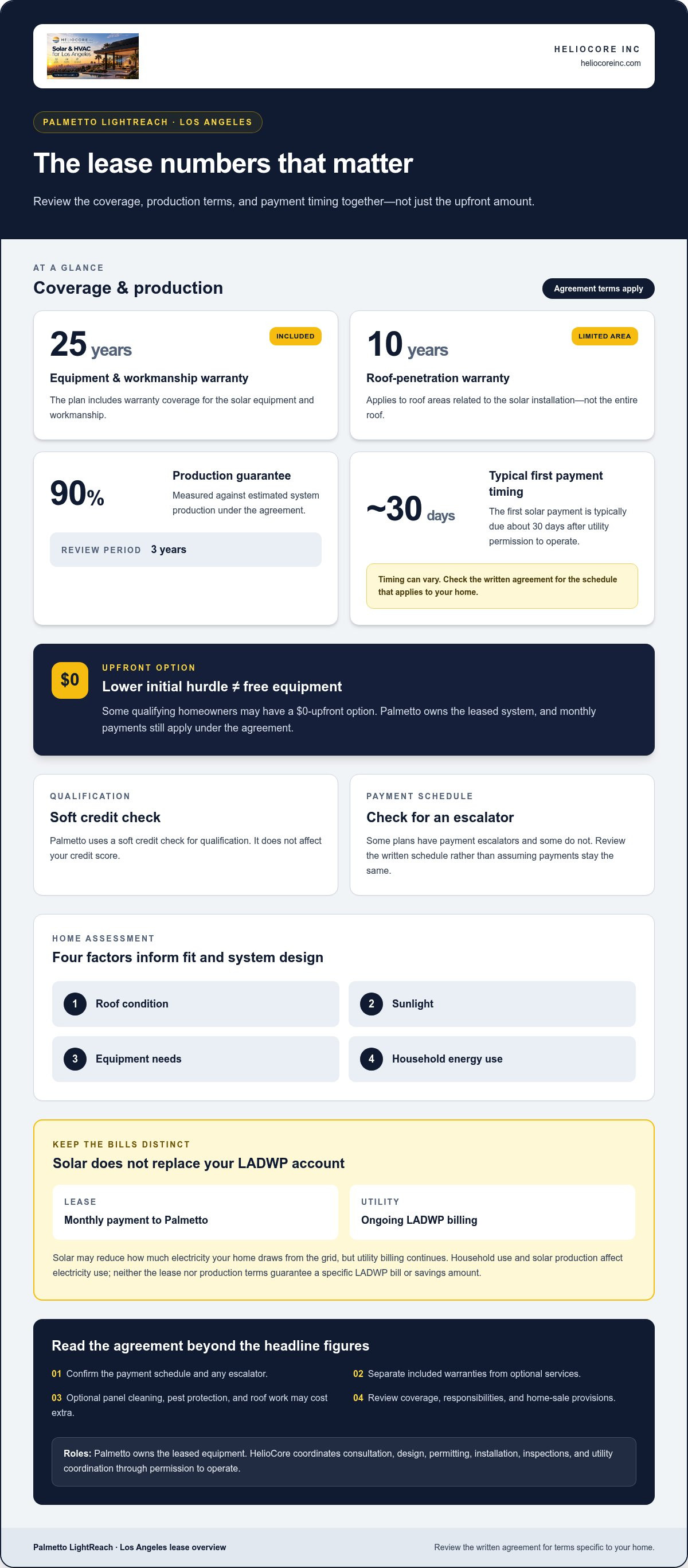
That’s a fair concern. A lease can reduce the upfront hurdle, but it doesn’t mean the equipment is free, that payments can never change, or that the utility bill disappears. With Palmetto LightReach, Palmetto owns the system and monthly payments apply. The plan includes a 25-year equipment and workmanship warranty, plus 10-year coverage for roof penetrations related to the solar installation. Its production guarantee is measured over a three-year review period.
This guide explains how to assess the lease terms, coverage, payment schedule, and home-sale provisions. It also covers how solar production fits with LADWP billing, when the first payment typically begins, and what to know about maintenance and outages. HelioCore coordinates consultation, design, permitting, installation, inspections, and utility permission to operate for Los Angeles homeowners. Use the details below to decide what to review for your home.
Key Takeaways
- Review roof condition, sunlight, equipment needs, and household energy use to understand whether your home may qualify for Palmetto LightReach.
- Palmetto uses a soft credit check for qualification, and it does not affect your credit score.
- Compare a palmetto solar lease los angeles plan with buying by weighing ownership, upfront payment, ongoing payments, and agreement responsibilities.
- Solar production can affect LADWP billing, but it won’t eliminate your utility bill or guarantee a specific saving.
- Before deciding, review the agreement’s coverage, production terms, and home-sale process. A transfer to a qualified buyer is subject to approval.
Table of Contents
What a Palmetto Solar Lease Means for a Los Angeles Home
For a Los Angeles homeowner, Palmetto LightReach is a solar lease for qualifying households. The equipment is installed on your home, but Palmetto owns the leased system. You make monthly payments under the agreement rather than buying and owning the panels. That ownership distinction affects payment obligations, coverage, and the options set out in the contract.
How a Palmetto LightReach lease works
When you buy a system, you pay for it and become its owner. With a lease, Palmetto retains ownership while you use the system and make the agreed payments. Solar leasing is an established model; the history of solar leasing offers background on how leasing can make solar available without requiring homeowners to purchase equipment outright.
HelioCore coordinates the home solar project, including consultation, system design, permitting, installation, inspections, and utility coordination through permission to operate. Palmetto’s role as equipment owner is distinct from HelioCore’s role managing the project. Before signing, read the agreement as a whole: check the payment schedule, any escalator, coverage, responsibilities, and options for selling the home or reaching the end of the lease.
What $0 upfront means for a Los Angeles homeowner
Some qualifying homeowners may have a $0-upfront option. This can reduce the initial amount needed to begin a project, but it doesn’t mean the equipment is free or that payments are waived. Palmetto owns the system, and monthly payments apply under the lease. Compare those ongoing payments and the agreement terms with your household budget, not just the initial amount.
Solar also doesn’t replace your LADWP account. Your panels may supply some of the electricity your home uses and reduce how much you draw from the grid, but LADWP billing continues. The utility electricity you use depends on household consumption and solar production. Evaluate a palmetto solar lease los angeles plan by considering both the lease payments and ongoing utility billing, rather than treating solar as a promise that the power bill will disappear.
The basic arrangement is straightforward: Palmetto owns the leased equipment, you make monthly payments, and HelioCore coordinates the project. The agreement sets the terms that apply to your home and system.
Palmetto Lease Qualification, Payments, and Coverage Explained
Eligibility involves more than selecting a $0-upfront option. Palmetto reviews the applicant, while the home assessment considers roof condition, sunlight, equipment, and household energy use. These factors inform the system design and whether the lease can proceed.
How qualification and monthly payments are assessed
Palmetto uses a soft credit check for qualification, and it does not affect your credit score. If you qualify, the plan and written agreement set your monthly payment. Some plans have payment escalators and some do not, so check the payment schedule in your agreement instead of assuming the amount stays the same. The first solar payment is typically due about 30 days after utility permission to operate, though timing can vary.
For a palmetto solar lease los angeles plan, look at the payment terms alongside your expected utility charges. Solar production may change how much electricity you draw from LADWP, but the lease payment is separate from the utility bill. Neither the lease nor its production terms guarantees a particular bill or saving.
What the solar agreement covers, and what it doesn’t promise
The plan includes a 25-year equipment and workmanship warranty and a 10-year roof-penetration warranty. Roof-penetration coverage applies only to the areas related to the solar installation, not the entire roof. Optional services such as panel cleaning, pest protection, and roof work may cost extra, so review these separately from the stated warranty coverage.
The production guarantee is 90% of estimated production over a three-year review period. It applies to system production under the agreement. It does not promise a particular LADWP bill or savings amount, since household energy use and utility billing are separate factors.
If you’re considering battery storage, California’s Self-Generation Incentive Program is a separate program to explore. Its details don’t replace the lease terms, and incentive availability depends on program rules. When reviewing the agreement, separate included coverage from optional services and check how payments are set. HelioCore coordinates the home solar project from consultation through utility permission to operate. Learn more about residential solar project coordination.
Palmetto Solar Lease vs. Buying: The Los Angeles Trade-Offs
Leasing and buying can both bring solar to a Los Angeles home, but they assign ownership and payment responsibilities differently. The right fit depends on your priorities: limiting upfront spending, owning the equipment, or following the responsibilities in a lease agreement. This comparison focuses on Palmetto LightReach and a direct purchase.
| Consideration | Palmetto LightReach lease | Buying a system |
|---|---|---|
| Equipment ownership | Palmetto owns the leased equipment. | The homeowner owns the system after purchase. |
| Upfront payment | Qualifying homeowners may have a $0-upfront option. | The homeowner pays to purchase the system. |
| Monthly payments | Monthly lease payments apply under the agreement. | Payments depend on how the homeowner funds the purchase. |
| Agreement responsibilities | The signed lease defines the homeowner’s obligations and available options. | The homeowner takes responsibility as system owner, subject to applicable coverage and service arrangements. |
Neither option guarantees a particular LADWP bill or saving. Solar production can affect how much electricity your home draws from the grid, while utility billing continues. Because a lease payment is separate from the LADWP bill, compare the combined household picture rather than treating solar as a one-for-one replacement for utility charges.
When leasing may fit a homeowner’s priorities
A qualifying $0-upfront option may suit a homeowner who prefers not to make an upfront equipment purchase. The system is not free: Palmetto retains ownership, and monthly payments apply. Before deciding, compare the payment schedule and responsibilities with your household budget and plans for the home. The first solar payment is typically due about 30 days after utility permission to operate, but timing can vary.
Ownership, purchase options, and selling the home
Future plans matter. Purchase options become available after the system’s fifth anniversary of utility connection, subject to the agreement. Ownership does not transfer automatically at the end of the lease; the agreement governs the available end-of-term options. If you sell your home, transferring the lease to a qualified buyer is subject to approval. Review these provisions early if a move or later purchase is part of your plans.
For a closer look at the broader decision, see Solar Panel Leasing in Los Angeles: Lease vs Buy 2026. Weigh the palmetto solar lease los angeles terms against the value you place on ownership, upfront spending, and flexibility over time.
From LADWP Home Assessment to Solar Permission to Operate
A leased solar project has several connected steps. HelioCore coordinates the process for homeowners in Los Angeles and the LADWP service area, from the first conversation through utility permission to operate. The sequence connects home assessment, project design, paperwork, installation, inspection, and utility coordination.
What HelioCore coordinates for a leased solar project
- Consultation and home assessment: HelioCore discusses your goals and assesses factors such as roof condition, sunlight, equipment needs, and household energy use.
- Custom system design: The design reflects the home and its energy needs rather than assuming one system fits every property.
- Permitting: HelioCore coordinates the required project permitting. For more detail on this stage, read Solar Permitting in LADWP Territory: What to Expect.
- Installation and inspection: The system is installed and inspected as part of the project process.
- Utility coordination: HelioCore coordinates with the utility through permission to operate, the approval step for the system to begin operating.
Project timing depends on the steps involved, so don’t assume a single timeline. The first solar payment is typically due about 30 days after permission to operate, but timing can vary. Keep that milestone in mind when planning for the transition from installation to system use.
LADWP bills, production, and outage expectations
Solar installation doesn’t end your LADWP account. You’ll continue to receive a utility bill, and the panels may reduce how much electricity your home draws from the grid. The effect depends on system production and household use, so installation and leasing don’t guarantee a specific bill reduction. Review your utility statements alongside the lease payment to understand your overall monthly energy costs.
Production information can help you track how the system performs over time. Compare the information available for your system with the estimate and review period in your agreement. System production by itself is not a forecast of a particular LADWP charge.
Outage planning is a separate consideration. Solar panels alone don’t provide backup power during an outage. Backup requires a compatible battery and system. HelioCore installs Tesla Powerwall battery storage, so include battery compatibility and system setup in your project discussion if outage backup matters to your household.
From assessment through utility coordination, HelioCore manages the project steps for a palmetto solar lease los angeles homeowner. Start planning your residential solar project.
How to Decide Whether Palmetto LightReach Fits Your LA Home
A qualifying $0-upfront option may make a solar project easier to start, but monthly payments and lease responsibilities still apply. Palmetto owns the equipment, and the signed agreement sets out the details. To decide whether a palmetto solar lease los angeles plan suits your household, consider how long you expect to stay, what coverage matters to you, and whether you prefer leasing or owning.
A practical checklist before choosing the lease
- Payments: Review the monthly payment schedule and check whether your plan includes an escalator. Palmetto uses a soft credit check for qualification, and it doesn’t affect your credit score.
- Ownership and home-sale plans: Palmetto owns the leased equipment. A transfer to a qualified buyer is subject to approval. Purchase options become available after the system’s fifth utility-connection anniversary, while end-of-lease ownership depends on the agreement.
- Coverage: The plan includes a 25-year equipment and workmanship warranty and a 10-year roof-penetration warranty for areas related to the solar installation. This is not whole-roof coverage. Panel cleaning, pest protection, and roof work may cost extra, so review those terms separately.
- Production terms: Check how the 90% estimated-production guarantee is measured over its three-year review period. It is a production commitment under the agreement, not a promise of a specific LADWP bill or saving.
- Responsibilities: Read the agreement for payment obligations, coverage terms, and the steps that apply if you sell your home or reach the end of the lease.
If you’re comparing lease and purchase options, HelioCore’s Residential Solar Installation in Los Angeles: A Homeowner’s Guide offers broader project context. Review the terms alongside your household budget and future plans. A lease may suit homeowners who value a qualifying $0-upfront path and defined agreement coverage, but ongoing payments and lease obligations remain part of the decision.
Plan the next step with HelioCore
HelioCore can discuss your home’s suitability and explain the Palmetto LightReach process. We coordinate consultation, system design, permitting, installation, inspections, and utility coordination through permission to operate. You can review the project steps while weighing the lease terms.
Discuss a Palmetto solar lease for your Los Angeles home.
Make Your Solar Decision With Clear Terms
A Palmetto LightReach lease is more than a $0-upfront option. Palmetto owns the equipment, monthly payments apply, and your LADWP bill continues. Solar may reduce the electricity you draw from the grid, but it doesn’t promise a specific bill or saving. Before deciding, review the payment schedule, ownership terms, and home-sale provisions.
Coverage includes a 25-year equipment and workmanship warranty and a 10-year roof-penetration warranty for areas related to the solar installation. The 90% production guarantee is measured over a three-year review period. These terms are useful points of comparison, but they don’t replace a careful review of your household needs and the agreement.
For homeowners considering a palmetto solar lease los angeles plan, HelioCore coordinates the process from consultation and system design through permitting, installation, inspection, and utility permission to operate. If you’re ready to discuss how the plan may fit your home, discuss Palmetto LightReach for your Los Angeles home. Review the agreement and talk with HelioCore about the project steps for your home.
Frequently Asked Questions
Is the Palmetto solar lease in Los Angeles really $0 upfront?
Some qualifying homeowners may have a $0-upfront option, but the equipment isn’t free and payments aren’t waived. Palmetto owns the leased system, and monthly payments apply under the agreement. Eligibility depends on the applicant and home, not simply on selecting the option. For a palmetto solar lease los angeles plan, review the payment schedule and agreement responsibilities before deciding whether it fits your budget.
Does a Palmetto solar lease eliminate my LADWP bill?
No. You’ll continue to receive an LADWP utility bill after solar installation. Your system may reduce how much electricity your home draws from the grid, but the amount depends on solar production and household energy use. The lease payment is separate from the utility bill, and neither the lease nor the system guarantees a particular bill reduction or saving. Consider both obligations when reviewing your household’s energy costs.
How does Palmetto qualify homeowners for a solar lease?
Qualification considers the applicant and the home. The home assessment looks at factors such as roof condition, sunlight, equipment needs, and household energy use. Palmetto also uses a soft credit check, which does not affect your credit score. HelioCore serves residential homeowners in Los Angeles, including Inglewood, South Los Angeles, Crenshaw, Leimert Park, Baldwin Hills, Westchester, Van Nuys, North Hollywood, Reseda, Northridge, Woodland Hills, and San Pedro.
What warranties come with the Palmetto LightReach solar plan?
The plan includes a 25-year equipment and workmanship warranty and a 10-year roof-penetration warranty. Roof-penetration coverage applies to the area related to the solar installation, not the entire roof. Optional panel cleaning, pest protection, and roof work may cost extra, so review those terms separately from the warranties. The signed agreement explains the coverage and responsibilities that apply to your system.
What happens if my leased solar system produces less than expected?
The plan’s production guarantee is 90% of estimated production over a three-year review period. It concerns system production under the agreement, not a promised LADWP bill or a specific amount of savings. If production appears lower than expected, compare your system’s production information with the estimate and review period in the agreement. The agreement describes the terms and process for addressing a production shortfall.
Can I buy or transfer my Palmetto solar lease if I sell my home?
Purchase options become available after the system’s fifth anniversary of utility connection, subject to the agreement. If you sell, transferring the lease to a qualified buyer is subject to approval. Ownership does not transfer automatically at the end of the lease; end-of-term options depend on the agreement. Review these provisions early if you expect to move or want the option to purchase the system later.
Will a leased solar system power my Los Angeles home during an outage?
Not on its own. Backup power during an outage requires a compatible battery and system; solar panels alone don’t mean your home will remain powered when the grid is down. If outage backup matters to your household, include battery compatibility and system setup in your project planning. HelioCore coordinates residential solar and battery projects for homeowners in Los Angeles and the LADWP service area.