

Solar
Solar Panel Permitting in the LADWP Service Area: A Step-by-Step Guide

What if your solar project needs two separate approvals before it can operate? For solar panel permitting in the LADWP service area, the local building department handles the construction permit, while LADWP reviews the system for utility interconnection. These are related steps, but one approval does not replace the other.
It’s understandable to wonder which agency is responsible, especially when the project also needs an inspection and a review may result in corrections. Your permitting authority depends on the property’s jurisdiction, not simply on whether LADWP supplies your electricity. For example, LADBS issues solar permits in the City of Los Angeles, while unincorporated Los Angeles County uses a different permitting authority.
This guide explains how to identify the right local department and follow the process from plan submission through inspection and LADWP approval. You’ll learn why passing the final inspection is not the same as receiving Permission to Operate, what to ask your installer about corrections and utility submissions, and why you should wait for LADWP’s authorization before turning on your system.
Key Takeaways
- For solar panel permitting ladwp service area projects, identify the authority for your property first. LADWP service boundaries do not determine which department issues your building permit.
- Follow a clear sequence: confirm jurisdiction, prepare project plans, submit the permit application, address review comments, and receive approval before construction.
- Check the current local plan checklist before submitting. Requirements can vary by jurisdiction and project.
- Keep permit status, correction responses, inspection results, and LADWP follow-up organized so you can see what remains at each stage.
- Ask your installer who handles submissions, corrections, inspection scheduling, and utility updates, and how you’ll be notified when each step is complete.
Table of Contents
- Solar Permitting in the LADWP Service Area: First Identify Your Local Authority
- How to Apply for a Residential Solar Permit Under LADWP
- Solar Permit vs. LADWP Interconnection: Understand the Two Approval Tracks
- Inspections, Corrections, and Permission to Operate: What Homeowners Should Track
- Choose a Solar Installer Who Can Coordinate LADWP Permitting and Approvals
Solar Permitting in the LADWP Service Area: First Identify Your Local Authority
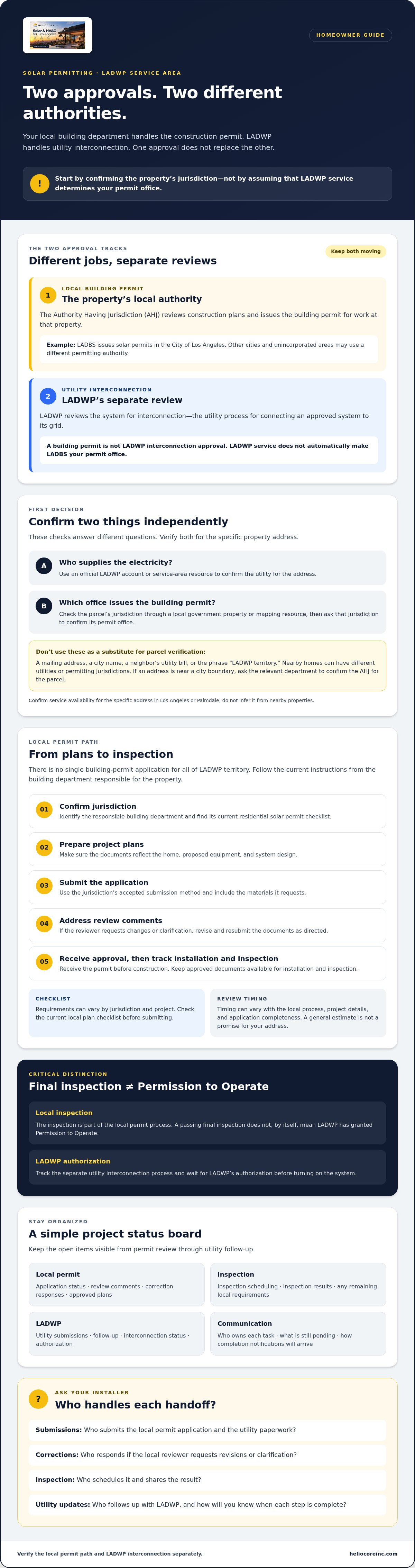
Solar approval follows two tracks. A local building department reviews construction plans and issues the building permit. LADWP, as the electric utility, handles the separate interconnection process that allows an approved system to connect to its grid. Having an LADWP electric account does not automatically make LADBS your permitting office. Searches for “solar panel permitting ladwp service area” can blur these roles, so verify the two approval paths separately.
California’s position as a leader in solar capacity provides a broad backdrop, but the permit for your project still depends on the exact property. If you’re researching solar panel permitting ladwp service area requirements, confirm the utility and the property jurisdiction independently.
The Authority Having Jurisdiction (AHJ) is the local agency responsible for reviewing and approving construction plans and issuing permits for work at a specific property. Identifying the AHJ early helps you send plans to the right office and follow the correct review process for a residential solar project.
Does LADWP issue the building permit for a home solar system?
No. The local AHJ reviews construction plans and handles the building permit. LADWP reviews utility interconnection separately. In the City of Los Angeles, the Los Angeles Department of Building and Safety (LADBS) issues solar permits. That example does not apply automatically to every LADWP customer. Other cities and unincorporated areas may have different permitting authorities.
Start by confirming the property’s city and parcel jurisdiction. Then contact that jurisdiction’s building department to verify which office handles residential solar permits. If the address is near a city boundary, don’t rely on its mailing address alone. Ask the relevant department to confirm the AHJ for the parcel.
How to check whether your address is in LADWP territory
First, use an official LADWP account or service-area resource to confirm who supplies electricity at the property. Separately, check the parcel’s jurisdiction through a local government property or mapping resource, then verify the permit office with that jurisdiction. These steps answer two different questions: who provides your electricity, and who reviews your permit.
Nearby homes can have different electric utilities or fall under different permitting jurisdictions, even when they share a street or postal city name. Confirm service availability for the specific address in Los Angeles or Palmdale. Don’t assume a city name, a neighbor’s utility bill, or the phrase “LADWP territory” identifies your AHJ.
How to Apply for a Residential Solar Permit Under LADWP
Once you’ve confirmed the property’s permitting authority, follow that department’s application process. There is no single building-permit application for all of LADWP territory. The local jurisdiction sets its submission requirements, while LADWP handles a separate utility interconnection process. The California Solar Rights Act is part of the state framework for local solar permit review, but you still need to follow the current instructions from the building department responsible for your property.
A practical sequence looks like this:
- Confirm jurisdiction. Verify which building department is responsible for the property and find its current residential solar permit checklist.
- Prepare plans. Make sure the project documents reflect the home, proposed equipment, and system design.
- Submit the application. Use the jurisdiction’s accepted submission method and include the requested materials.
- Respond to review comments. If the reviewer asks for changes or clarification, revise the documents and resubmit them as directed.
- Receive the permit. Review the approved documents and keep them available for installation and inspection.
Review timing can vary. The local process, project details, and completeness of the application can all affect how quickly it moves. Treat a general estimate as a guide, not a promise for your address.
What information may a residential solar permit application require?
Depending on the jurisdiction and project, a plan package may include a site or roof plan, equipment details, electrical diagrams, and structural information. These are examples, not a universal checklist. Confirm every required document against the current official instructions for your property. If the system includes battery storage, check whether the local application has additional plan requirements.
Consistency matters. The submitted drawings should match the intended system design, electrical details, and site conditions. If the equipment or project details change, ask the responsible contractor whether the plans or permit documents need updating before work proceeds.
What happens when a plan reviewer requests corrections?
A correction request means the reviewer needs revised information or clarification before the review can continue. The applicant or contractor addresses each comment, updates the affected documents, and resubmits them through the jurisdiction’s process. Keep the comments, responses, revised plans, and approved set together in one project record. This makes it easier to identify the current version and see who is handling each item.
Before submission, ask your installer who tracks review comments and prepares responses. HelioCore Inc coordinates residential solar projects through engineering, permitting, installation, inspections, and utility coordination. Homeowners comparing project support can review HelioCore Inc’s residential solar process and ask who will manage permit corrections and provide status updates.
Solar Permit vs. LADWP Interconnection: Understand the Two Approval Tracks
A solar project needs local construction approval and utility approval for connection. These are separate reviews with different purposes. The local building department reviews plans and issues the permit for the approved work. After installation, the authority’s inspection checks whether the system meets applicable requirements. LADWP reviews the proposed connection to its electric grid and provides Permission to Operate (PTO) when its requirements are met. Homeowners searching for “solar panel permitting ladwp service area” should keep these approval tracks distinct.
Think of the process in stages:
- Building permit: The local permitting authority reviews the project and authorizes the permitted construction.
- Installation: The solar contractor installs the system according to the approved plans.
- Inspection: The local inspector checks the completed work for code compliance. If corrections are needed, the contractor may need to address them and arrange a follow-up.
- Interconnection review and PTO: LADWP reviews the system’s proposed grid connection and provides utility authorization for operation under its current process.
The homeowner, installer, building department, inspector, and utility may each have a role. The installer often coordinates documents and scheduling, but responsibilities can vary by project and jurisdiction. As you plan solar panel permitting ladwp service area approvals, ask who submits each application, tracks review comments, and confirms the next step.
What does LADWP review during solar interconnection?
LADWP reviews the proposed connection between the home system and its electric grid. Application names, technical requirements, required documents, and submission sequences can change, so check current LADWP instructions instead of relying on an old checklist. Confirm with your installer who submits the materials, responds to utility questions, and follows the application through to a decision.
When can a homeowner turn on a permitted solar system?
Installation completion means the equipment is in place. A passed local inspection confirms the inspected work met applicable requirements. Neither step, by itself, confirms that LADWP has authorized the system to operate in parallel with its grid. Wait for the utility’s required authorization and follow its current instructions before turning the system on.
A passed inspection confirms local code compliance; it does not necessarily mean LADWP has granted Permission to Operate. Ask your installer to share the inspection result and confirm when LADWP’s authorization has been received. Keep both records with your project documents.
Inspections, Corrections, and Permission to Operate: What Homeowners Should Track
After the permit is issued, keep a simple record of each handoff. The local inspection and LADWP’s utility authorization are separate milestones, and a project isn’t ready to operate just because installation looks complete. For solar panel permitting in the LADWP service area, track who owns each task and save documents that show its status.
What should you expect during a residential solar inspection?
The local inspector checks the completed work against the approved plans and applicable codes. The exact inspection scope depends on the jurisdiction and project, so follow the instructions from your permitting department and installer. Before the visit, confirm that the installation is ready, required areas are accessible, and approved plans and permit records are available if requested.
If the inspector identifies corrections, ask the contractor what needs to change, who will complete the work, and how a follow-up review will be arranged. Save the inspection result and any correction details with your project records.
How do you know LADWP has granted Permission to Operate?
Look for explicit authorization through LADWP’s current official process. An installed system or a passed local inspection alone is not proof of utility Permission to Operate. The installer or designated applicant should monitor the interconnection application, respond to utility requests, and tell you when authorization is confirmed. Ask for written confirmation and a clear handoff explaining what you may do next.
Use a status log like this to keep each step visible:
| Stage | Responsible party | Evidence to save | Next action |
|---|---|---|---|
| Permit issued | Local permitting department; installer tracks status | Permit and approved plans | Confirm installation follows the approved documents |
| Inspection | Local inspector; contractor prepares the site | Inspection result and correction notes | Resolve any corrections and confirm follow-up |
| Utility review | Applicant or installer, with LADWP review | Submission record and utility correspondence | Respond to requests and check application status |
| Authorization | LADWP; installer confirms the handoff | Written Permission to Operate confirmation | Follow the utility’s operating instructions |
Save the permit, approved plan set, inspection results, correction responses, and LADWP messages together. Before work begins, ask your installer who will update the record and how you’ll receive status changes. HelioCore coordinates residential solar projects through permitting, inspections, and utility coordination. Ask HelioCore about solar project coordination and how inspection results and utility authorization are tracked.
Choose a Solar Installer Who Can Coordinate LADWP Permitting and Approvals
A well-coordinated project has a clear owner for each step. The installer can prepare and submit documents, track review comments, help arrange inspections, and follow up on utility interconnection. City and utility agencies control their own reviews, however, so no contractor can guarantee how quickly they’ll respond. For solar panel permitting in the LADWP service area, look for clear responsibilities and regular updates, not promises about approval dates.
Questions to ask before signing a solar installation agreement
Ask how the installer will manage your project from permit application through LADWP authorization. Get specific answers to these questions:
- Jurisdiction: Who will confirm the local building department responsible for my property and verify that jurisdiction?
- Plans and applications: Who prepares the plans, submits the permit application, and submits the utility interconnection materials?
- Corrections: Who reviews agency comments, prepares revised documents, and confirms that corrections have been resubmitted?
- Inspection: Who coordinates inspection scheduling, prepares the site, and shares the result with me?
- Utility follow-up: Who tracks LADWP’s application status, responds to requests, and provides written confirmation of Permission to Operate?
- Updates: How will I receive status updates, and where can I find copies of approved plans, inspection results, and utility correspondence?
Before signing, confirm that these responsibilities are written into the project scope or clearly explained by the installer. A named point of contact and a shared record make it easier to see what’s complete, what’s pending, and who is responsible for the next action.
How HelioCore can support a LADWP-area solar project
HelioCore manages residential solar projects in Los Angeles through engineering, permitting, installation, inspections, and utility coordination. This coordination helps keep plan documents, inspection readiness, and LADWP follow-up connected, while the permitting department and utility retain control of their own decisions and review timelines.
Confirm address eligibility and project details directly with the team, especially if the property is outside Los Angeles or in Palmdale. Ask who will track corrections, share inspection results, and notify you when utility authorization is confirmed. Clear answers make it easier to understand the process before work begins.
To discuss a residential solar project and its approval steps, contact HelioCore about solar installation.
Move Forward With a Clear Solar Approval Plan
A smoother project starts with knowing who handles each approval. Confirm the property’s local building authority, then follow its permit and inspection process. Keep LADWP interconnection separate: a completed installation or passed inspection does not replace the utility’s Permission to Operate.
For solar panel permitting in the LADWP service area, clear responsibilities matter as much as the paperwork. Ask who prepares and submits plans, tracks correction requests, coordinates inspections, and follows up with LADWP. Keep copies of approvals and status updates so you can see what’s complete and what still needs attention.
HelioCore manages residential solar projects through permitting, inspections, and utility coordination. The company serves Los Angeles homeowners, but service availability should be confirmed for each address. To discuss your project and its approval steps, discuss your LADWP-area solar project with HelioCore.
With the right authority identified and each approval clearly tracked, the process is easier to manage one step at a time.
Frequently Asked Questions
Does LADWP issue solar permits in Los Angeles?
No. LADWP handles utility interconnection, while the local building department generally handles construction permits. The correct department depends on the property’s jurisdiction, not only on its electric utility. A City of Los Angeles address may involve LADBS, while another municipality or unincorporated area may use a different authority. Confirm the parcel’s jurisdiction and the current permit process with the responsible building department before submitting plans.
What permits are needed for solar panels in the LADWP service area?
A residential solar project commonly requires local construction and electrical approvals, followed by utility interconnection review. The exact permits and documents depend on the address, system design, and whether battery storage is included. For anyone searching “solar panel permitting ladwp service area,” the key step is to check requirements with both the property’s building department and LADWP. Don’t treat a generic checklist as the final authority before installation.
How long does LADWP solar approval take?
There’s no single timeline that applies to every solar project. Local plan review, application completeness, correction requests, inspection availability, and utility review can all affect the schedule. Ask your installer for the current status of each approval track and what action remains. An estimate from another city or an older project isn’t a guarantee for your home, whether it’s in Los Angeles, Palmdale, or elsewhere.
Can I turn on my solar panels after the city inspection?
Not necessarily. A passed local inspection confirms that the inspected work met applicable requirements, but LADWP may still need to approve the system’s interconnection and grant Permission to Operate. Follow LADWP’s current written instructions before operating the system in parallel with the grid. Ask your installer to confirm the utility authorization status and provide written confirmation. Installation completion or inspection approval alone does not establish permission to switch on.
Who submits the LADWP solar interconnection application?
The homeowner or solar contractor may submit the application, depending on the project arrangement and LADWP’s current process. Before signing an agreement, ask who prepares and submits the documents, monitors application status, responds to utility requests, and communicates the final decision. Request copies of submissions and written updates for your records. Confirm responsibilities for your specific project instead of assuming every contractor follows the same process.
Does adding a battery change solar permitting requirements in LADWP territory?
It can. Adding battery storage may affect the system design, electrical plans, equipment documentation, and utility review. Requirements depend on the equipment and the local authority having jurisdiction. Ask whether the solar and battery systems will be submitted together or handled in separate steps. Before relying on a solar-only checklist, confirm current permit requirements with the local building department and current interconnection instructions with LADWP.
What should I do if my solar permit application is rejected or needs corrections?
Ask the reviewing authority or your contractor to identify each requested change and the document that needs revision. Have the project team update the plans, prepare responses, and resubmit through the correct channel. Track the resubmission and any follow-up inspection, and keep revised plans with the project record. If a correction affects system design or electrical details, confirm that any related LADWP application remains consistent with the updated documents.