
Solar
Whole House Battery Backup in Los Angeles: How to Plan Your System

What if planning whole-home backup starts with deciding what can pause, not just what should stay on? If you’re researching whole house battery backup Los Angeles options, begin by listing the circuits and appliances that matter most during an outage. That list gives the system design a practical starting point and helps avoid assuming that one battery can power everything in every home.
It’s reasonable to want your home to stay comfortable and functional when the grid goes down. But “whole-home backup” depends on the battery, a compatible system, the loads you prioritize, and how the installation is designed. Solar panels alone won’t keep your home powered during an outage. Backup power requires a battery and compatible system configured for that purpose.
This guide explains how to define backup priorities, what information helps plan battery capacity and solar compatibility, and how installation fits together. It also covers the practical steps HelioCore coordinates for Los Angeles homeowners, including permitting, electrical integration, and utility coordination. With a clear plan, you can decide what your system should support and understand the path from planning to installation.
Key Takeaways
- Start by deciding which household circuits matter most during an outage. Those priorities help define what whole-home backup should mean for your home.
- Planning whole house battery backup los angeles homeowners can rely on begins with the home’s electrical setup, any existing solar, and expected backup needs.
- Compare backup plans by scope, system compatibility, solar integration, and project coordination, rather than assuming one battery suits every home.
- A clear installation journey moves from defining needs and assessing the home to system design, approvals, installation, and review.
- HelioCore coordinates battery permitting, electrical integration, and utility coordination for Los Angeles homeowners.
Table of Contents
- What Whole-House Battery Backup Means for a Los Angeles Home
- How Battery Backup Design Matches Your Home’s Power Needs
- How to Compare Battery Backup Plans Without Overpromising
- How to Prepare for Battery Backup Installation in LADWP Territory
- Plan Whole-House Battery Backup with HelioCore in Los Angeles
What Whole-House Battery Backup Means for a Los Angeles Home
What should keep working when grid power is unavailable? Start with the parts of home life you most want to maintain, such as food storage, basic lighting, internet access, or other household needs. Your answer turns “whole-home backup” from a broad label into a practical design goal.
Whole-home battery backup is a system design goal: supplying backup power to the household loads selected to operate during a grid outage. It isn’t a universal promise that every battery installation can run every circuit or appliance. Backup requires a battery and a compatible system configured for the home. The home’s electrical setup, the loads chosen for backup, and the final system design all affect what can operate.
A battery stores electricity for later use. The broader principle also appears in large stationary systems such as a battery storage power station, though a home system must be designed around a residence’s electrical setup and backup priorities. Solar panels can be part of a compatible system, but panels alone don’t provide backup power during an outage.
Whole-home backup versus backing up selected household loads
Selected-load backup focuses on chosen circuits, such as a refrigerator, essential lighting, or a home office. Broader coverage aims to support more of the home. Neither description guarantees that all appliances or circuits can run at once. The design needs to account for what you want powered and how those loads fit the home’s electrical configuration.
Picture a typical outage routine. Which rooms need light? Which devices need to stay connected? Are there appliances you can pause? Your answers clarify the difference between essential coverage and a wider backup goal. For more detail on planning around a specific battery system, see the Tesla Powerwall whole-home backup planning guide.
Why Los Angeles homeowners should plan before choosing a battery
Daily electricity use gives the backup plan useful context. Consider which appliances and circuits your household relies on, when they’re typically used, and what you’d want to keep available during an outage. A home with different routines or electrical configurations may need a different design. Starting with those details helps prevent choosing a battery based on the assumption that one setup fits every property.
For eligible homes in the Los Angeles service area, LADWP is the relevant utility context. Utility coordination is part of planning an installation, and the project details depend on the system and home. A home-specific plan brings household priorities, the electrical setup, any existing solar, and utility coordination into one process. That’s the foundation for setting a realistic backup scope before system design begins.
How Battery Backup Design Matches Your Home’s Power Needs
A useful battery plan involves more than a general goal of keeping the house running. It brings together your household priorities, electrical setup, existing solar equipment, and expected use during an outage. Those details help shape a system that fits the home instead of relying on a generic capacity estimate.
Backup performance depends on system configuration and household loads. The design needs to account for how the battery connects to the home and which electrical loads are intended to receive backup power. Details about specific equipment should be verified for the proposed system rather than assumed from a general rule.
Identify the circuits and equipment that matter most
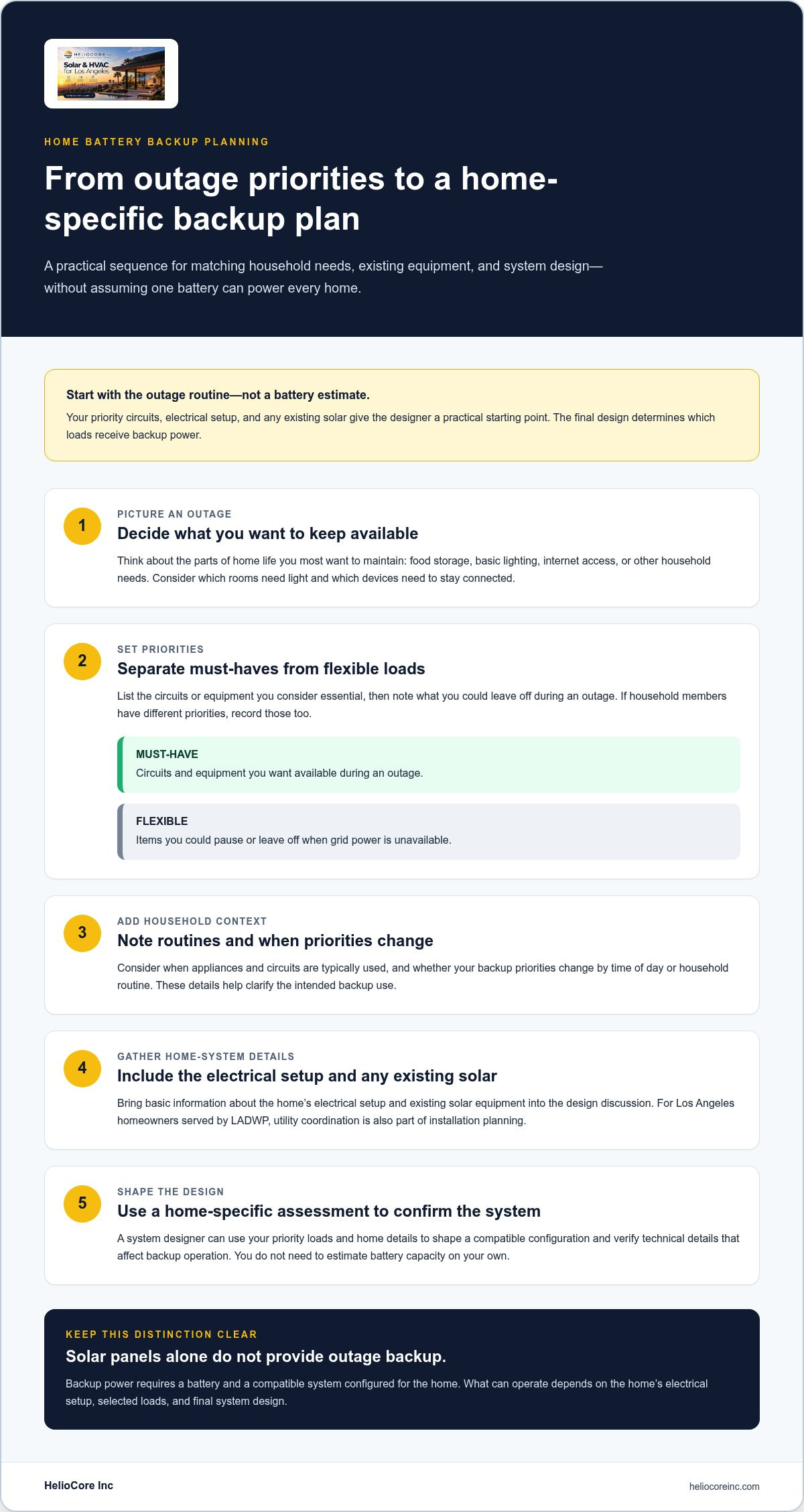
Make a practical list of what you’d want available if grid power were interrupted. Think about daily routines and which parts of the home support them. The final design determines which loads receive backup power, so a clear list gives the planning process a concrete starting point.
- Note the circuits or equipment you consider essential.
- Separate must-have needs from items you could leave off during an outage.
- Consider whether your priorities change by time of day or household routine.
This exercise doesn’t determine the technical configuration by itself. It gives the system designer a clearer picture of your intended backup use and helps avoid assuming every circuit is included. If different household members have different priorities, record those too, then decide which loads are essential and which are flexible.
Consider how existing solar fits with battery backup
If your home already has solar, include the existing equipment in the design discussion. Solar panels alone don’t provide outage backup. Backup operation requires a battery and a compatible system, so the solar equipment and its connection to the home need to be assessed as part of the plan.
For Los Angeles homeowners served by LADWP, utility coordination is another project detail to plan for. The LADWP residential battery storage guide offers related local context, while system-specific capabilities depend on the home and final design.
Gather what you already know before design begins: a list of priority loads, basic information about the home’s electrical setup, and details about any existing solar equipment. You don’t need to estimate battery capacity on your own. A home-specific assessment can use these inputs to shape a compatible configuration and verify technical details that affect backup operation.
For homeowners considering whole house battery backup los angeles options, the practical next step is to connect household priorities with the home’s electrical configuration. HelioCore installs Tesla Powerwall battery storage and coordinates the related project steps. The HelioCore battery storage installation page provides an overview as you prepare to plan a system around your home.
How to Compare Battery Backup Plans Without Overpromising
Two battery plans can sound similar while aiming to support different parts of a home. Compare what each plan is designed to do, how it fits the home’s electrical setup, and what coordination the project includes. Keep desired coverage separate from verified capability. A system should only be described in terms of the whole home after the design confirms which household loads it can support.
Use this framework to compare priorities and project details, not unverified product specifications or broad promises:
Backup scope: Which household loads are intended to receive backup power? Does the proposed scope match your must-have priorities?
System compatibility: How will the battery connect with the home’s electrical configuration? Is the proposed integration part of the design?
Solar integration: If solar is present or planned, how will the battery and solar equipment work together for backup operation?
Project coordination: Who coordinates permitting, electrical integration, and utility communication as part of the installation?
Compare backup scope against household priorities
Start with the coverage you want, then compare it with the loads the design confirms. A plan focused on essential loads may keep selected household functions in scope, while broader coverage aims to include more of the home. Broader goals still need a home-specific assessment; they don’t automatically mean every circuit or appliance can operate at once.
For each plan, write down two separate things: the loads you hope to back up and the loads the final design identifies for backup. That distinction can reveal gaps early. It also keeps “whole-home” from being mistaken for a guaranteed, identical outcome across different properties.
Compare system compatibility and project support
Battery compatibility and electrical integration matter as much as the coverage goal. The battery must work with a system configured for the home. If solar is involved, the design also needs to account for how the existing or planned solar equipment integrates with storage for outage backup.
Project coordination is another useful point of comparison. Permitting, electrical integration, and communication with the utility are practical parts of a battery installation. HelioCore coordinates these steps for residential battery projects in Los Angeles. For background on the installation process, the Tesla Powerwall installer guide for Los Angeles explains relevant planning considerations.
Before settling on a plan, make sure its stated backup scope matches your household priorities and that system compatibility is addressed in the design. For whole house battery backup los angeles homeowners can plan around, clarity comes from a considered configuration, not a broad label. HelioCore installs Tesla Powerwall battery storage and coordinates the related project steps. The HelioCore battery installation page outlines the service as you consider a design tailored to your home.
How to Prepare for Battery Backup Installation in LADWP Territory
A clear installation plan connects your backup goals to the home’s electrical setup, then carries that design through permitting, utility coordination, installation, and review. For Los Angeles homeowners in LADWP territory, project details depend on the system and home. Keep expectations tied to the requirements established for the specific installation.
Prepare useful information for a home assessment
Gather what you already have. Recent electricity-use information can help describe how the household uses power, while a list of priority circuits or equipment shows what you hope to keep available during an outage. Note whether solar equipment is already installed and gather any details you have about it. The home and its existing equipment inform the system design.
Understand the design, permitting, and installation sequence
Each stage builds on the one before it. Your role is to share priorities and useful information; the project team connects those needs to a compatible system and coordinates the work.
- Define your needs. Describe the household functions you want backup power to support and distinguish essential needs from lower priorities.
- Assess the home. Review the electrical setup, existing equipment, and available electricity-use information to understand the project’s starting point.
- Design the system. Match the intended backup scope to the home’s electrical configuration and compatible battery setup. Confirm which loads are included in the design.
- Coordinate approvals. Prepare the project’s permitting and utility coordination steps. LADWP details depend on the system and project, so one process should not be assumed for every installation.
- Install and integrate. Complete the battery installation and electrical integration according to the project design.
- Review the system. Go over the completed setup and understand which household loads the design is intended to back up.
HelioCore coordinates battery permitting, electrical integration, and utility communication for residential installations. This connects the planning stage with the practical work required to complete a home battery project.
For broader local context, the LADWP battery storage overview provides related information alongside project-specific coordination. A home assessment turns your priorities, electrical setup, and existing equipment into a defined system design and a clearer path to installation. That is a useful starting point for planning whole house battery backup los angeles homeowners can evaluate against their own needs.
Once you’ve gathered your household priorities and any available system details, HelioCore’s battery installation team can help move your home-specific plan forward.
Plan Whole-House Battery Backup with HelioCore in Los Angeles
A practical plan starts with three things: what you want to keep running, how your home is set up, and how a battery can work with that setup. Define your backup priorities first. Then assess electrical compatibility and existing solar equipment before settling on a system design. This gives you a clearer basis for deciding what “whole-home backup” should mean in your home, without assuming every circuit will be powered.
HelioCore installs Tesla Powerwall battery storage for residential homeowners in Los Angeles and the LADWP service area. The system design is tailored to the home and its equipment, with backup capability determined by the final configuration and loads.
What HelioCore coordinates for a battery project
A battery installation involves more than placing equipment at the home. The system needs to fit the electrical setup, and the project needs to move through its practical steps in an organized way. HelioCore manages battery permitting, electrical integration, and utility coordination as part of the installation process.
This local coordination connects the design to the work required for the project. LADWP details depend on the system and the home, so utility coordination takes place in the context of the specific installation rather than through a one-size-fits-all assumption.
Take the next step with a home-specific plan
Before beginning, gather a few useful details. Note which circuits or household functions matter most during an outage, whether solar equipment is already installed, and any available information about your electrical setup or electricity use. You don’t need to calculate battery capacity yourself. These details help ground the assessment in how your household actually uses power.
The assessment and planning stage connects those priorities to the home’s electrical configuration and existing equipment. It helps define the intended backup scope, identify compatibility considerations, and establish a design for the specific property. The final configuration determines which loads receive backup power; it doesn’t promise a particular duration, whole-home performance, or savings.
With a clear design, the next steps are easier to follow: permitting, electrical integration, utility coordination, and installation. HelioCore coordinates these project elements for Los Angeles homeowners, keeping the path from planning to installation organized and specific to the home.
If you’re ready to discuss your backup goals and existing solar or electrical setup, plan your Los Angeles home battery backup with HelioCore. Share what you want your system to support and begin a design process tailored to your home and its equipment.
Turn Your Backup Priorities Into a Home-Specific Plan
The most useful next step is a simple one: write down what you want to keep running and what you know about your home’s electrical setup or existing solar. That gives the design process a clear starting point. A thoughtful plan can match those priorities with compatible equipment and a realistic backup scope for your home.
For homeowners exploring whole house battery backup los angeles, HelioCore installs Tesla Powerwall battery storage for residential homes in Los Angeles, including the LADWP service area. The team also coordinates permitting, electrical integration, and utility communication as the project moves forward.
Your home deserves a plan built around its equipment and the way you use power, not a one-size-fits-all promise. Plan your Los Angeles home battery backup with HelioCore and take the next step toward a system designed for your household.
Frequently Asked Questions
Can a home battery keep my house powered during a LADWP outage?
Yes, a home battery can provide backup during an outage if it’s part of a compatible system configured for that purpose. The power available depends on the equipment and the loads included in the design, so don’t assume every circuit will stay on. Solar panels by themselves won’t power a home during a grid outage. Review the system’s intended backup operation and supported loads as part of planning.
Does whole-house battery backup mean every appliance will run during an outage?
No. “Whole-house” describes a backup goal, not an automatic promise that every appliance can operate at once. For example, a household may prioritize refrigeration and selected lighting while treating other equipment as lower priority. Which loads receive backup power depends on the system design. Evaluate the proposed coverage in terms of actual household loads, not just a broad label.
Do I need solar panels to install a home battery in Los Angeles?
Solar panels aren’t necessarily required, but a battery and a compatible system are required for backup. If you don’t have solar, the project design still needs to explain how the battery fits your home and intended use. If you do have panels, include their equipment details in the assessment. That helps determine whether the existing setup can integrate with battery storage as planned.
Can a home battery recharge from solar during a power outage?
It may, if the solar and battery equipment are compatible and the system is configured to operate that way during an outage. Solar panels alone don’t establish that capability. The answer depends on the specific equipment and final system design, so don’t assume your panels will recharge a battery whenever the grid is down. The planned outage operation should be clear for your home.
How long does it take to install whole-house battery backup in Los Angeles?
There isn’t one timeline that applies to every home. The schedule depends on the project’s design, electrical integration, permitting, and utility coordination, along with the home’s existing setup. An assessment can clarify the steps for your project, but a general estimate shouldn’t be treated as a confirmed installation date. For whole house battery backup, Los Angeles homeowners should base timing on the details of their specific project.
What should I prepare before planning a home battery backup system?
Write down the household needs you’d prioritize during an outage, gather available electricity-use information, and note whether solar is already installed. Include any details you have about the home’s electrical setup. This preparation can help homeowners in Los Angeles, Inglewood, South Los Angeles, Crenshaw, Leimert Park, Baldwin Hills, Westchester, Van Nuys, North Hollywood, Reseda, Northridge, Woodland Hills, and San Pedro begin a more focused assessment.