
Solar
Choosing a Reliable Home Solar Contractor in LA: 2026

What should you look for in a reliable home solar contractor LA homeowners can count on? Not just the lowest quote, but a team that takes responsibility after the proposal. Solar plans can differ in what they include, and the work doesn’t end when panels go on the roof. Permits, inspections, and coordination with LADWP all need a clear owner.
It’s reasonable to want straightforward answers before making a long-term home improvement. You should know what the agreement covers, how production expectations are set, and who supports the system after installation. Your utility matters, too: LADWP customers aren’t subject to the same net billing rules as customers of investor-owned utilities such as SCE.
This checklist will help you compare project responsibilities, review agreement and warranty details, and understand what ongoing support should look like. At HelioCore, we manage the process from consultation and system design through permitting, installation, inspections, and LADWP coordination to permission to operate. That means fewer handoffs for you and a clearer path from the first plan to an activated system.
Key Takeaways
- Use the checklist to assess whether a reliable home solar contractor LA homeowners can depend on clearly assigns responsibilities at each project stage.
- Compare proposals side by side, focusing on included work, agreement terms, and who handles permitting, inspections, and utility coordination.
- Read warranty details closely: equipment and workmanship coverage differs from roof-penetration coverage, which applies only to the solar installation area.
- Set realistic expectations for utility bills and production. Solar can reduce electricity purchases but doesn’t automatically eliminate your LADWP bill.
- Review the Palmetto LightReach agreement for its stated warranty and production terms, qualification process, and any optional work that may cost extra.
Table of Contents
- What makes a home solar contractor reliable in Los Angeles?
- Use this checklist to assess a Los Angeles solar contractor’s process
- Compare solar proposals by scope, agreement, and ongoing support
- Check long-term expectations before choosing a solar contractor
- How HelioCore Manages Home Solar Projects in LA
What makes a home solar contractor reliable in Los Angeles?
A solar proposal is only the beginning. A dependable contractor makes the full process clear: consultation, custom engineering, permitting, installation, inspection, utility coordination, and activation. They explain what happens at each stage, who is responsible, and how you’ll receive updates. That structure matters because a project can involve several handoffs before the system is ready to operate.
A reliable solar project has a clear scope, an accountable team, honest updates, and support that continues beyond installation. Sales promises alone don’t show how the work will be managed. For homeowners searching for a “reliable home solar contractor la,” a more useful measure is whether the team manages the process from planning through utility permission to operate.
Clear communication should make the technical details easier to follow. For example, a contractor should explain how the panels convert sunlight into electricity and how the proposed system fits your home. For a broader introduction, explore Solar power.
What should a dependable solar project include?
The project should follow a defined sequence. It starts with a consultation and a system designed for the home, then moves through permitting, installation, inspection, and utility steps. You should know which team is handling each handoff and how questions or schedule changes will be communicated. Plain-language updates help keep you informed without leaving you to coordinate the moving parts yourself.
Why does LADWP coordination matter for LA homeowners?
Finishing the installation and receiving utility permission to operate are separate milestones. A system may be physically in place before the utility process is complete, so the project plan should make that distinction clear. HelioCore manages permitting, inspections, and utility coordination through permission to operate for homeowners in its LADWP service area. For more on what happens after solar production is credited, read the LADWP solar true-up billing guide.
Local knowledge is practical, not just familiarity with Los Angeles. It means understanding the LADWP handoffs and keeping you informed as the project moves from design to activation. A clear point of contact, defined responsibilities, and understandable updates can make a complex installation easier to manage.
Use this checklist to assess a Los Angeles solar contractor’s process
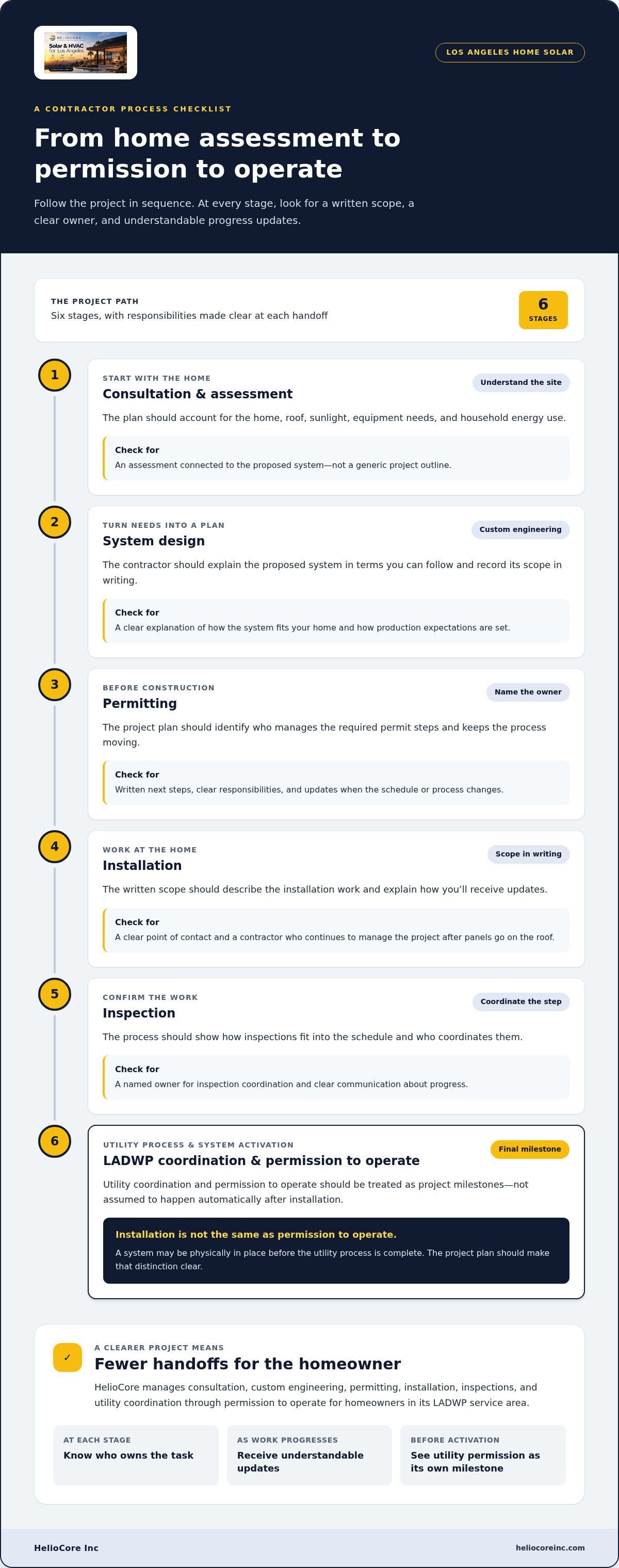
A polished proposal can still leave important questions unanswered. Look for a written scope that shows what happens at each stage, who owns each task, and how progress is shared. A clear process is more useful than broad sales language because it lets you see where responsibility sits from the first home assessment through system activation.
Use this sequence to compare project plans:
- Assessment: The plan should account for the home, roof, sunlight, equipment needs, and household energy use.
- System design: The proposed system should be explained in terms you can follow, with its scope recorded in writing.
- Permitting: The project plan should identify who manages the required permit steps and keeps the process moving.
- Installation: The written scope should describe the installation work and explain how you’ll receive updates.
- Inspection: The process should show how inspections fit into the schedule and who coordinates them.
- Activation: Utility coordination and permission to operate should be treated as project milestones, not assumed to happen automatically after installation.
Checklist: project planning and local coordination
Each home needs a plan shaped around its conditions and energy use. A reliable home solar contractor LA homeowners can work with should connect that assessment to system design, permitting, installation, inspections, and utility coordination. Project timing depends on project-specific factors, so a clear explanation of milestones is more useful than an unsupported fixed timeline. For a fuller view of the process, see this Los Angeles residential solar installation guide.
Checklist: communication and clear responsibilities
Look for written next steps, homeowner responsibilities, and a clear point of contact. The Solar Energy Industries Association’s consumer protection resources offer useful context on transparent conduct in the industry. HelioCore coordinates the residential project so homeowners have fewer separate handoffs to manage.
HelioCore manages consultation, custom engineering, permitting, installation, inspections, and utility coordination through permission to operate. That sequence gives each stage an owner and helps keep you informed as the project advances. To see how HelioCore approaches residential solar projects, visit HelioCore’s home solar services.
Compare solar proposals by scope, agreement, and ongoing support
Proposals are easier to compare when you look beyond the system summary. Put the written details side by side and check whether each plan explains the equipment and work it includes, who manages project steps, what the agreement requires, and how support works after installation. A lower upfront amount or polished presentation won’t tell you whether the responsibilities and protections fit your needs.
Use these categories to organize your comparison:
- System scope: Record the proposed system and the work described in each proposal.
- Project responsibilities: Note who coordinates permitting, installation, inspections, and utility steps.
- Agreement terms: Compare payment structure, qualification, warranties, and any responsibilities that continue over time.
- Ongoing support: Look for clear service terms and whether optional work, such as cleaning or roof work, may cost extra.
This simple format helps you see differences in scope and obligations without relying on slogans. It also gives you a practical basis for reviewing lease and purchase approaches in this Los Angeles solar lease comparison.
Compare what the solar agreement actually says
For Palmetto LightReach, the stated terms include a 25-year equipment and workmanship warranty and a 10-year roof-penetration warranty. These cover different things: the roof-penetration warranty applies only to the area related to the solar installation, not the entire roof. The plan also includes a production guarantee of 90% of estimated production over a three-year review period. Review the agreement for the exact conditions and responsibilities that apply to your project.
Keep those protections distinct in your comparison. Equipment and workmanship coverage is not the same as roof coverage, and the roof-penetration warranty is not a whole-roof warranty. Clear wording helps you understand what a stated term does and doesn’t cover.
Compare payment and qualification details without assumptions
Qualifying homeowners may have a $0 upfront option, but monthly payments still apply. Palmetto uses a soft credit check for qualification, and it doesn’t affect your credit score. Don’t treat “$0 upfront” as free equipment or assume that two payment plans have identical terms. Read the agreement for payment timing and responsibilities. The first solar payment is typically due about 30 days after utility permission to operate, though timing can vary.
For more plan-specific context, read the Palmetto solar lease guide. A reliable home solar contractor LA homeowners can trust should make these distinctions understandable, so you can compare the written terms with your priorities before choosing.
Check long-term expectations before choosing a solar contractor
A well-managed solar project also sets clear expectations for life after installation. Solar may reduce the electricity you buy from LADWP, but you’ll continue to receive utility bills. Any reduction depends on your system’s production and household energy use, so a contractor shouldn’t promise a specific savings amount.
A production guarantee addresses the system’s measured output under the agreement’s terms; it isn’t a promise of a particular utility-bill reduction. That distinction helps keep expectations grounded. A reliable home solar contractor la homeowners can count on explains what the agreement measures and what still depends on household use and utility billing.
Understand production, maintenance, and roof-work terms
The Palmetto-backed plan includes a guarantee of 90% of estimated production over a three-year review period, as stated in the agreement. Review the agreement for how production is assessed and what steps apply if it falls short. Maintenance and covered service are included as specified in the solar agreement. Panel cleaning, pest protection, and roof work may cost extra. The roof-penetration warranty applies only to the solar installation area, not the entire roof or every future roof project.
Clear support terms matter, too. Know which work is part of the agreement and which may require an additional charge. That clarity helps you plan for upkeep without assuming every future service is included.
Plan for utility bills, outages, and a future home sale
Solar panels alone don’t provide backup power during an outage. Backup requires a battery and a compatible system, so treat resilience as a separate system-planning question. If you may sell your home, review the lease’s transfer terms in advance. Transfer to a qualified buyer is subject to approval, and ownership doesn’t automatically pass to the homeowner at the end of a lease. The agreement governs what happens. Solar purchase options become available after the fifth anniversary of the system’s utility connection, subject to the applicable agreement.
Payment timing is another detail to understand before activation. The first solar payment is typically due about 30 days after utility permission to operate, though timing can vary. A qualifying $0 upfront option still includes monthly payments.
HelioCore helps Los Angeles homeowners review project expectations and coordinate the solar process through utility permission to operate. For a clear starting point, explore HelioCore home solar options.
How HelioCore Manages Home Solar Projects in LA
A well-managed solar project should feel like one connected process, not a set of tasks you have to stitch together. HelioCore guides Los Angeles homeowners from consultation and custom engineering through permitting, installation, inspections, and utility coordination. The project continues through permission to operate, the utility milestone that allows the system to be activated.
That step-by-step ownership is a practical measure of a reliable home solar contractor la homeowners can depend on. You should understand what comes next, who is coordinating it, and how your project plan fits your home. Timing depends on project factors, so focus on clear responsibilities and steady communication, not a promised completion date or a guaranteed utility-bill reduction.
From home assessment to utility permission to operate
HelioCore starts by learning about the home and its energy needs. The team then develops a custom system plan and manages the handoffs that follow: permitting, installation, inspections, and utility coordination. Each stage builds on the last, giving you a guided route from early planning to activation rather than separate processes to manage alone.
Installation completion and permission to operate are distinct milestones. HelioCore coordinates the utility steps through permission to operate and keeps the project moving along its planned path. You get a clearer view of progress and fewer administrative handoffs to manage.
Review a Palmetto LightReach plan with clear expectations
For homeowners considering the Palmetto LightReach solar lease, the stated terms include a 25-year equipment and workmanship warranty and a 10-year roof-penetration warranty. The latter applies only to the area related to the solar installation, not the entire roof. The agreement sets out the responsibilities and conditions, so review its project-specific language carefully. Qualifying homeowners may have a $0 upfront option, but monthly payments still apply. Palmetto uses a soft credit check for qualification, which does not affect your credit score.
A lease may suit some homeowners better than other arrangements. The goal is to understand the written terms, project steps, and applicable support before deciding. You can explore HelioCore’s solar service at your own pace.
Start with three simple steps:
- Discuss your home: Share your property and household energy needs.
- Review a tailored plan: Understand the proposed system and agreement terms.
- Map the project path: See how consultation, permitting, installation, inspections, and utility coordination lead to permission to operate.
Choose a Solar Project You Can Feel Confident About
A dependable solar project is more than panels on a roof. It starts with a clear scope, follows a coordinated path through permitting and utility activation, and spells out agreement terms and ongoing responsibilities. These are practical ways to assess a reliable home solar contractor la homeowners can trust with a major home upgrade.
HelioCore manages consultation, custom engineering, permitting, installation, inspections, and utility coordination. For homeowners considering Palmetto LightReach, stated plan terms include a 25-year equipment and workmanship warranty and a 10-year roof-penetration warranty for the solar installation area. Review the agreement to understand how its terms apply to your project.
Ready to take a clear next step? Explore a managed home solar plan with HelioCore and learn how the project can be tailored to your home. With a well-defined process and straightforward expectations, you can move forward with greater confidence.
Frequently Asked Questions
What makes a solar contractor reliable in Los Angeles?
A reliable contractor clearly explains the project scope, assigned responsibilities, agreement terms, and next steps. For homeowners in Los Angeles, Inglewood, South Los Angeles, Crenshaw, Leimert Park, Baldwin Hills, Westchester, Van Nuys, North Hollywood, Reseda, Northridge, Woodland Hills, and San Pedro, local coordination matters. Permitting, installation, inspections, and utility steps should form a clear process. HelioCore manages these stages through utility permission to operate. Review written warranty and service terms, and don’t treat a sales estimate as guaranteed bill savings.
How do I compare home solar contractors in LA?
Compare written proposals by system scope, project responsibilities, agreement terms, warranties, and ongoing support. Check that each plan explains who coordinates permitting, inspections, installation, and utility steps. A production guarantee and a promise about your electric bill are different things. For homeowners searching for a reliable home solar contractor la, a clear, accountable process is a practical point of comparison. HelioCore guides LADWP-area homeowners through the project and explains applicable Palmetto LightReach terms.
Does solar eliminate my LADWP bill?
No, installing solar doesn’t automatically eliminate your LADWP bill. You’ll continue receiving utility bills, though solar may reduce the amount of electricity you purchase from LADWP. The effect depends on the home, system production, and household energy use. HelioCore doesn’t guarantee a specific bill reduction. Review estimated production and billing details as part of your project and agreement discussion so you have realistic expectations about how solar may fit your household.
What warranties come with a Palmetto LightReach solar plan?
Stated Palmetto LightReach terms include a 25-year equipment and workmanship warranty and a 10-year roof-penetration warranty. The roof-penetration warranty applies only to the area related to the solar installation, not the entire roof. The plan also describes a production guarantee of 90% of estimated production over a three-year review period. Read the written agreement for the applicable terms, coverage boundaries, and responsibilities for your project.
Does a $0 upfront solar option mean the system is free?
No. A qualifying homeowner may have a $0 upfront option, but monthly lease payments still apply. Qualification uses a soft credit check that doesn’t affect your credit score. The payment arrangement and responsibilities are set out in the applicable agreement, so review those terms before deciding whether the lease suits your household and plans. “$0 upfront” describes the initial payment option, not free equipment or an absence of ongoing payments.
When does the first solar payment start after installation?
The first solar payment is typically due about 30 days after the system receives utility permission to operate, but timing can vary. Installation and permission to operate are separate milestones, so don’t count the payment date from installation alone. HelioCore manages utility coordination through permission to operate for homeowners in its LADWP service area. Review the agreement for the payment terms that apply to your project and the timing details.
Will solar panels keep my home powered during a power outage?
Not by themselves. Backup power during an outage requires a battery and a compatible system. HelioCore installs Tesla Powerwall battery storage, and the system configuration and agreement determine how backup is set up for a home. If keeping selected household needs powered during an outage matters to you, include that goal in project planning. Don’t assume rooftop panels alone will supply electricity when the grid is down.