
Solar
Emergency Home Power Backup Costs in Los Angeles
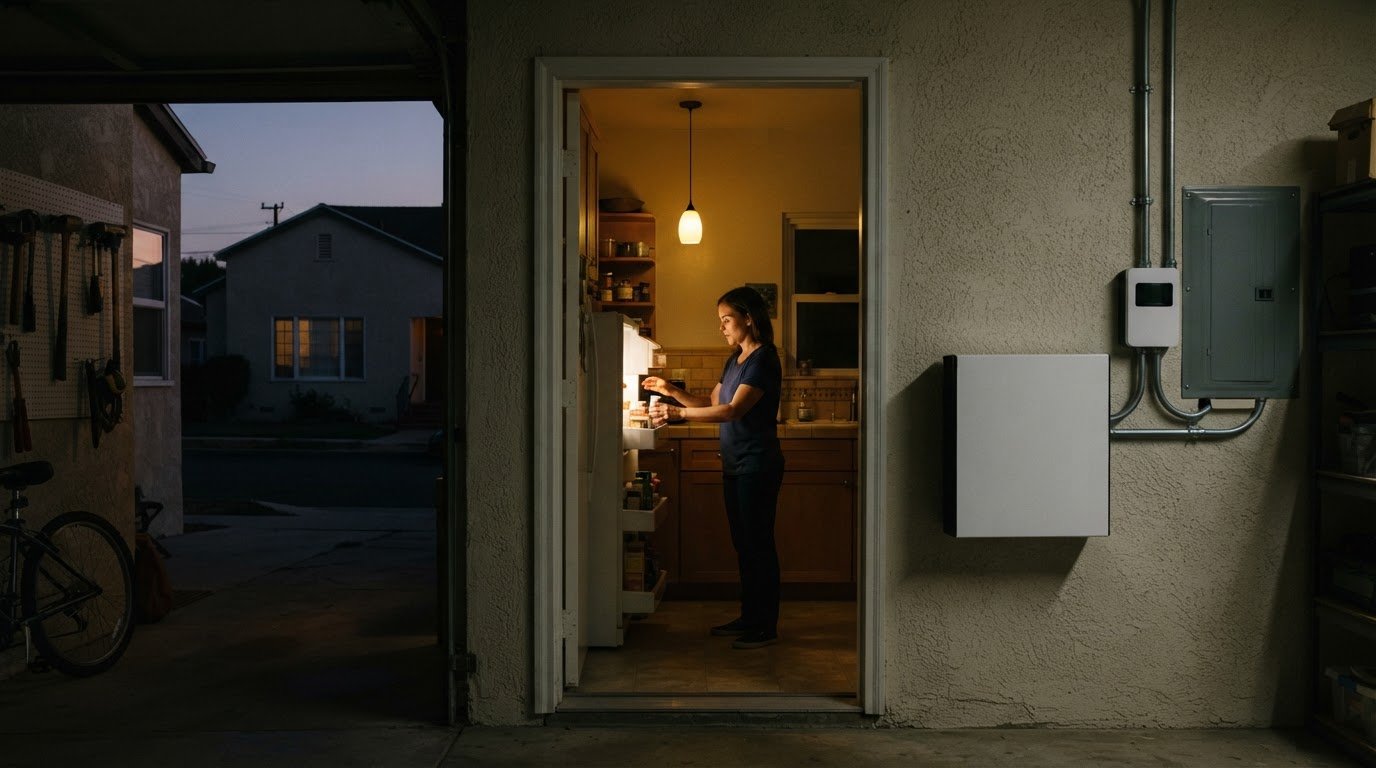
The best outage plan may not be the one that keeps every appliance running. A home battery can power selected essential devices, and its runtime depends on battery capacity and the loads you use. For emergency power backup for a home in Los Angeles, a battery can provide backup without a solar installation.
It’s natural to want the refrigerator, lights, and communication devices to keep working when the power goes out. The key is matching backup capacity to what matters most in your home, rather than assuming the system will run the whole house for the same length of time.
This guide explains what affects battery runtime, what shapes installation costs, and how to choose backup power for Los Angeles outages. You’ll also see how battery storage can fit into a residential, zero-emission backup plan, with or without solar panels.
Key Takeaways
- Estimate battery runtime by deciding which appliances and devices need power first, then matching that load to battery capacity.
- Understand how system size, electrical panel work, permitting, and installation needs shape the total cost.
- Choose backup power with Los Angeles heat and wildfire-related shutoffs in mind, not just everyday outages.
- Learn why safe circuit transfer matters and how the right setup keeps backup power separate from utility lines.
- Explore how battery storage can provide zero-emission backup power with or without solar panels.
Table of Contents
- Q2: What’s the average cost of installing a home battery backup system in Los Angeles?
- Choosing a backup system for Los Angeles outage patterns
- Appliance and device power assumptions
- Automatic transfer switches and circuit selection
- Residential zero-emission backup power options
- HelioCore: Tesla Powerwall & Battery Storage Installation
Q2: What’s the average cost of installing a home battery backup system in Los Angeles?
Installation cost depends on battery capacity, electrical panel work, and the circuits connected for backup. A quote reflects the equipment and work required for your home.
Backup System Types
A portable generator can serve selected needs, while a standby generator connects to household circuits for backup. A home battery can charge from the grid and provide backup without solar panels. Compare which circuits each setup can serve, how it switches to backup, and whether its fuel or charging needs suit your home.
For safe operation, portable and standby generators belong outdoors, away from doors, windows, and vents. Portable generators should sit at least 20 feet from the home, with exhaust pointed away from openings. UL 2201 identifies portable-generator models with carbon-monoxide shutoff features. Battery systems also need correctly installed electrical equipment and inspection.
Permits and Electrical Integration
In the City of Los Angeles, a home battery installation requires an LADBS electrical permit, listed equipment, and an inspection. A natural-gas standby generator requires an LADBS electrical permit and plumbing permit, including a gas-line pressure test. Requirements can differ across Los Angeles-area jurisdictions, so permitting is part of the installation plan.
A battery backup connected to home electrical circuits must isolate the home from utility lines during an outage to prevent electricity from flowing back onto those lines. The system can then direct stored power to selected circuits. Ask for a design that identifies those circuits and explains how the transfer equipment operates automatically.
Installer and Product Comparisons
Compare products by reviewing their warranty terms and coverage conditions. When choosing an installer, look for reviews that describe electrical work, permitting, inspections, and follow-through. These details help distinguish equipment coverage from installation-related support.
Expansion depends on whether additional battery capacity works with the existing system and electrical setup. Include that possibility when discussing the initial design, along with the circuits the system must support. The project price depends on equipment, battery capacity, panel work, and installation requirements; it is given after a quote request.
For incentives, Southern California Edison lists eligibility that includes living in a Tier 2 or Tier 3 High Fire Threat District, or experiencing two or more utility Public Safety Power Shut-offs. The Internal Revenue Service states that the federal residential clean energy credit under section 25D does not apply to systems installed after December 31, 2025. Check incentive eligibility and timing as part of your project planning.
Choosing a backup system for Los Angeles outage patterns
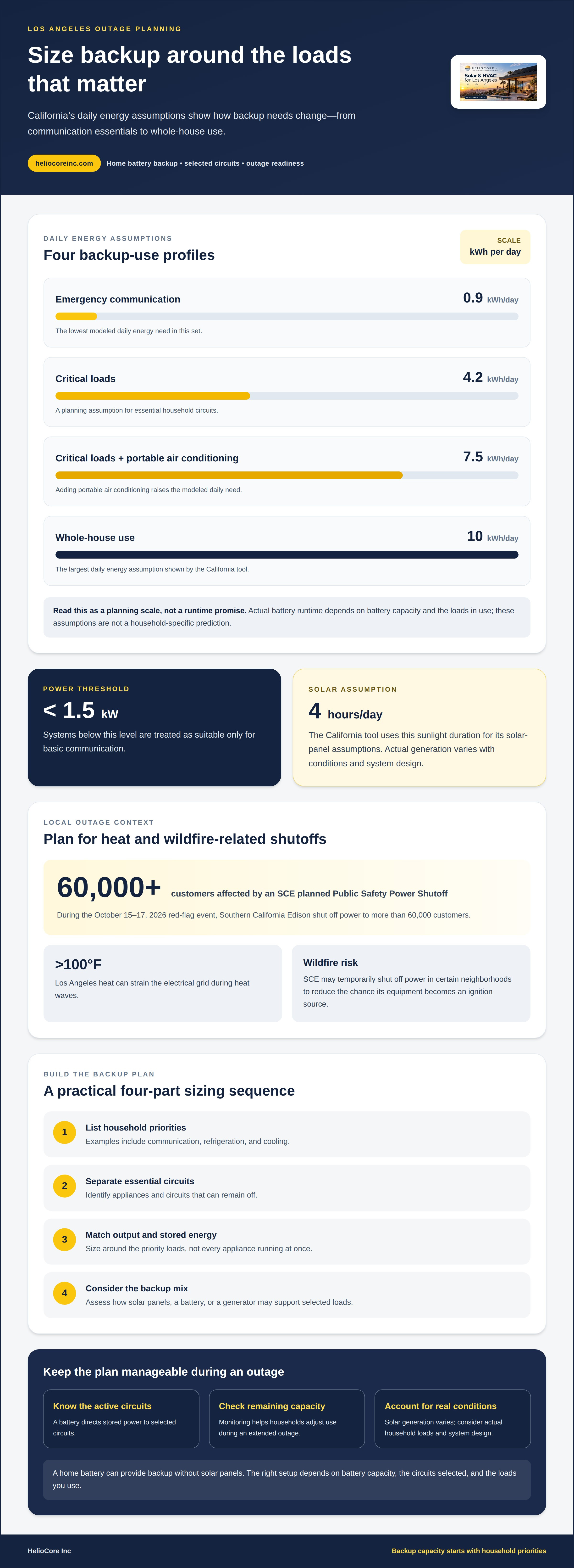
Choose backup around the outages your household needs to manage, not the largest system available. Emergency power backup for a home in Los Angeles should account for heat-related demand, wildfire-related shutoffs, and the essential circuits you want to keep running.
Heat matters. Los Angeles temperatures above 100°F can strain the electrical grid during heat waves. Southern California Edison may temporarily shut off power in certain neighborhoods when wildfire risk is high, reducing the chance its equipment becomes an ignition source. During the October 15-17, 2026 red-flag event, SCE shut off power to more than 60,000 customers through a planned Public Safety Power Shutoff.
Use a simple planning sequence:
- List household priorities, such as communication, refrigeration, or cooling.
- Separate essential circuits from appliances you can leave off.
- Match system output and stored energy to those priorities.
- Consider how solar panels, a battery, or a generator may support selected loads.
This helps avoid sizing a system around appliances that don’t need to run at the same time.
California’s residential backup power tool uses daily energy assumptions for different needs. Emergency communication is modeled at 0.9 kWh per day; critical loads use 4.2 kWh per day. Adding portable air conditioning raises the critical-load assumption to 7.5 kWh per day, while whole-house use assumes 10 kWh per day. Systems below 1.5 kW are treated as suitable only for basic communication. These figures are planning assumptions, not a household-specific runtime prediction.
Solar panels can contribute to a backup plan, but generation varies with conditions and system design. The California tool uses four hours of sunlight per day for its solar-panel assumptions. A professional assessment should consider your household’s actual loads and the role solar generation may play during an outage. This helps clarify whether panels are central to the plan or a supporting feature.
Monitoring also matters after installation. The installer should explain how to read available system status, track remaining battery capacity, and identify which circuits are drawing power. These details help households adjust their use during an extended outage. For emergency power backup for a home in Los Angeles, knowing which loads are active makes the system easier to manage.
A residential solar installation can be considered alongside backup planning, with the design shaped around household priorities and outage conditions. Residential solar panel installation may be relevant when you want solar panels included in that plan.
Appliance and device power assumptions
California’s residential backup power tool uses appliance wattage assumptions to help households understand electrical demand. These figures are planning references, not exact readings for every device. A system must meet both the power needed at one time and the energy required over an outage. Inverter output relates to simultaneous demand, while battery capacity determines how long stored energy can serve those loads.
Small devices can add up. The tool assumes a router draws 6 W, a phone 9 W, a tablet 33 W, and a laptop 35 W. A 27 W lamp adds lighting. Together, those example loads total 110 W when operating at their assumed draws. A CPAP machine is modeled at 45 W. The combined figure helps show why several modest devices still matter in a backup plan.
Cooling and refrigeration change the load picture. The California tool assumes 72 W for a refrigerator and 730 W for a window, wall, or portable air conditioner. If both operate at once, their assumed draw totals 802 W. That example excludes other household devices, so the system’s power output must account for the full set of equipment expected to run together.
Some appliances have substantially higher assumed demand. The tool assigns 725 W to a well pump and 4,500 W to a water heater. Those figures show why circuit selection matters: adding a high-demand appliance can change the power requirement sharply. An installer can use the household’s intended loads to assess inverter output, battery capacity, and which circuits belong in the backup plan.
- Communication: A router, phone, and laptop support connectivity and work devices.
- Lighting: A 27 W lamp provides a clear example of a modest lighting load.
- Cooling: A 730 W air conditioner can use far more power than a router or lamp.
- Essential equipment: A 45 W CPAP machine may take priority over less-needed appliances.
For an extended outage, the key decision is how long each selected device needs power. A watt figure describes assumed demand while a device operates; total energy use also depends on operating time. A refrigerator’s actual demand, for example, depends on how it is used. The tool’s assumptions help compare loads, while system design should reflect the specific appliances and circuits intended for backup.
Bring your desired device list to the system-sizing discussion. Include essential equipment, lighting, and any planned cooling. This gives the installer a practical basis for evaluating simultaneous electrical demand and the battery capacity needed to support your household’s priorities.
Automatic transfer switches and circuit selection
A backup system needs a safe way to connect stored power to household circuits. For a battery or generator, the transfer setup separates the home from utility lines during an outage, helping prevent electricity from flowing back onto lines outside the home.
A portable generator connected to hardwired circuits needs an electrician-installed interlock kit or transfer switch. A listed generator interlock prevents the main breaker and generator breaker from being on at the same time. This arrangement provides a controlled connection through the electrical panel, rather than an improvised route through an outlet.
Never plug a portable generator into a wall outlet to power a home. This can send electricity back through the home’s wiring and onto utility lines, creating a serious hazard. A dryer outlet is not a substitute for an interlock kit or transfer switch. The generator must connect using equipment designed for that purpose.
A battery system also needs transfer equipment that disconnects the home from the grid during an outage. The setup then supplies stored energy to the circuits included in the backup design. The switch and electrical panel determine how power reaches those circuits. Professional installation accounts for this connection as part of the system design.
Circuit selection starts with household priorities. The installer can group critical needs, such as refrigeration, lighting, or communication devices, then assess which circuits the backup system can support together. A water heater or air conditioner may add substantial demand, so the combination of circuits matters as much as their number.
- Identify critical loads: Include the devices that must remain available during an outage.
- Separate optional loads: Mark appliances that can remain off while stored power is limited.
- Review combined demand: Assess the circuits expected to run at the same time.
- Choose the connection: Match a battery or portable generator with suitable transfer equipment.
For example, a household might prioritize its refrigerator, selected lights, and router while leaving nonessential circuits out. The installer uses that plan to determine how the transfer equipment connects to the panel. A clear layout also helps occupants understand which circuits receive backup power when utility service is interrupted.
Before installation, the project design should identify the backup circuits and explain how the transfer setup works. This gives the household a practical operating plan, reduces uncertainty about which outlets remain powered, and helps prevent unsafe generator connections during an outage.
Residential zero-emission backup power options
A home battery stores electricity for use when utility power is interrupted. It can charge from the electrical grid, so solar panels aren’t required. Pairing a battery with panels adds another charging source to the backup plan. The practical choice depends on which loads matter, how long they need power, and how the system will recharge.
A home battery can keep essential loads running during an outage, with runtime depending on usage and available capacity. That estimate can change with the appliances operating and the amount of stored energy available. A household running only communication devices and selected lights draws less energy than one adding cooling or other major appliances. Matching capacity to actual priorities matters more than aiming for a whole-house setup by default.
Solar panels and a battery can work together, but their roles differ. Panels produce electricity when conditions allow; the battery stores electricity for later use. The California residential backup tool uses four hours of sunlight per day for its solar assumptions. That’s a planning assumption, not a promise of charging during a particular outage. System design should consider when charging is expected and which circuits need backup power.
A battery system also needs a transfer switch or equivalent equipment to disconnect the home from utility lines during an outage. The transfer arrangement then directs stored power to designated circuits. Professional installation coordinates the panels, battery, electrical connection, and selected loads so the system works as a coordinated setup rather than separate pieces of equipment.
Medical equipment can make backup planning especially important. SCE’s Critical Care Backup Battery Program requires customers to use electrically powered medical equipment regularly or have another qualifying medical device. This makes the equipment’s power needs and expected operating time central to planning. A household relying on a CPAP machine, for example, should include it among priority loads.
Battery chemistry also affects long-term use. Lithium iron phosphate batteries can last for 6,000-10,000 charge cycles, according to the available market information. Cycle life is one comparison point, alongside usable capacity, expected loads, and system compatibility. It doesn’t replace an assessment of how the household will use stored energy during outages.
For a zero-emission backup plan, define the essential circuits, decide whether panels should contribute to charging, and account for medical equipment or cooling needs. Then have the system design connect those priorities to battery capacity and transfer equipment. Plan a residential backup power system around the loads your household depends on.
HelioCore: Tesla Powerwall & Battery Storage Installation
HelioCore Inc installs Tesla Powerwall and battery storage systems for homeowners planning backup around essential household needs. Turn to HelioCore Inc when you want a professionally installed battery system and a clear plan for which circuits matter during an outage.
The process connects your backup priorities with your home’s electrical setup. If you’re planning to install solar panels, HelioCore Inc can coordinate battery storage with solar panel installation. The design can reflect your household’s energy use, chosen backup loads, and interest in solar, without assuming every home needs the same arrangement.
Share which appliances and devices you want to keep powered, and whether you’re considering solar panels. Contact HelioCore Inc to discuss Tesla Powerwall and battery storage installation for your home.
Make a backup plan that fits your home
Planning emergency power backup for a home in Los Angeles starts with a practical choice: which parts of daily life should stay powered during an outage? Keep that priority at the center of your next conversation. It can guide decisions about backup equipment and whether solar belongs in your plans.
HelioCore offers battery storage, high-efficiency solar panels, and HVAC solutions for homeowners. If you’re considering a battery system, discuss your household’s priorities and how a backup plan could fit your home. A clear starting point makes a major home upgrade easier to approach, without assuming every household needs the same setup.
Talk with HelioCore about home backup and take a thoughtful next step toward a plan shaped around your home.
Frequently Asked Questions
Q1: How long can a home battery backup power my house during an outage?
A home battery can provide backup power for essential loads, but runtime depends on usage. That doesn’t necessarily mean whole-house power for that period. Cooling, water heating, and several appliances running together use stored energy faster than basic communications. A practical runtime estimate starts with the circuits you plan to use and how often connected devices operate. Treat the estimate as a guide for planning, not a fixed duration for every home.
Battery or generator?
A battery stores electricity for selected home circuits, while a generator produces power during operation. Choose based on the loads you need to support, how you expect to recharge or supply the system, and whether automatic transfer is important to your plan. A battery can charge from the electrical grid without solar panels. A generator connection needs appropriate transfer equipment, and portable models must operate outdoors.
Q3: Do I need solar panels to benefit from a home battery backup system?
No. A home battery can charge from the electrical grid and provide backup without solar panels. This may suit a homeowner who wants stored power but isn’t planning a solar installation. Solar panels can be part of a combined design, but they aren’t required for battery backup. The main planning choice is which appliances or circuits the battery should support when utility power is unavailable.
Does a home battery work without solar, and how long does it last in an outage?
Yes, a battery can charge from the grid without solar and supply backup power during an outage. A fully charged system may keep essential loads running for 1-2 days, depending on usage. Its runtime is affected by the connected appliances and how much electricity they use. A household that limits backup to priority devices can make stored energy last longer than one using more loads.
What home backup power options are available in Los Angeles: portable generators, standby generators, and battery systems?
Los Angeles homeowners can consider portable generators, standby generators, and battery systems. Portable units are brought out for use; standby systems connect to household circuits; batteries store electricity for backup. Equipment and installation needs vary across Los Angeles neighborhoods, including Inglewood, South Los Angeles, Crenshaw, Leimert Park, Baldwin Hills, Westchester, Van Nuys, North Hollywood, Reseda, Northridge, Woodland Hills, and San Pedro.
How much does home backup power cost in Los Angeles, including installation and permits?
The total cost depends on the system, capacity, electrical work, and installation requirements. Permits and inspections may also affect the project scope. In the City of Los Angeles, a home battery installation requires an LADBS electrical permit, listed equipment, and an inspection. For a project estimate, account for the equipment and work needed at the property; the cost is provided after a quote request.
What size generator or battery system does a Los Angeles home need to power essential appliances?
Size the system around the appliances that need backup and the power they require together. California’s residential backup tool includes systems producing at least 2 kW for its critical-loads use case. That threshold isn’t a complete sizing answer for every home. The household’s priority devices, simultaneous demand, and desired backup duration all affect the system design.
How long can home batteries and generators run during a power outage?
A fully charged home battery can support essential loads for 1-2 days, depending on use. Generator runtime depends on its fuel supply and the loads it serves, so it varies with operating conditions. For either option, the connected devices matter: running fewer essential circuits uses less backup energy or fuel. Plan around the equipment your household needs most during an outage.