
HVAC
Energy Efficient Air Conditioner Options in Los Angeles
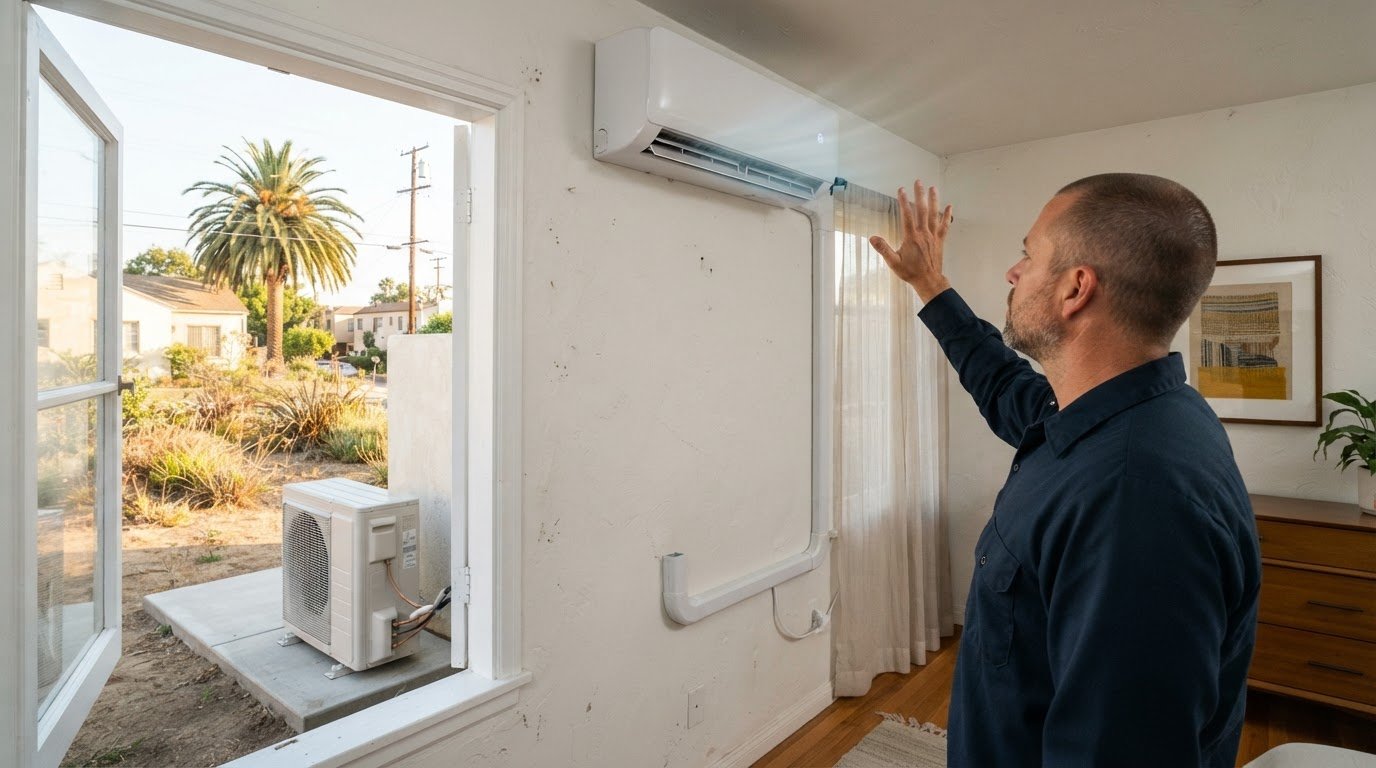
The most efficient central AC replacement is the one matched to your home, not simply the unit with the biggest capacity. For an energy efficient air conditioner in Los Angeles, look for a SEER2 rating generally above 16, and consider a heat pump as part of a central system upgrade. The right fit also depends on sizing and installation.
It makes sense to focus on the equipment first. But even an efficient system can struggle if heat keeps entering the home or cooled air cannot circulate freely.
This guide compares central AC and heat pump replacements, explains how inverter compressors can help manage cooling, and outlines local rebate considerations. It also covers practical ways to reduce heat gain and improve airflow, helping you assess which upgrades may support comfort and lower energy use. Use it as a starting point for choosing an AC system that suits your Los Angeles home.
Key Takeaways
- Compare central AC and heat pump options by how well they suit your home and cooling needs, not by equipment rating alone.
- Learn how inverter compressors adjust cooling output and why that can support steadier operation.
- See how local rebates may lower the cost of eligible room air conditioners, with eligibility tied to the product and program rules.
- Understand how insulation, window condition, and duct leaks can affect comfort and cooling efficiency.
- Find out which efficiency details and permit considerations matter when planning an AC replacement in Los Angeles.
Table of Contents
- Energy-saving AC modes and inverter compressors
- Rebates and incentives for efficient HVAC systems
- How professionals can reduce heat gain and improve airflow
- What SEER2 rating do I need for an AC in California?
- What permits and efficiency requirements apply to air conditioner replacement in Los Angeles?
- HelioCore
Energy-saving AC modes and inverter compressors
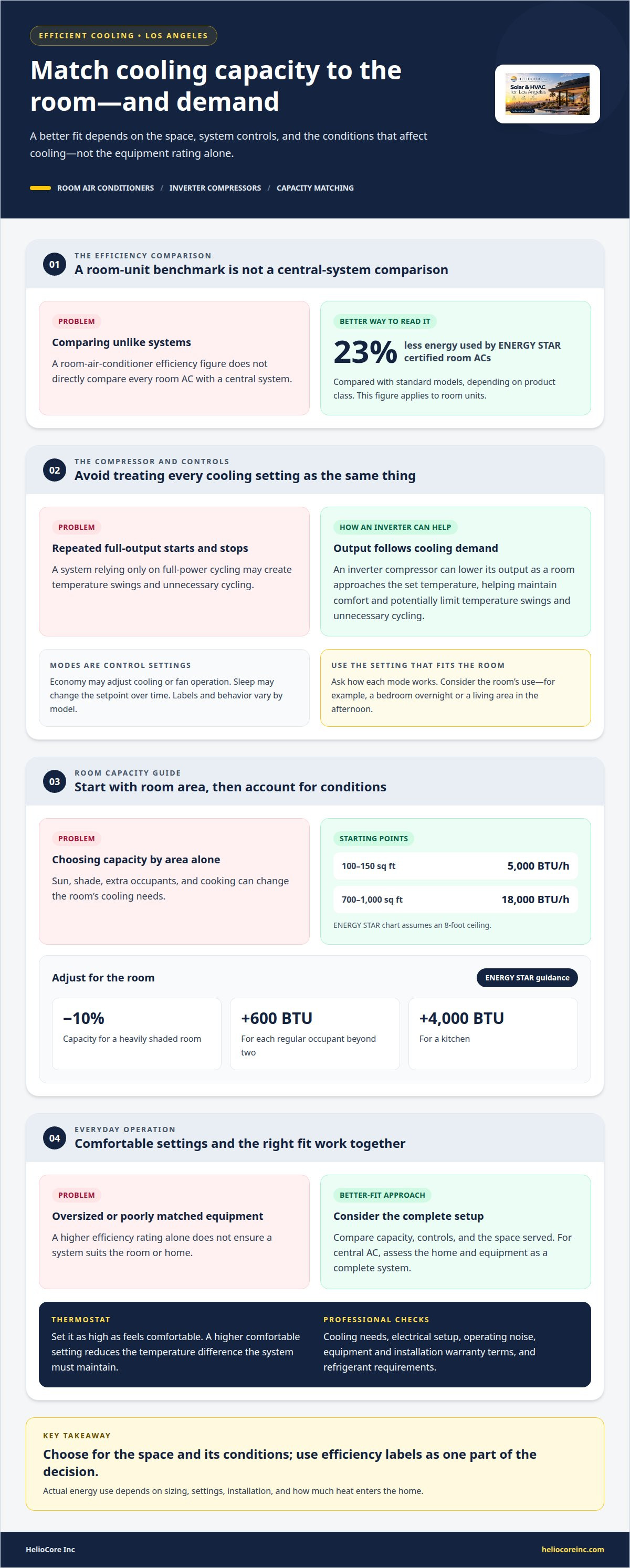
For an energy-efficient air conditioner, compare the cooling system, its controls, and how it matches the space. ENERGY STAR certified room air conditioners use about 23% less energy than standard models, depending on product class. That figure applies to room units, so it shouldn’t be treated as a direct comparison between every room AC and central system.
An inverter compressor adjusts its output to match cooling demand instead of relying only on repeated full-power starts and stops. As a room approaches the set temperature, the compressor can run at lower output to maintain comfort. This may limit temperature swings and unnecessary cycling. Actual energy use depends on system sizing, settings, installation, and how much heat enters the home.
Energy-saving modes are control settings, not a separate compressor type. Depending on the model, an economy setting may adjust cooling or fan operation, while a sleep mode may change the setpoint over time. These labels vary across products. Ask how each mode works and whether it fits the room’s use, such as cooling a bedroom overnight or a living area during the afternoon.
Setting the thermostat as high as feels comfortable can help reduce cooling demand. A higher comfortable setting reduces the temperature difference the system must maintain. Pairing that setting with a mode that avoids unnecessary full-output operation can support energy savings without sacrificing the comfort you need.
Capacity matters too. A room air conditioner serving 100 to 150 square feet corresponds to 5,000 BTUs per hour, while 700 to 1,000 square feet corresponds to 18,000 BTUs per hour. ENERGY STAR’s chart assumes an 8-foot ceiling. Its guidance also calls for adjusting capacity for room conditions: reduce it by 10% for a heavily shaded room, add 600 BTUs for each regular occupant beyond two, and add 4,000 BTUs for a kitchen.
Before recommending a system, a professional should assess the home’s cooling needs, electrical setup, operating noise, warranty terms, and refrigerant requirements. Consider noise in the intended space, especially a bedroom. Review warranty coverage for both equipment and installation, and confirm refrigerant compatibility with the selected system and its service needs.
These checks connect efficiency claims to everyday performance. An inverter model with suitable capacity and useful controls may fit better than an oversized unit with a higher rating. For room AC, compare ENERGY STAR certification, controls, and capacity together. For central AC, assess the home and equipment as a complete system before weighing efficiency labels.
Rebates and incentives for efficient HVAC systems
Los Angeles rebates can reduce the purchase cost of certain room air conditioners, but programs differ by customer eligibility and product type. According to the Los Angeles Department of Water and Power, residential electric customers can receive up to $125 for an eligible Energy Star-rated window air conditioner. This incentive applies to qualifying room equipment, not every central AC or heat pump replacement.
Product requirements vary: window and through-the-wall models must be ENERGY STAR-rated, while portable units must meet California Title 20 requirements. The rebate cannot exceed the product’s purchase price, and taxes and shipping aren’t covered.
The Cool LA amount combines two program contributions. The limited-time coupon reservation deadline is December 1, 2026, and coupons expire December 31, 2026. These dates matter if a household is considering an eligible purchase near the end of the year.
Unit limits also affect planning. LADWP rebates cover no more than two air conditioners, regardless of type. Window and through-the-wall rebates are limited to two units every 10 years; portable air conditioner rebates are limited to two units every five years. A household considering several rooms should account for these limits before relying on multiple rebates.
Clean Power Alliance offers another option for eligible residential customers enrolled in CARE or FERA. Eligibility must be verified promptly to receive the coupon, so check the timing and program enrollment requirements as part of your decision.
Before choosing a program, compare the equipment category, efficiency requirements, household eligibility, purchase timing, and unit limits. When estimating the LADWP rebate, separate the product purchase price from taxes and shipping, which are not covered. A rebate may help with the purchase, but it does not make an unsuitable system right for your home’s cooling needs.
These incentives primarily support room air conditioners, not central HVAC replacements. For central AC or heat pump projects, consider equipment efficiency, home comfort, and local climate together. Program details can change, so review the current requirements before choosing an eligible product or deciding when to apply.
How professionals can reduce heat gain and improve airflow
In Los Angeles, strong sun can warm rooms before outdoor temperatures peak. An assessment looks beyond the air conditioner to find where heat enters and cooled air gets trapped. It can help identify whether the main issue is a sunny window, weak insulation, leaky ductwork, or uneven airflow between rooms.
Start by checking gaps around doors, windows, and pipes. California weatherization improvements can include sealing holes and cracks in these areas. Closing the gaps limits unwanted air movement that can make indoor temperatures harder to manage. An assessment can pinpoint problem areas and identify repairs that address the home’s sources of heat gain.
Windows deserve close attention. California weatherization improvements can include repairing or replacing windows, while an assessment may also consider how sunlight affects the room. For a very sunny room, ENERGY STAR advises increasing room air conditioner capacity by 10 percent. That adjustment illustrates why exposure matters, but capacity should be considered alongside the room and system as a whole.
Insulation is another part of the assessment. California home weatherization reviews may check whether insulation is adequate. If it is weak, heat can pass through the building envelope and increase cooling demand. A professional can identify where insulation may need attention and explain how it affects AC performance, rather than treating equipment as the only solution.
Duct condition affects how much cooled air reaches the rooms. Leaky ducts can lose up to 30% of conditioned air. A professional can inspect accessible ductwork for leaks, damage, or disconnected sections, then recommend appropriate repairs. Better-sealed ducts help direct cooled air where the system is designed to deliver it, instead of losing it before it reaches living spaces.
Comfort also depends on how air moves through the home. A professional can review supply and return locations, check for blocked or poorly balanced airflow, and consider whether distant rooms get less cooling. For example, a sunny back bedroom that stays warm may have both extra heat gain and a distribution problem. Addressing both may help more than simply increasing cooling output.
A practical sequence keeps the assessment focused: identify heat entry, review insulation and windows, inspect ducts, then evaluate airflow between rooms. The right combination depends on the home’s condition and the source of discomfort. Some improvements may be straightforward, while window or insulation work can involve broader upgrades. Reducing heat gain and improving airflow helps an AC system maintain comfort without avoidable load.
What SEER2 rating do I need for an AC in California?
For an energy-efficient air conditioner in California, look for a SEER2 rating generally above 16. Treat that as a practical target, not a guarantee of lower energy bills or a universal legal minimum. SEER2 helps compare cooling efficiency, but the rating alone cannot show how a system will perform in a particular home.
SEER2 measures seasonal cooling efficiency under standardized test conditions. A higher rating indicates that the equipment provides more cooling for its energy use under those conditions. For example, comparing two central AC systems with similar capacities can make their SEER2 ratings useful for narrowing choices. Comparing unlike system types or mismatched capacities gives a less helpful picture.
Start with the equipment type. Central air conditioners and heat pumps serve different system needs, so compare ratings within the category being considered. Then review capacity and the home’s cooling load. A high-SEER2 unit that is poorly matched to the home may not deliver the comfort or savings expected from its label.
Installation matters too. Airflow, duct condition, controls, and correct setup affect how equipment operates. For example, a high-rated central AC connected to leaky ducts may lose cooled air before it reaches living spaces. An efficiency label cannot make up for problems elsewhere in the cooling system.
Compare the full equipment details, not just the largest number on a product label. A professional assessment can connect the proposed capacity and efficiency rating to the home’s layout, insulation, sun exposure, and existing ductwork. Those details help explain why two homes in California may need different equipment, even if both owners want a rating above 16.
Consider how the system will be used, too. Cooling demand changes with occupancy, thermostat settings, room exposure, and the length of time the system runs. A household that cools several rooms throughout the day may weigh efficiency differently from one that mainly cools a single occupied area. The SEER2 figure offers a consistent starting point, while those real conditions shape expected operation.
When reviewing replacement options, ask for the proposed system’s SEER2 rating and capacity together. Have the professional explain how the selection fits the home and what installation or duct issues may affect performance. This turns the rating into a useful comparison rather than a standalone sales number.
In short, above 16 is a sensible SEER2 target for identifying an efficient option in California. Use it alongside equipment type, capacity, installation quality, and household cooling patterns. A well-matched system supports comfort and can use energy more effectively; the rating by itself cannot predict an individual home’s energy bill.
What permits and efficiency requirements apply to air conditioner replacement in Los Angeles?
For an AC replacement in Los Angeles, begin by defining the work scope. Replacing equipment alone differs from a project that also changes wiring, ductwork, refrigerant lines, or exterior openings. These details shape permit review, so identify them in the project plan before installation. Do not assume permit requirements based on the equipment label alone.
Next, separate permit questions from efficiency comparisons. The available California guidance for this article recommends looking generally above 16 SEER2 for an efficient air conditioner. That is a recommendation, not a stated Los Angeles permit rule or a legal minimum. A rating can help compare equipment, but it does not determine which approvals apply to a particular replacement.
A professional project review can organize the key details into a clear scope:
- Equipment: record whether the replacement is central AC, a heat pump, or another system type.
- Connections: note whether electrical work or refrigerant piping will change.
- Distribution: identify duct modifications, new openings, or changes to indoor equipment locations.
- Efficiency: include the proposed system’s SEER2 rating and capacity in the equipment comparison.
For example, replacing an outdoor unit while keeping existing ducts raises different project questions from a replacement that also changes duct routes and electrical connections. This example does not determine whether a permit is needed. It shows why documenting the scope first helps establish which local approvals and inspections apply.
Efficiency review also needs more than one label. Compare the proposed SEER2 rating with the home’s cooling needs, equipment capacity, and existing system condition. The general target above 16 can help narrow options, but an oversized system or poorly planned installation may not deliver the expected comfort. The rating describes equipment efficiency, not the entire home’s performance.
A clear replacement sequence is practical: define the scope, identify applicable permits and inspections, select equipment, then coordinate installation around those requirements. Keep permit documents and equipment specifications together. This makes it easier to compare the installed system with the project plan and clarify what work was included.
For Los Angeles homeowners, the key distinction is simple: efficiency ratings guide equipment selection, while permits relate to the work being performed. Have the professional responsible for the replacement assess the project scope and coordinate applicable requirements before work starts. This keeps approvals, installation details, and efficiency choices aligned without treating a SEER2 number as a substitute for permit review.
HelioCore
HelioCore Inc helps Los Angeles homeowners turn efficiency information into a practical air-conditioning plan. Its HVAC and air-conditioning services support decisions about replacement, system fit, and installation. This can help when an older unit struggles to keep rooms comfortable or you are weighing efficiency against your home’s needs. A useful assessment considers both the equipment and operating conditions, including airflow and cooling demand, rather than treating one rating as the whole answer.
Planning an AC replacement? Contact HelioCore Inc to discuss your home’s cooling needs.
Make your next cooling decision with confidence
Choosing an energy-efficient air conditioner in Los Angeles is also an opportunity to consider how cooling fits your household’s broader energy needs. HelioCore offers HVAC alongside high-efficiency solar panels and battery storage, bringing these home energy options into one conversation. Start by identifying what matters most, from room comfort to how you want your energy systems to work together.
You do not need to settle every detail before taking the next step. A conversation can help turn your priorities into a practical plan for your home and its cooling needs.
Contact HelioCore about efficient AC to discuss your next step. A thoughtful plan can make a major home upgrade feel more manageable.
Frequently Asked Questions
What type of AC unit is most energy efficient?
No single AC type is the most efficient for every home. Efficiency depends on system design, capacity, controls, and fit. Inverter compressors can adjust output to changing demand, while central AC or a ductless mini-split may suit different layouts. Compare equipment within the same category, then consider how many rooms need cooling and how the home is used.
Which AC consumes the least electricity?
The AC that uses the least electricity is the one that meets the space’s cooling needs without excess capacity or unnecessary operation. ENERGY STAR certified room air conditioners use about 23% less energy than standard models, depending on product class. For a home with several rooms, compare a central system or heat pump with room-by-room options. The best comparison considers the whole home, not just one unit’s label.
What is the most energy-efficient air conditioner for a Los Angeles home?
For an energy-efficient air conditioner in Los Angeles, match the system to your home’s layout, cooling needs, and existing equipment. Central AC can serve multiple connected rooms, while a ductless mini-split can cool selected areas. A heat pump is another option for heating and cooling. A sound recommendation weighs equipment efficiency alongside installation conditions and how your household uses each space.
Which air conditioner types work best in Los Angeles, including central AC, heat pumps, and mini-splits?
Central AC suits homes that need cooling across connected rooms with existing ductwork. Heat pumps provide heating and cooling through one system, making them an option if you are considering both. Ductless mini-splits can serve selected rooms without relying on ducts throughout the home. For example, a home addition or frequently used room may call for a different solution than whole-home cooling.
How much can a high-efficiency air conditioner save on Los Angeles electricity bills?
There isn’t one bill-savings amount that applies to every Los Angeles home. ENERGY STAR certified room air conditioners use about 23% less energy than standard models, depending on product class, but that figure describes energy use, not a guaranteed dollar reduction. Your bill also reflects usage, thermostat settings, local rates, weather, and the equipment being replaced. Compare energy use rather than assuming a specific bill outcome.
What are the current California and Los Angeles rebates or tax credits for efficient air conditioners and heat pumps?
Los Angeles incentives include LADWP rebates for eligible room air conditioners and a Clean Power Alliance coupon for eligible customers enrolled in CARE or FERA. The programs described offer rebates and coupons, not tax credits. Eligibility depends on customer status and equipment requirements, so match the program to the unit type before purchase. The room-unit rebates described here do not cover central AC or heat pump replacements.
How can I reduce air-conditioning energy use during Los Angeles heat waves?
During a Los Angeles heat wave, set a room AC thermostat as high as feels comfortable; ENERGY STAR gives 78°F as a typical setting. Reduce direct sun through exposed windows, and keep cooled air from escaping through gaps around doors or windows. If some rooms stay warm, have duct condition and airflow assessed. Addressing heat entry and distribution can reduce unnecessary cooling demand while maintaining comfort.