
Solar
Federal solar tax credit 2026 California: costs and incentives
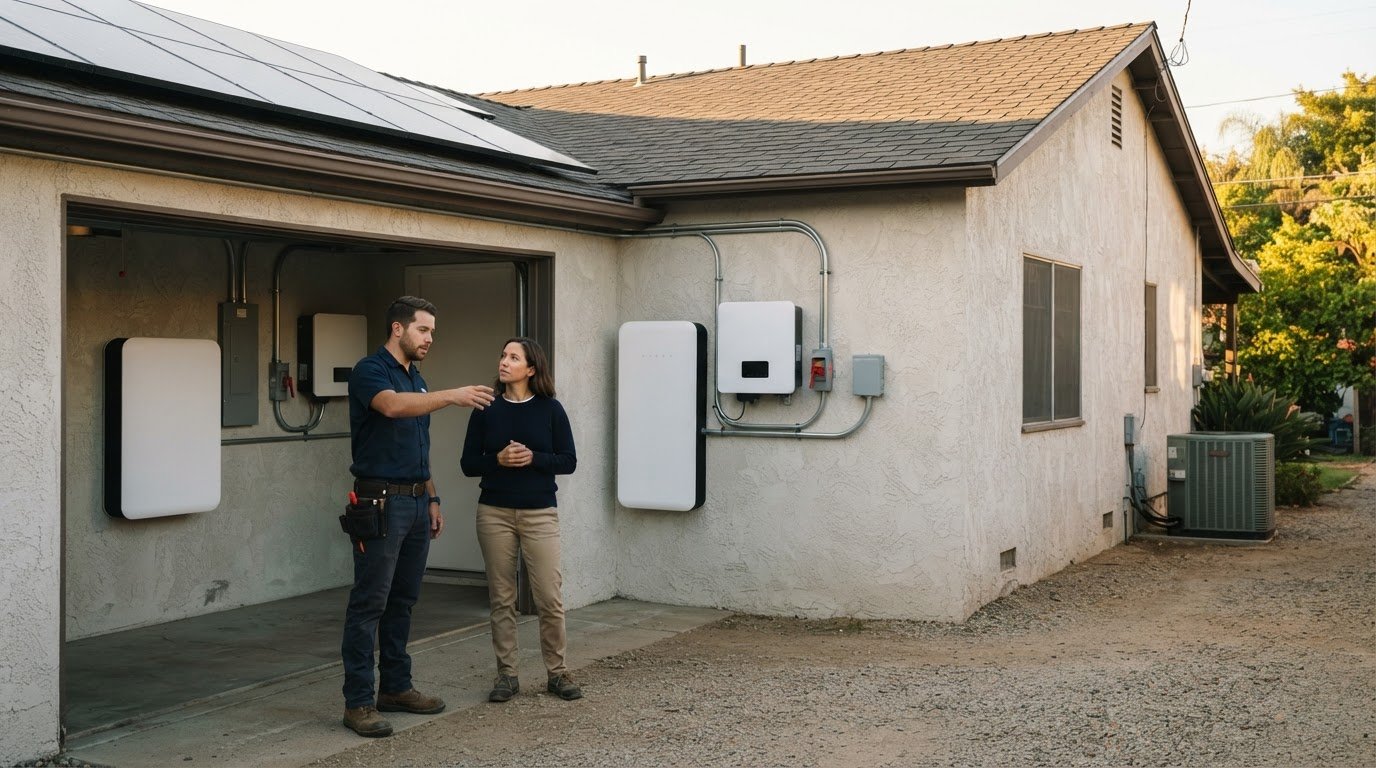
The federal solar tax credit in California for 2026 is $0 for a new homeowner-owned system placed in service that year. According to the Internal Revenue Service, the Residential Clean Energy Credit isn’t available for solar property placed in service after December 31, 2025.
That changes the savings calculation, but it doesn’t mean every incentive has disappeared. If your system was placed in service by December 31, 2025, you may still be able to claim the federal credit on your 2025 return. California incentives may also help eligible households, while system size, battery storage, and utility export credits shape the value of going solar.
This guide explains what applies in 2026 and 2027, which California incentives may remain, and how installation costs affect estimated savings without assuming a federal credit that no longer applies. You’ll also see why a system’s price alone doesn’t tell the whole story: how much electricity you use, when you use it, and whether you store or export power all matter.
Key Takeaways
- Federal credit eligibility depends on when a system is placed in service, so distinguish completed 2025 projects from new 2026 installations.
- Eligible low-income homeowners in disadvantaged communities may find support through California’s DAC-SASH program, including incentives for qualifying system sizes.
- Under California net billing, exported solar power is worth about 25% of retail electricity rates on average, making the timing of household electricity use an important part of savings.
- Local battery incentives vary by program and eligibility, so the incentive available can depend on where you live and how your system is configured.
- Compare estimated savings by separating installation costs, applicable incentives, utility bill effects, and any federal credit assumption.
Table of Contents
Is the federal solar tax credit still available in 2026 or 2027?
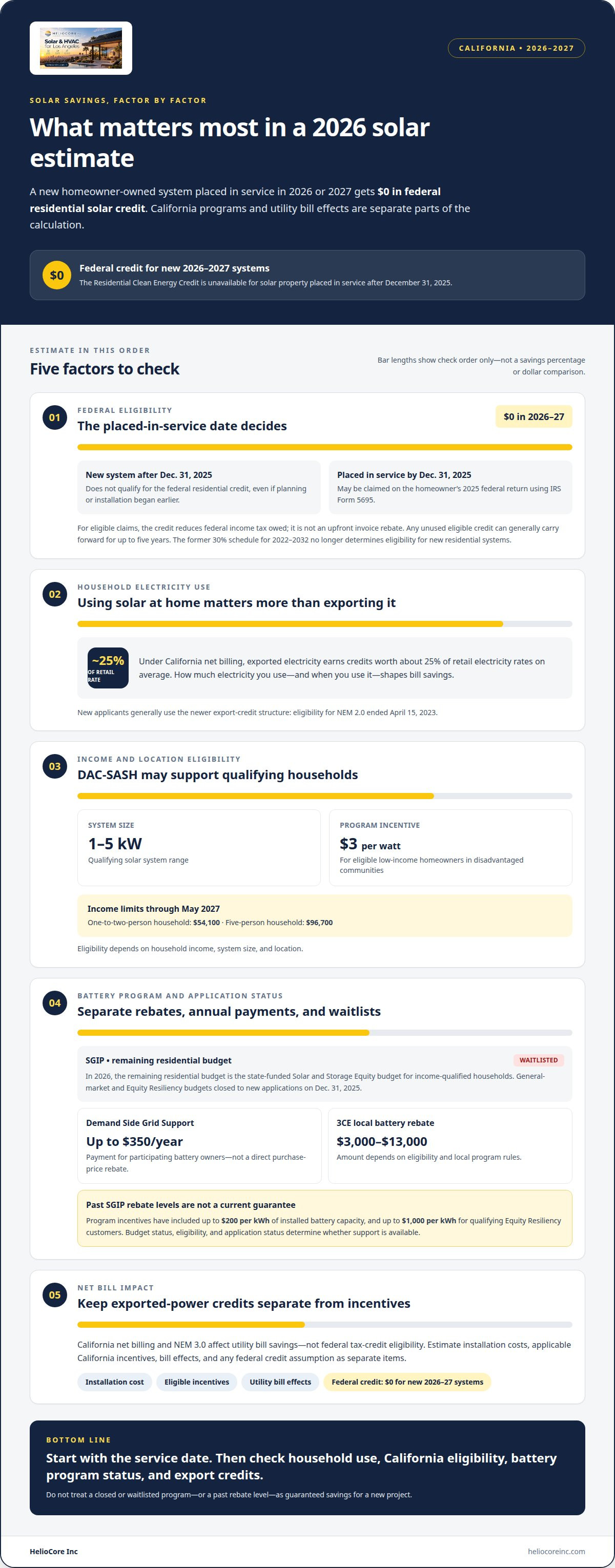
For a new homeowner-owned system placed in service in 2026 or 2027, the federal residential solar credit is $0. California’s remaining public incentives work separately, while net billing affects the value of electricity sent to the grid.
Federal Credit Rates and Eligibility Periods
The federal residential solar investment tax credit, also called the Residential Clean Energy Credit, reduced eligible system costs through a tax credit. Before Public Law 119-21 changed the schedule in July 2025, the credit rate was 30% for systems installed from 2022 through 2032. The law accelerated its end under Internal Revenue Code Section 25D, so the former schedule no longer determines eligibility for new residential systems.
Completion Dates and 2025 System Eligibility
For this credit, the installation’s placed-in-service date determines whether a residential solar system falls within the eligible period. A system placed in service by December 31, 2025, may be claimed on the homeowner’s 2025 federal return. A project completed after that date does not qualify for the federal residential credit, even if planning, financing, or installation work began earlier.
Eligible homeowners claim the credit by filing IRS Form 5695 with their annual federal tax return. The credit reduces federal income tax owed; it is not an upfront rebate that lowers an installer’s invoice. Any unused eligible credit can generally carry forward for up to five years. That distinction matters when estimating savings, because the amount applied in a tax year depends on the taxpayer’s available credit and tax liability.
California’s DAC-SASH program offers a separate path for eligible low-income homeowners in disadvantaged communities. It provides an incentive of $3 per watt for solar systems between 1 and 5 kW. Through May 2027, the income limit is $54,100 for a one-to-two-person household and $96,700 for a five-person household. These limits help determine whether a household may qualify; system size and location also matter.
California utility net billing and NEM 3.0 affect bill savings, not federal tax-credit eligibility. Under net billing, exported electricity earns credits worth about 25% of retail electricity rates on average. Eligibility for NEM 2.0 ended on April 15th, 2023, so new applicants generally use the newer export-credit structure. Using more solar power at home can therefore matter more than exporting it.
For a 2026 or 2027 project, estimate the federal credit at zero, then assess applicable California programs and utility bill effects separately. A qualifying 2025 system follows a different filing timeline and may still be claimed on the 2025 return.
What are the best solar incentives in California?
California battery incentives come from state programs, local utilities, and regional energy agencies. The benefits available depend on the program, household eligibility, and the utility serving the home.
For San Diego Community Power customers, local offers are separate from statewide programs such as SGIP and Demand Side Grid Support. Each program has its own eligibility rules and payment structure. Don’t treat a local offer as a statewide rebate or assume it can automatically be combined with another incentive. The amount and form of support depend on the specific program and qualifying project.
SGIP has changed substantially. The general-market and Equity Resiliency budgets closed to new applications on December 31, 2025. In 2026, the remaining residential SGIP budget is the state-funded Residential Solar and Storage Equity budget for income-qualified households, and new applications are waitlisted. That means SGIP is not a broadly available new-application rebate for residential batteries. The program’s past rebate levels should not be used to estimate current savings.
Separate SGIP incentives have included rebates of up to $200 per kWh of installed battery capacity, while qualifying Equity Resiliency customers could receive up to $1,000 per kWh. These figures describe program incentives, not a promise of payment to every household. Eligibility, the applicable budget, and application status determine whether a project can receive support. The closed budgets and waitlist status are especially important when estimating a new system’s net cost.
Demand Side Grid Support works differently. It offers participating battery owners payments of up to $350 per year. Rather than reducing the battery’s purchase price directly, this program pays for participation in grid-support activity. A homeowner assessing this option should distinguish recurring program payments from an upfront rebate and account for the participation terms.
Local offers can add another layer. The 3CE local battery rebate ranges from $3,000 to $13,000, depending on eligibility. These are distinct regional programs, so location and program rules affect which offer applies.
Compare incentives by type, not just by headline amount. Upfront rebates, annual payments, and waitlisted funds affect household savings differently. Check that a program applies to your utility territory, battery project, and eligibility category before including it in a financial estimate.
End of the federal Residential Clean Energy Credit
The federal credit’s end changes the financial picture for new residential solar. California’s separate tax treatment has its own deadline.
Expiration of the Federal Residential Solar Credit
The Residential Clean Energy Credit is a federal tax credit for eligible clean energy property, and its expiration removes that federal offset from qualifying new projects. According to the Internal Revenue Service, the credit is unavailable for California solar property placed in service after December 31, 2025.
Before the 2025 law changed the schedule, the residential credit was set at 30% through 2032, with a phase-down scheduled through 2034. That former timeline is historical, not a basis for estimating a 2026 project’s tax savings. Homeowners comparing ownership and financing should separate any federal tax credit from payments or savings tied to other programs.
California Residential Solar Costs After the Credit
California homeowners assessing residential solar costs should not assume an expired federal credit will reduce the cost of a new system. The total depends on system size, equipment, installation needs, and whether battery storage is included. The cost of a residential solar installation depends on these project details and is provided in an estimate.
California also has a separate Active Solar Energy System Exclusion. It applies only to solar or solar-plus-storage systems completed before January 1, 2027. This state property-tax treatment has a different cutoff from the federal credit, so the relevant completion date can affect more than one part of an owner’s calculation.
California’s state property tax rate is 0.75% per dollar of assessed value per year. The exclusion’s deadline matters because solar property completed after its cutoff no longer falls within the stated completion window. Homeowners should keep the federal credit and the state exclusion distinct: one is a federal income-tax credit, while the other concerns property-tax treatment.
For a residential system completed in 2026, estimate the project’s costs without a federal Residential Clean Energy Credit. Then consider applicable California incentives, the system’s expected effect on electricity use, and any battery’s role in storing power. These are separate parts of the financial picture, not replacements for the expired federal credit.
Distinguish installation costs from potential long-term household savings. A system’s contribution depends on how much electricity the home uses directly and how much it exports under utility metering. Battery storage can change when solar electricity is used, while eligibility for local programs can affect available payments. These factors shape a California project’s overall value beyond federal tax treatment.
California solar system costs and estimated tax credits
For a system placed in service in 2026, estimate installation costs without a federal residential credit. Separate the equipment, installation, and any eligible incentives.
System Costs Without the Federal Credit
A solar system estimate describes the project’s cost before incentives, while net cost reflects applicable rebates afterward. For a 2026 installation, don’t subtract the expired federal residential credit. Installation price depends on the project and is given after a quote request; key factors include system size, equipment, site conditions, and whether battery storage is included.
To compare California solar estimates clearly, keep each part separate. Start with the proposed solar system and installation scope, then list local rebates or incentive-program support on their own. This helps show which benefits reduce project costs directly and which depend on eligibility or program participation.
System size affects the equipment selected and the amount of electricity it can produce. Household electricity use, roof layout, and when energy is used also shape the design. A battery adds storage and can change how much solar electricity the household uses instead of exporting it to the utility.
Estimated Tax Credits for California Systems
Estimated tax credits depend on both eligible costs and the system’s placed-in-service date. The former 30% federal rate applied to qualifying residential systems during its earlier eligibility period, but it does not create a credit for a new 2026 project. Use the applicable date first, then calculate only incentives that fit that project.
For eligible residential solar property placed in service by December 31, 2025, the former 30% rate can illustrate how the prior credit was calculated: multiply eligible costs by the rate. That historical calculation should not be applied to a system placed in service during 2026. A California rebate or other incentive program is a separate line in the estimate.
Compare scenarios without blending credits, rebates, and utility-bill effects. First estimate the system cost, then subtract only incentives the household qualifies for. Assess electricity savings separately, since they depend on household use and exported power. This avoids mistaking projected savings for an upfront discount.
For a complete estimate, organize the solar installation scope, equipment choices, battery storage, and eligible rebates as separate items. Then use the project’s completion date to determine whether any federal credit applies. In 2026, the federal residential credit is not part of the calculation, so California incentives and household energy use carry more weight.
California average solar system cost and federal credit amount
A California system estimate needs two separate figures: the project’s installed cost and any applicable tax credit. For a new homeowner-owned system placed in service in 2026, the federal residential credit amount is $0.
A useful historical comparison is a 6 kW California system. Its estimated federal credit was $5,994 under the former residential credit calculation. That estimate helps explain the scale of the tax benefit homeowners once considered, but it isn’t a saving available for a system placed in service in 2026 or 2027.
System size alone doesn’t set the installed cost. Panel selection, site conditions, installation scope, and whether the project includes battery storage all affect an estimate. A 6 kW system is a reference point, not a universal design. Household electricity use and roof layout help determine whether that capacity fits a particular home.
The federal credit amount also depended on eligible costs and the project’s eligibility date. Public Law 119-21, signed in July 2025, accelerated the end of the residential credit. That change means a California homeowner planning a 2026 installation should not use the historical $5,994 estimate as a deduction from today’s project cost.
Tax liability affected how much of an eligible credit a homeowner could use in a tax year. Under the former rules, unused credit could generally carry forward for up to five years. That past feature matters when interpreting older estimates, but it doesn’t restore eligibility for a new 2026 system.
For income-qualified homeowners in disadvantaged communities, California’s DAC-SASH incentive is a separate consideration. It offers $3 per watt for solar systems between 1 and 5 kW. Through May 2027, the income limit is $54,100 for a one-to-two-person household and $96,700 for a five-person household. Eligibility for that state program doesn’t change the federal credit amount.
When reviewing an estimate, separate the installed project cost, federal credit, and California incentives. Then account for utility-bill effects based on electricity used at home and power exported. This prevents a historical credit estimate from being mistaken for current savings and clarifies which factors depend on system design or household eligibility.
Installation costs depend on the home, panels, system size, and project scope; a price is given after a quote request. Request a solar system estimate to review a design around your household’s needs.
HelioCore Inc
HelioCore Inc helps homeowners turn incentive information into a practical residential solar plan. Its team manages the solar adoption process, from initial consultation and custom engineering through permitting, installation, inspections, and utility permission to operate.
For a home in the Los Angeles area, the plan can account for high-efficiency solar panels, battery storage, and the choice between equipment ownership and solar leasing facilitated through Palmetto. That helps connect system design and payment structure with household energy needs, while keeping the expired federal credit out of a 2026 savings estimate.
Contact HelioCore Inc to discuss a solar plan for your home.
Plan your next energy decision
The federal solar tax credit in California for 2026 changes one part of a household’s decision, but it doesn’t define the home’s energy priorities. Start with how your household wants to use electricity, the improvements you’re considering, and the ownership or leasing approach that fits your plans. A clear project scope makes those choices easier to discuss.
HelioCore offers high-efficiency solar panels, battery storage, and HVAC solutions. These options can be considered as part of a broader home energy plan, rather than as disconnected upgrades. The right conversation starts with your goals and the home’s needs.
Contact HelioCore about solar to discuss a practical next step for your home. A thoughtful plan can help you move forward with greater clarity and confidence.
Frequently Asked Questions
Can I still claim the federal credit if my system was installed in 2025?
Yes, if your system was placed in service by December 31, 2025, you may claim an eligible credit on your 2025 federal return. Installation beginning in 2025 isn’t enough by itself; the placed-in-service date matters. File IRS Form 5695 with your annual return. If your eligible credit exceeds your tax liability, some unused credit may be available to apply in a later tax year.
Is the Federal ITC Worth the Time/Effort of Claiming in California?
For an eligible system placed in service by December 31, 2025, claiming the credit can make a meaningful difference. For example, a hypothetical taxpayer with $5,000 in tax liability and a $7,200 eligible credit could use $5,000 that year, with $2,200 generally carried forward. Form 5695 is the federal filing step. A new system placed in service after the deadline has no residential credit to claim.
Is the federal residential solar tax credit available in 2026?
No. The federal residential credit is $0 for a new homeowner-owned solar system placed in service in 2026. The IRS states that the Residential Clean Energy Credit is unavailable for California solar property placed in service after December 31, 2025. California incentives are separate from this federal credit, so a homeowner may still assess programs for which their household and project qualify.
What federal solar tax credit rules apply to California homeowners in 2026?
For a homeowner-owned residential solar system placed in service during 2026, the federal Residential Clean Energy Credit doesn’t apply. The 2025 law, Public Law 119-21, accelerated the end of the credit under Internal Revenue Code Section 25D. A 2026 project’s federal credit estimate is therefore zero. California program incentives and utility bill effects are separate calculations, not federal tax credits.
Did the federal solar tax credit end or change after 2025?
Yes. Public Law 119-21 changed the schedule in July 2025 and accelerated the end of the residential credit. The earlier schedule had set a 30% rate for systems installed from 2022 through 2032, but that schedule no longer governs new residential projects after 2025. For homeowners, the key distinction is the system’s placed-in-service date, not simply when planning or installation began.
Which solar panel, battery, and installation costs qualify for the federal tax credit?
For a 2026 system, none of its costs qualify for the expired federal residential credit. For eligible property placed in service within the prior credit period, the credit calculation used qualifying costs under Section 25D. Don’t assume every panel, battery, or installation charge qualifies solely because it appears on one invoice. Keep itemized contracts and invoices to support the eligible-cost calculation on Form 5695.
Can California homeowners claim a federal solar credit for leased or third-party-owned systems?
Generally, homeowners don’t claim the homeowner-owned residential credit for a leased system because the financier owns it. Some lease structures use the separate business credit, Section 48E, subject to its project rules. HelioCore’s solar leasing option is facilitated through Palmetto, which retains system ownership while the homeowner makes monthly payments. This distinction applies to homeowners in Los Angeles, Inglewood, South Los Angeles, Crenshaw, Leimert Park, Baldwin Hills, Westchester, Van Nuys, North Hollywood, Reseda, Northridge, Woodland Hills, and San Pedro.
How do homeowners claim a federal solar tax credit on their tax return?
For an eligible system, homeowners claim the credit by filing IRS Form 5695 with their annual federal tax return. Keep records showing eligible costs and when the property was placed in service. The credit reduces federal income tax owed; it isn’t an upfront rebate. If an eligible credit exceeds the amount usable that year, the unused balance could generally carry forward for up to five years.