
HVAC
Home Ventilation System Replacement: ERV and HRV Options

A whole-house ventilation system replaces stale indoor air with fresh outdoor air. A home ventilation system replacement can restore controlled airflow, and an ERV or HRV can bring in fresh air while exhausting indoor air at the same time.
If your current system is aging or no longer suits your home, it’s reasonable to want a clear picture before replacing it. The right approach depends on your home’s layout, how air moves through it, and whether you need to manage moisture as well as heat.
This guide explains how whole-house ventilation works and how ERVs and HRVs differ: an ERV transfers heat and moisture between air streams, while an HRV transfers heat. You’ll also learn what smart controls can do, what affects retrofit options, and why a professional evaluation helps plan an installation that suits your home.
Key Takeaways
- Choose ventilation based on your home’s airflow needs, moisture conditions, and existing HVAC layout, not just the equipment type.
- Understand the key difference: ERVs transfer heat and moisture, while HRVs transfer heat.
- Use smart controls to coordinate ventilation with indoor conditions and household schedules.
- Consider ductless ERVs or HRVs when adding ducts would be difficult, while matching unit capacity to the rooms that need fresh air.
- A professional evaluation can assess space, duct routes, and HVAC configuration before replacement or installation.
Table of Contents
- What is a whole-house ventilation system?
- How do ventilation systems integrate with smart home or building automation systems?
- What is an energy recovery ventilation system?
- Ductless ERVs and HRVs for controlled fresh air
- Professional ventilation system evaluation and installation
- HelioCore: High-Efficiency Solar Panels
What is a whole-house ventilation system?
A whole-house ventilation system exchanges indoor air for fresh air using equipment that serves the home. Rebates or tax credits depend on the specific program and equipment, so don’t assume a replacement qualifies.
Whole-Home Ventilation Basics
A whole-home ventilator moves stale air out and outdoor air in, either continuously or on a controlled schedule. This matters because a tightly closed home can hold moisture, odors, and indoor pollutants. The EPA identifies source control, ventilation, and air cleaning as core strategies for improving indoor air quality. Ventilation calculations account for how long a fan operates during each 24-hour period.
Types of Whole-House Systems
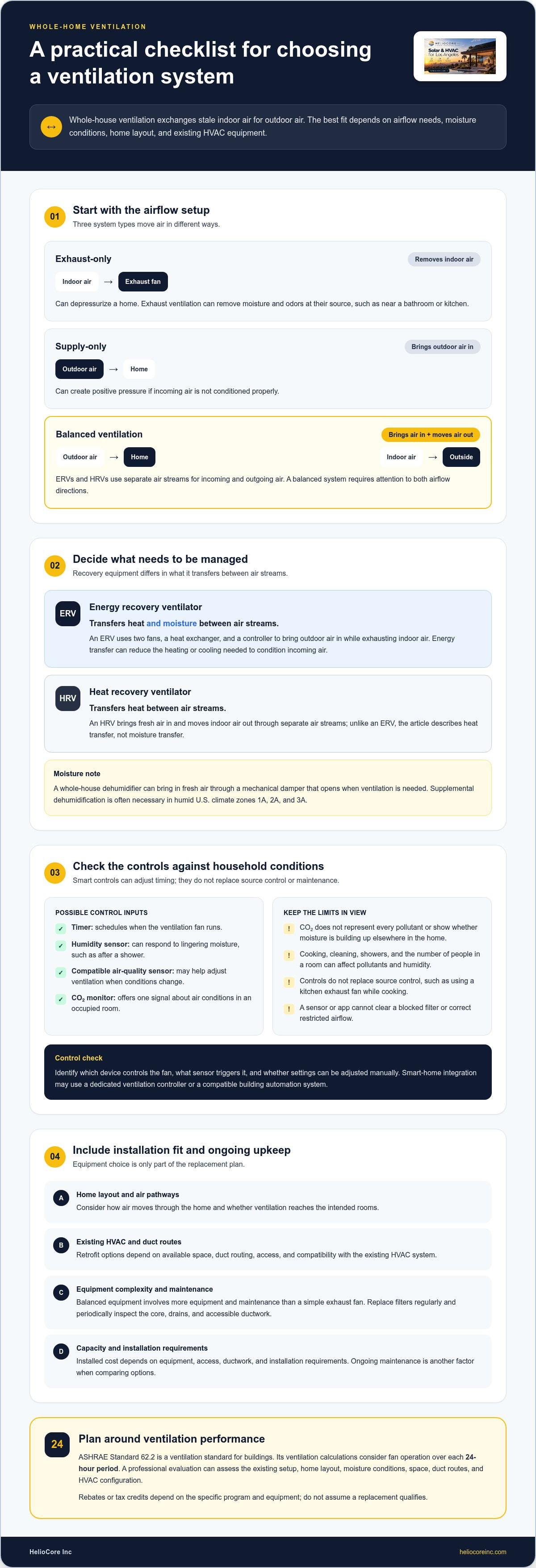
Whole-house systems use exhaust-only, supply-only, or balanced ventilation. Exhaust fans remove indoor air, supply systems bring outdoor air in, and balanced systems do both. The type matters because pressure and air pathways affect comfort and moisture. Exhaust-only systems can depressurize a home, while supply-only systems can create positive pressure if incoming air isn’t conditioned properly.
Balanced equipment includes energy recovery ventilators (ERVs) and heat recovery ventilators (HRVs). They bring fresh air in and move indoor air out through separate air streams. An ERV transfers heat and moisture; an HRV transfers heat. Both require more equipment and maintenance than a simple exhaust fan. Replace filters regularly, and periodically inspect the core, drains, and accessible ductwork to support airflow and energy efficiency.
Whole-house dehumidifiers can also bring in fresh air through a mechanical damper. The damper opens when ventilation is needed, combining moisture management with controlled outdoor air. That can help where humidity is a concern, though supplemental dehumidification is often necessary in humid U.S. climate zones 1A, 2A, and 3A. Exhaust ventilation can remove moisture and odors at their source, such as near a bathroom or kitchen.
Tradeoffs include equipment complexity, duct routing, filter upkeep, and compatibility with the existing HVAC system. A basic exhaust fan is generally easier to test and commission. A balanced system requires attention to both incoming and outgoing airflow. Installed cost depends on the equipment, access, ductwork, and installation requirements. Ongoing maintenance is another factor to consider when comparing options.
ASHRAE Standard 62.2 is a ventilation standard for buildings, and its ventilation calculations consider fan operation over each 24-hour period. For a replacement, the existing setup, home layout, and moisture conditions help determine which system type fits. Matching the equipment to those needs can avoid relying on uncontrolled air leaks or ventilation that does not reach the intended rooms.
How do ventilation systems integrate with smart home or building automation systems?
Smart controls can coordinate ventilation with indoor conditions instead of relying only on a fixed schedule. A controller may use a timer, humidity sensor, or compatible air-quality sensor to adjust when the ventilation fan runs. The goal is steady fresh-air exchange without running equipment unnecessarily. What the system can respond to depends on the controls and sensors installed.
Indoor air quality changes with household activity. Cooking, cleaning, showers, and the number of people in a room can affect pollutants and humidity. The EPA explains that inadequate ventilation can allow indoor pollutants and excess humidity to build up. Controls can help manage ventilation timing, but they don’t replace source control, such as using a kitchen exhaust fan while cooking.
A carbon dioxide, or CO2, monitor can offer one useful signal about air conditions in an occupied room. A reading that rises when people gather may prompt more ventilation, if the control system can use that sensor. CO2 is only one measure, however. It doesn’t represent every pollutant or tell you whether moisture is accumulating in a bathroom, basement, or other part of the house.
Humidity controls address a different need. A bathroom sensor, for example, can detect lingering moisture after a shower, while a timer can keep an exhaust fan running after the room is empty. A whole-house system can also be scheduled to bring in outdoor air. The right balance depends on moisture sources, outdoor conditions, and the ventilation equipment.
Smart-home integration varies by system. Some setups use a dedicated ventilation controller; others coordinate through a compatible building automation system. Before relying on automation, identify which device controls the fan, what sensor triggers it, and whether you can adjust the setting manually. Filters still need regular attention: a sensor or app can’t clear a blocked filter or correct restricted airflow.
Use household readings as context, not as a complete indoor air quality diagnosis. Place the monitor where people spend time, then compare readings during everyday activities, such as cooking or gathering in a bedroom. Consider those observations alongside humidity concerns and ventilation performance.
During a home ventilation system replacement, controls deserve the same attention as the fan and duct layout. A well-matched sensor can help the system respond to actual household conditions, while a mismatched control may run too little or too much. For homeowners reviewing ventilation and indoor conditions, indoor air quality and ventilation can be part of the wider HVAC discussion.
What is an energy recovery ventilation system?
An energy recovery ventilator exchanges indoor and outdoor air while transferring energy between the two air streams. This can reduce the heating or cooling needed to condition incoming air.
Energy Recovery Ventilators
An ERV uses two fans, a heat exchanger, and a controller to bring outdoor air in while exhausting indoor air. The separate streams pass through the exchanger without mixing. Most ERV systems can recover 70-80% of the heat energy in indoor air and transfer it to incoming fresh air. This helps limit the temperature difference ventilation creates, while still supplying outdoor air to the home.
Ventilation in Tighter Homes
A tightly sealed home limits uncontrolled air leakage, so mechanical ventilation becomes more important for planned air exchange. According to the U.S. Department of Energy, energy-efficient homes, both new and existing, often require mechanical ventilation to help maintain indoor air quality. Without controlled replacement air, exhaust-only ventilation may draw air through wall cavities, garages, or crawl spaces. Those paths can bring air from places the household did not intend to ventilate.
Humidity and Energy Recovery
An ERV transfers moisture as well as heat between incoming and outgoing air streams. This matters when outdoor humidity and indoor moisture levels affect comfort. For example, moisture in outgoing air can transfer toward incoming air during operation. An HRV transfers heat only, so it handles moisture differently. Neither unit replaces source control, such as bathroom exhaust or fixing a leak that adds moisture indoors.
Energy recovery can affect heating and cooling demand because outdoor air needs conditioning to reach indoor temperature. In colder weather, the exchanger transfers some heat from outgoing air to incoming supply air. In warm conditions, energy can move in the opposite direction. The system helps temper incoming air, but it doesn’t eliminate the need for the home’s heating and cooling equipment.
When replacing an ERV, the key question is how it will work with the home’s layout and HVAC system. Duct routing determines where fresh air enters and stale air leaves. A controller manages operation, while filters and the heat-exchange core need periodic attention. Regular upkeep supports airflow, and blocked filters can interfere with the intended air exchange.
Energy recovery balances controlled fresh-air delivery with added equipment care. A simple exhaust fan has fewer components, while an ERV adds balanced airflow and heat-and-moisture transfer. The right fit depends on the home’s air tightness, moisture conditions, existing ducts, and heating and cooling setup. These details help determine whether energy recovery addresses a practical ventilation need.
Ductless ERVs and HRVs for controlled fresh air
Ductless ERVs and HRVs deliver controlled fresh air directly to a room without relying on whole-home ductwork. They may suit a renovation in a finished space or help address stale air where adding ducts would be difficult or costly. The aim is targeted air exchange, with a unit suited to the room and the home’s ventilation needs.
These units are often called spot ventilators because they serve specific areas rather than distributing air through a central duct network. A bedroom with limited airflow, for example, may need a different solution from a bathroom with frequent moisture. Room use, occupancy, and existing airflow all affect whether a spot unit can address the issue. Don’t assume one unit will ventilate every room equally.
ERVs and HRVs support balanced ventilation by bringing outdoor air in while exhausting stale indoor air. Their air streams exchange energy inside the unit. An ERV transfers heat and moisture; an HRV transfers heat. This can temper incoming air while maintaining controlled airflow. The choice depends partly on whether moisture transfer is useful for the home’s conditions.
Capacity matters as much as equipment type. ERV capacity should be based on the home’s square footage, occupancy, and required ventilation rate. If you’re considering several spot units, the design should account for each room and the combined airflow. Simply adding units doesn’t ensure balanced ventilation. Placement and capacity need to work together.
Ductless equipment can reduce the need to route new ducts through walls, ceilings, or finished rooms. It’s worth considering when the home’s layout limits duct access. But each unit still needs a suitable location and a path for outdoor air. The wall opening, nearby obstructions, room use, and service access all affect placement.
Comfort depends on more than fresh-air delivery. Air directed toward a bed, desk, or seating area may feel different from air introduced into an open hallway. Consider where people spend time and where stale-air concerns arise. Filtration matters too: check the unit’s filter as part of routine care, and keep accessible components clear so air can flow.
Before choosing ductless ERVs or HRVs, compare the rooms needing ventilation with the home’s existing system. A spot unit can address a specific room, while central equipment may better serve a wider area. The replacement decision depends on layout, occupancy, required airflow, and how difficult it would be to add ducts. These factors help determine whether targeted ventilation suits the home.
Professional ventilation system evaluation and installation
A sound replacement plan starts with the home, not just the existing fan. An evaluation connects airflow, duct routes, moisture concerns, and code requirements to the equipment choice.
Permits and Building Codes
Permits and code requirements depend on the project scope and local rules, while ventilation design can reference the International Residential Code (IRC) and International Energy Conservation Code (IECC). According to the research facts, the IRC requires mechanical ventilation when a house measures 5 ACH50 or less. That threshold makes measured airtightness relevant to planning, but it does not describe every replacement project.
An evaluation should identify whether the work changes duct routes, electrical connections, or exterior openings. These details shape permit review and installation requirements. A ventilation professional can assess the existing system and document the proposed airflow plan, giving you a clear basis for coordinating the work.
Signs of Needed Replacement
A system may need attention when it no longer moves air as intended. Persistent stale air, uneven airflow between rooms, or moisture lingering after a shower are practical signs to investigate. A noisy fan, visible damage, or recurring operating problems can also indicate worn equipment or restricted airflow.
These symptoms don’t automatically mean the entire system needs replacement. A dirty filter, blocked grille, or duct restriction can limit performance. An evaluation can distinguish a repairable issue from equipment that no longer suits the home. It should consider airflow at supply and exhaust points, filter condition, and moisture patterns.
Replacement Time and Maintenance
Installation time depends on access, duct routing, available space, and how the replacement connects to the existing HVAC system. A direct equipment swap differs from a project requiring new duct paths or exterior openings. An evaluation establishes the work sequence, and commissioning checks that the system moves air as designed.
After installation, check and replace filters regularly. Periodically inspect the core, drains, and accessible ductwork to maintain airflow and energy efficiency. A bathroom exhaust fan also needs a clear grille and working duct path to remove moisture effectively. These tasks support consistent operation over time.
Risks of Incorrect Replacement
Incorrect airflow can create pressure problems. Exhaust-only ventilation can depressurize a home and draw outdoor air through unintended paths. Supply-only ventilation can create positive pressure, which may push moisture into building assemblies or cause comfort issues if incoming air isn’t conditioned properly.
An ERV or HRV also needs balanced incoming and outgoing airflow. Poor duct routing, unsuitable capacity, or neglected filters can reduce the intended exchange. A professional evaluation considers the home’s layout, existing HVAC configuration, and moisture sources before installation. For help addressing ventilation and airflow concerns, explore ventilation and indoor air quality solutions.
HelioCore: High-Efficiency Solar Panels
HelioCore can help homeowners pair ventilation planning with broader home energy upgrades. If you’re reviewing how your home uses and manages energy, HelioCore offers high-efficiency solar panels, battery storage, and air conditioning. These address different needs from ventilation, but considering them together can help you organize priorities and see how each upgrade fits your household.
For a ventilation project, focus on airflow, moisture, and equipment fit. Consider solar or battery storage if you’re also exploring ways to manage household electricity. Air conditioning may be relevant if comfort and cooling are part of the same home review.
To discuss home energy options, contact HelioCore or visit heliocoreinc.com.
Make Your Next Home Upgrade a Clear One
Use your ventilation plans as an opportunity to think about how your home should work day to day. A home ventilation system replacement is one part of a broader picture that includes comfort, energy use, and household priorities. Set those priorities first, then have a focused conversation about what matters now and what can wait.
HelioCore can help homeowners consider ventilation alongside its HVAC solutions. If you’re also planning broader energy improvements, HelioCore offers high-efficiency solar panels and battery storage. Each upgrade serves a different purpose, so a practical plan starts with your home’s needs, not adding equipment for its own sake.
Bring your questions and priorities to the conversation. Contact HelioCore about ventilation and take the next step toward a home plan that feels considered, manageable, and right for you.
Frequently Asked Questions
Can an ERV be added to an existing HVAC system?
Yes, an ERV can connect to an existing HVAC system when the home has suitable space and duct routes. The layout and configuration of the existing equipment affect the integration plan. For example, accessible ductwork may allow a different approach from finished ceilings with limited routing options. An evaluation should consider airflow paths and where fresh air will reach the rooms.
How do you size an ERV?
ERV capacity depends on the home’s square footage, occupancy, and required ventilation rate. A larger home may need more airflow, but room layout and how air reaches occupied spaces matter too. For example, a home with bedrooms on a separate floor should account for those rooms, not just total floor area. The goal is to match the unit and its airflow to the home’s needs.
So, should you spend a lot of time fretting over ventilation?
No. Give ventilation practical attention, especially if rooms feel stuffy, moisture lingers, or renovation work makes the home tighter. Start by noting where and when the issue appears, such as after cooking or in a closed bedroom overnight. That pattern can help distinguish a room-specific concern from a whole-home issue. A focused assessment is more useful than worrying over every indoor-air reading.
What is ventilation and why does it matter?
Ventilation moves indoor air out and brings outdoor air into a home. It matters because household activities can add moisture, odors, and pollutants indoors. The EPA identifies source control, ventilation, and air cleaning as core strategies for improving indoor air quality. For example, using a kitchen exhaust fan while cooking addresses pollutants near their source, while whole-house ventilation supports air exchange beyond that room.
What types of home ventilation systems can be replaced?
Replacement options include exhaust-only fans, supply ventilation, balanced ERVs or HRVs, and systems that bring fresh air through a whole-house dehumidifier. Existing equipment helps define the project: replacing a bathroom exhaust fan differs from changing a balanced system connected to several rooms. Choose a ventilation approach that matches the home’s layout and moisture needs, rather than simply copying the old configuration.
How much does home ventilation system replacement cost in the United States?
There isn’t one price that applies to every home ventilation system replacement. Cost depends on the equipment, project scope, duct routing, access, and changes needed to connect the system with existing HVAC equipment. The price is provided after a quote request. A simple equipment change and a project involving new duct routes have different requirements, so compare the scope of work as well as the system selected.
What factors affect the cost of replacing a home ventilation system?
Equipment type, ductwork, installation access, and the existing HVAC configuration all affect project cost. ERV or HRV installation may involve more components and routing considerations than replacing a basic exhaust fan. A finished ceiling, for example, can affect how new ducts reach a room. The quote should reflect the chosen system and the work needed to connect it, not just the equipment itself.
How do you choose the right ventilation system for your home?
Start with the rooms needing better air exchange, the home’s moisture patterns, and the existing duct layout. Then compare whether exhaust, supply, balanced ERV or HRV, or a ductless unit best fits those conditions. In Los Angeles, homeowners in Inglewood, South Los Angeles, Crenshaw, Leimert Park, Baldwin Hills, Westchester, Van Nuys, North Hollywood, Reseda, Northridge, Woodland Hills, and San Pedro can weigh these same practical factors alongside their home’s configuration.