
Solar
How to Lower Your LADWP Bill by Monitoring Regular Usage
A lower LADWP bill starts with knowing what you use, not just what you pay. If you’re asking how to lower my LADWP bill, compare usage across regular bi-monthly bills and note changes in electricity, water, or sanitation. LADWP Level Pay sends monthly payment notices, but the regular bill still arrives bi-monthly and shows actual usage.
A steady payment schedule can make bills easier to plan for, but tracking actual usage helps explain what drives them. Household routines and seasonal energy use can both affect the numbers.
This guide explains how to read bills over time, spot usage patterns, and find practical ways to reduce consumption. It also covers whether the senior and disability Lifeline Rate may apply, and what to know about LADWP payment assistance. Clear records help you weigh your options and choose a useful next step.
Key Takeaways
- Use regular bi-monthly bills to compare actual usage over time, even if you receive monthly Level Pay notices.
- Learn whether the senior and disability Lifeline Rate could reduce eligible utility charges for your household.
- Find out what steps to take if you need payment assistance or want to discuss a payment arrangement.
- Understand how residential rates and time-of-use periods can affect electricity costs, and when shifting appliance use may help.
- See when home energy upgrades such as solar panels, battery storage, or HVAC improvements may be worth considering.
Table of Contents
- Regular bi-monthly bills and usage monitoring
- Senior and disability Lifeline Rate
- How do I apply for LADWP payment assistance or a payment arrangement?
- What are LADWP’s current residential electricity rates and time-of-use plans?
- How can I shift electricity use to reduce LADWP time-of-use charges?
- HelioCore
Regular bi-monthly bills and usage monitoring
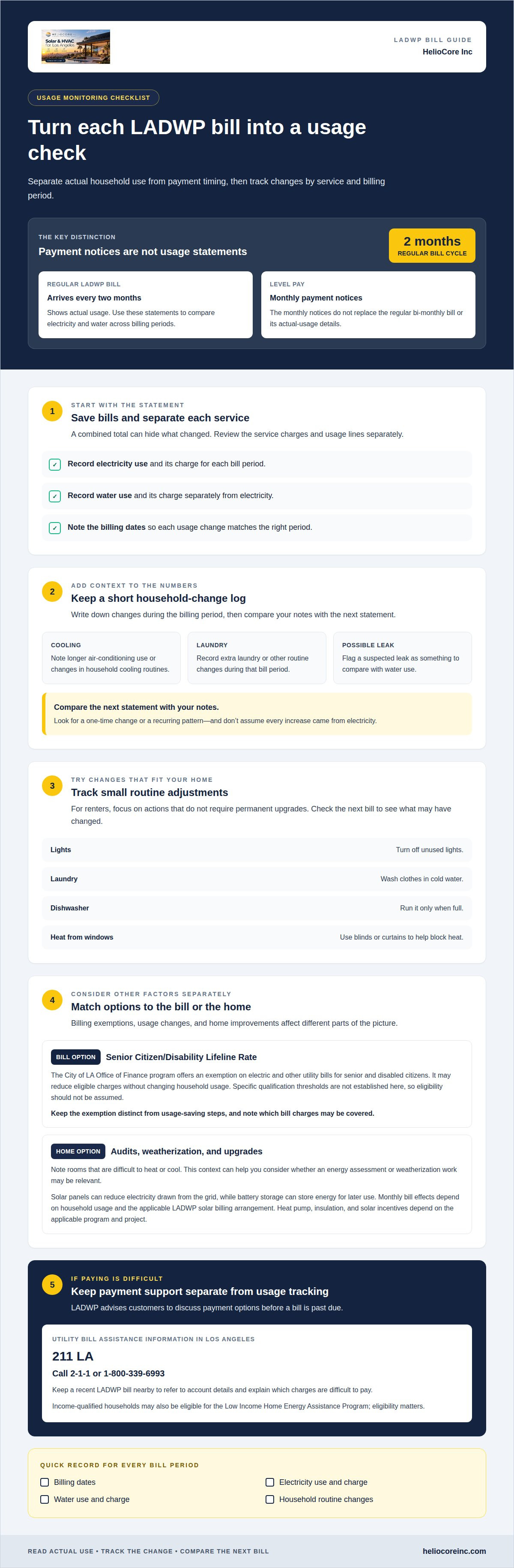
A practical starting point for how to lower my LADWP bill is to separate actual usage from payment timing. LADWP’s regular bill arrives every two months and shows actual usage. Level Pay customers receive monthly payment notices, but those notices don’t replace the bi-monthly bill. Compare electricity and water use across statements to see which service changed.
The example shows why it helps to review each service charge separately. A large combined bill may have several causes, so the total alone won’t show what changed.
Note the billing dates and usage amounts, then record household changes during each period. Longer air-conditioning use, extra laundry, or a suspected leak are worth noting. Compare these notes with the next statement to tell a one-time change from a recurring pattern, without assuming every increase comes from electricity.
Heat pump, insulation, and solar incentives depend on the applicable program and project.
No-cost energy audits or weatherization services are separate from bill monitoring. Note rooms that are difficult to heat or cool, along with changes in usage. These details can help you identify whether an energy assessment or weatherization work may be relevant.
Solar generation can reduce electricity drawn from the grid, while battery storage can store energy for later use. The effect on monthly bills depends on household usage and the applicable LADWP solar billing arrangement.
Renters can focus on changes that don’t require permanent upgrades. Turn off unused lights, wash clothes in cold water, and run the dishwasher only when full. Blinds or curtains can help block heat. If you rent and are wondering how to lower my LADWP bill, track usage alongside these small routine changes to see which actions suit your home.
- Save each bi-monthly bill and record electricity and water usage separately.
- Note changes in cooling, laundry, or possible leaks alongside the relevant billing period.
- Compare the next bill with your notes to see which service or routine may have changed.
Senior and disability Lifeline Rate
The City of LA Office of Finance’s Senior Citizen/Disability Lifeline Rate offers senior and disabled citizens an exemption on electric and other utility bills. For a household managing LADWP charges, the exemption may reduce eligible costs without changing how much electricity or water the home uses. It addresses the bill, while usage monitoring helps explain consumption.
Start by identifying the utility charges on a recent LADWP bill. Separate electricity from water and other listed services, then note which charges the Lifeline Rate may cover. This matters because a lower eligible charge does not necessarily change every line on a combined bill.
The program is aimed at senior and disabled citizens. Specific age, income, or documentation thresholds are not established here, so don’t assume a household qualifies based on one circumstance alone. Treat the Lifeline Rate as a potential billing exemption, not a guaranteed reduction for every account.
- Locate the electricity and other utility charges on the LADWP bill.
- Record the bill period and total so you can compare later statements.
- Keep the Lifeline Rate separate from usage-saving steps, such as reducing unnecessary electricity use.
For example, if a household’s electricity charge changes while its water charge stays similar, record the amounts separately. This makes it easier to see which part of the bill shifts after an exemption or a change in consumption. A combined total can hide the difference.
For households considering the Senior Citizen/Disability Lifeline Rate, a useful next step is to understand how the exemption relates to account charges. Review the bill’s service categories and note changes between statements. Keep comparing bills the same way even if usage habits also change, so billing adjustments and consumption changes don’t blur together.
The Lifeline Rate and regular usage monitoring serve different purposes. The City of LA Office of Finance program offers an exemption on electric and other utility bills for senior and disabled citizens. Tracking LADWP charges shows how actual household use changes over time. Considering both can help households determine whether a bill change reflects an exemption, a usage shift, or both.
Households may also want to distinguish the bill exemption from other assistance opportunities. This is a separate possibility tied to purchasing a used electric vehicle, so keep information about it apart from monthly LADWP bill comparisons. Customers enrolled in a qualifying discount program are eligible for a special discounted shared solar rate. That rate is distinct from the Senior Citizen/Disability Lifeline Rate exemption. When reviewing options, note whether a household is enrolled in EZ-SAVE or Lifeline and whether it is enrolled in a qualifying discount program. Keeping these categories separate helps clarify what each option relates to, without assuming that one enrollment guarantees another benefit.
How do I apply for LADWP payment assistance or a payment arrangement?
If an LADWP bill is becoming difficult to manage, contact the utility before the account becomes delinquent. LADWP advises customers to discuss payment options before a bill is past due. Reaching out early gives you a chance to explain the situation and ask what options may fit.
For help locating utility bill assistance in Los Angeles, call 211 LA at 2-1-1 or 1-800-339-6993. These numbers connect customers with information about available help. Keep your recent LADWP bill nearby so you can refer to the account details and explain which charges are difficult to pay.
Income-qualified households may also be eligible for the Low Income Home Energy Assistance Program. Eligibility matters, so distinguish this assistance from an LADWP payment arrangement: one helps with the bill, while the other is a way to discuss paying the utility account.
Before contacting LADWP or 211 LA, make a short record of the amount due, the bill’s due date, and what you can manage. Be clear about whether you need help with an existing balance or upcoming bills. This preparation keeps the conversation focused and helps you describe the problem without confusing current charges with older amounts.
Level Pay has a separate payment rule. Customers must pay the full scheduled Level Pay amount each month by the due date shown on the payment notice. A monthly notice does not replace the regular bill, which shows actual usage. If a customer is removed from Level Pay for failure to pay, they cannot re-enroll for 180 days.
Early communication is especially useful if a scheduled payment may be missed. Contact LADWP before the bill becomes delinquent rather than assuming a partial payment will preserve Level Pay enrollment. Ask about payment options for the account, and record the next due date and amount discussed.
- Contact LADWP before the bill becomes delinquent to discuss payment options.
- Call 211 LA at 2-1-1 or 1-800-339-6993 to find utility bill assistance.
- Ask about LIHEAP if your household is income-qualified and needs help with electricity bills.
- Track Level Pay’s full scheduled amount and payment due date to avoid removal.
Payment assistance and arrangements address a bill’s affordability or timing; they don’t reduce household energy use. Keep these steps separate from usage changes so you can seek account support while also identifying what drives future charges.
What are LADWP’s current residential electricity rates and time-of-use plans?
LADWP electric rates increased 7% from the previous year. That change describes rates, not necessarily each household’s total bill. Your electricity costs also depend on how much power you use and, on a time-of-use plan, when you use it. Separate the rate change from changes in household consumption when reviewing a bill.
Start with the electricity section of your LADWP bill. Identify the rate plan and billing period, then compare electricity use and charges with another bill for a similar period. Seasonal air-conditioning or heating can change consumption, so compare similar periods where possible instead of treating every difference as a rate change.
On a time-of-use plan, when you use electricity affects charges. The applicable time periods and rates determine whether shifting a task could help. Use the time information on your LADWP bill or plan materials to identify those periods. Don’t assume every hour has the same charge.
- Find the rate plan and electricity charges on your LADWP bill.
- Compare electricity use across billing periods, noting changes in household routines.
- Check which time periods apply to your plan before shifting appliance use.
- Review the next bill to see whether usage patterns or charges changed.
A useful comparison separates three factors: electricity consumed, when it was consumed, and the resulting charge. For example, if electricity use rises during a period with higher time-of-use charges, both factors may contribute. If use stays similar but charges change, review the rate information and the dates covered by each bill.
LADWP’s 7% rate increase from the previous year makes this distinction especially useful. It does not mean every household’s total electricity charge rose by that same amount. Different consumption patterns and time-of-use periods can produce different bill outcomes. Track the plan and usage together to understand what changed.
Rates and time-of-use charges differ from payment plans. Level Pay notices affect payment timing, while the regular LADWP bill shows actual usage. Keep the rate plan, electricity use, and payment notice separate when reviewing the account.
Before changing appliance schedules, identify when your home uses the most electricity. Laundry or dishwashing may be easier to reschedule than heating or cooling, which depends on comfort needs. Match flexible tasks to the lower-cost periods shown for your LADWP plan, then compare usage and charges on the next bill.
How can I shift electricity use to reduce LADWP time-of-use charges?
On a time-of-use plan, when electricity is used can affect charges. LADWP customers can shift flexible tasks to early morning or later evening, when the page recommends running heavy household appliances. Check your plan’s time periods first, then schedule tasks during the lower-cost periods it identifies.
Start with appliances that don’t need to run at a fixed time. A full dishwasher, laundry load, or other heavy task can often wait until early morning or later evening. Shift one task first, then see how the new schedule fits your household routine.
Cooling can also affect when electricity is used. The page recommends ventilating a home in the late evening by opening windows and doors. If outdoor conditions allow, this can help release stored indoor heat before the next day. Close windows when needed for household comfort and safety.
During summer, the page recommends setting the thermostat to 78 degrees while at home. Ceiling fans can help cool a room while allowing the thermostat to be raised a few degrees. Use fans in occupied rooms, and turn them off when you leave. Fans cool people, not empty rooms.
Try a simple schedule:
- Identify flexible appliances and choose an early-morning or later-evening run time.
- Run the dishwasher when full, and let dishes air dry instead of using heated dry.
- Wash clothes in cold water, then shift the laundry cycle to a suitable time.
- Ventilate in the late evening when conditions make open windows comfortable.
- Compare the next LADWP bill’s electricity use with the prior period.
Don’t shift every task at once. Changing one thing, such as delaying a dishwasher cycle, makes it easier to see whether the routine works. Note the appliance, when you used it, and any changes in household comfort. This helps distinguish a scheduling change from increased cooling or other use.
Some electricity use is difficult to shift. Heating, cooling, cooking, and household schedules depend on comfort and daily needs. Focus on flexible tasks first, then use the time periods shown for your LADWP plan to guide other adjustments.
For a home-wide efficiency plan, explore options for improving household energy use alongside your time-of-use schedule.
Other small adjustments can reduce electricity use between scheduled appliance runs. The page recommends unplugging non-essential appliances and electronics when they are fully charged and not in use. An advanced power strip or smart plug can automatically turn off idle electronics, helping avoid leaving devices on unnecessarily. Reducing screen brightness by 30 can also help conserve energy; apply the change on screens used regularly and adjust it to a comfortable level.
For electricity, focus on flexible uses in your home and keep the schedule manageable enough to fit daily routines.
HelioCore Inc
HelioCore Inc helps Los Angeles homeowners consider home energy improvements when bill reviews point to high electricity use. High-efficiency solar panels, battery storage, HVAC, and air conditioning may be relevant depending on what drives consumption and when energy is used. These upgrades don’t replace checking LADWP rates, pursuing eligible assistance, or shifting flexible appliance use. They can be part of a broader home energy plan.
If your bills point to cooling, heating, or grid electricity use as areas to investigate, HelioCore Inc can help you explore suitable home improvements. Contact HelioCore Inc to discuss your home’s energy needs.
Make your next energy decision with confidence
If you’re considering how to lower your LADWP bill, let your household’s priorities guide the next decision. A home that overheats may need a different approach from one with consistently high electricity use. Start with a change that fits your routine, comfort, and longer-term plans. One manageable step is easier to assess than several changes made at once.
Keep your goal practical: make the home more comfortable, improve energy predictability, or explore a broader upgrade. HelioCore can help you consider options suited to your home and energy needs. The right path depends on what matters most to your household, not on making every possible change.
When you’re ready to discuss a next step, contact HelioCore to discuss your options. Move forward at a pace that feels right for your home.
Frequently Asked Questions
What LADWP income-qualified discounts and bill assistance programs are available?
Options include EZ-SAVE, the Senior Citizen/Disability Lifeline Rate, and discounts for households using eligible life-support equipment. For example, a household using a respirator or dialysis machine may want to look into the life-support discount, while another may qualify based on income.
How do I read an LADWP bill and check for estimated readings or billing errors?
Compare the service dates, usage figures, and charges on the bill with your previous statement. Look for a reading-status note, then compare current and prior meter readings if they appear. Check that the billing period matches the dates you expect and that the listed charges add up to the total. If a reading or charge seems inconsistent, note the specific line and contact LADWP about the discrepancy.
What are the eligibility rules, deadlines, and documents for LADWP assistance programs?
For EZ-SAVE, maximum annual gross income limits effective July 1, 2026, range from $43,280 for a household of 1 or 2 to $111,440 for a household of 8. Limits are $54,640 for 3 people, $66,000 for 4, $77,360 for 5, $88,720 for 6, and $100,080 for 7. Each additional member beyond 8 adds $11,360. Application deadlines and documents depend on the program.
How do LADWP solar net metering and battery programs affect monthly bills?
Solar generation can reduce electricity drawn from the grid, while battery storage can store energy for later use. The effect on monthly bills depends on household usage and the applicable LADWP solar billing arrangement.