
Solar
Ladwp nem: How Solar Export Credits Affect Your Bill
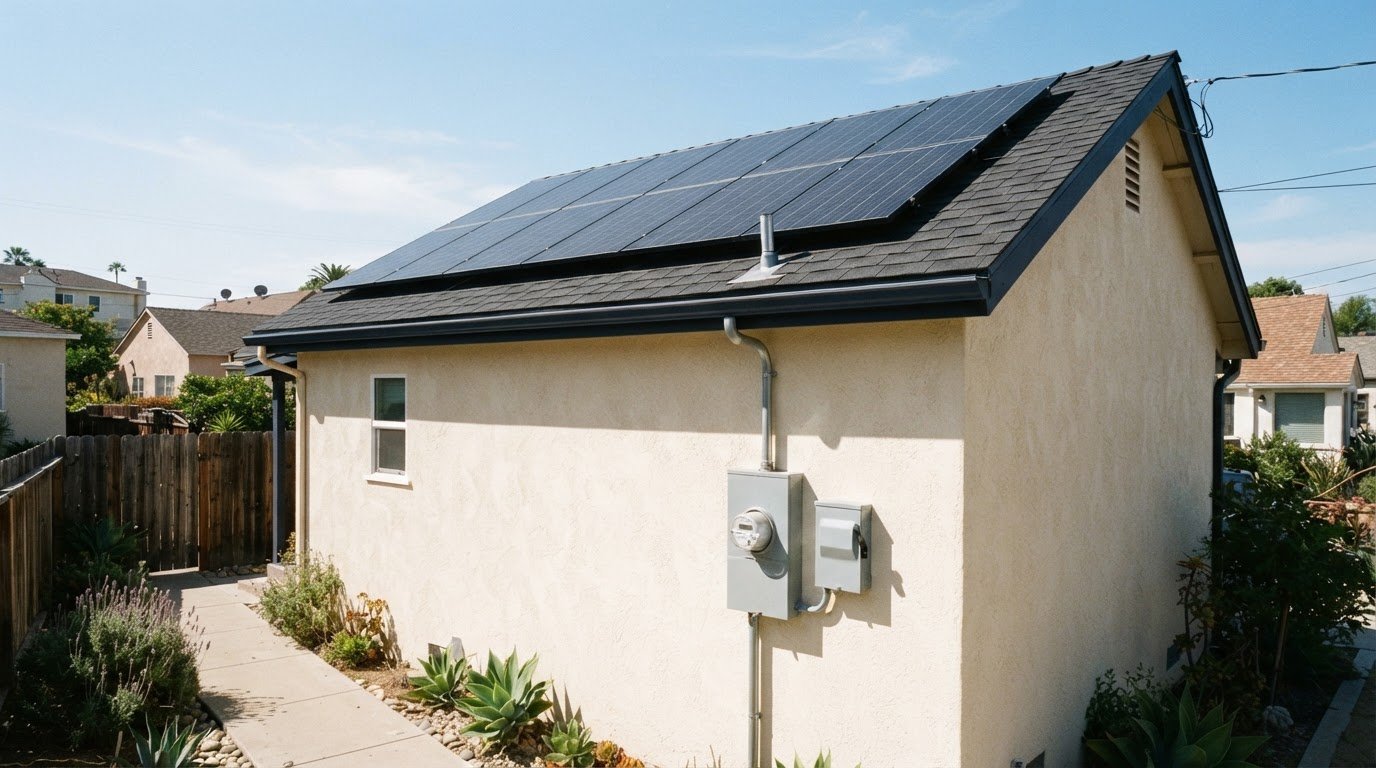
A solar-only system can still make financial sense under LADWP’s net energy metering rules. To understand LADWP NEM for homeowners, start with export credits: solar electricity sent to the grid earns credits against eligible energy charges. Those credits can lower the bill, but they do not cover taxes or minimum charges.
It’s reasonable to ask whether export credits make solar worthwhile without a battery. The answer depends on how much electricity your household uses, when you use it, and how your LADWP rate values the power you import and export.
This guide explains how solar exports affect your bill, how standard and time-of-use rates can change credit values, and what to consider when weighing a solar-only system. It also explains why a remaining bill does not necessarily mean your panels are not helping.
Key Takeaways
- Learn why a solar-only system can still make sense under LADWP’s export-credit rules, and what household usage has to do with the outcome.
- Understand how excess solar credits carry forward and why a credit balance may not erase every part of your bill.
- See how R-1A and R-1B charges differ, and why your rate schedule matters when estimating solar savings.
- Explore what LADWP’s interconnection program covers for residential solar projects and how it fits into connecting a system to the grid.
- Compare LADWP’s credit approach with California NEM 3.0 to understand why solar export value can vary by utility.
Table of Contents
Can a solar-only system still pay off on LADWP?
Yes, a solar-only system can still make financial sense under LADWP’s export-credit rules. LADWP NEM is best understood by looking at household use, rate schedules, and charges that credits cannot offset. A battery is optional, but the value of exported electricity depends on your LADWP rate and how much power your home uses.
Interconnection and System Eligibility
LADWP’s interconnection program connects eligible solar projects to its grid and sets requirements for operating them. It covers solar photovoltaics, battery energy storage, and cogeneration within the City of Los Angeles. Systems can qualify up to 1 MW AC when installed on the customer’s premises and built mainly to offset that customer’s electricity use.
Projects below 10 kW AC may qualify for a fast-tracked process when they need no service upgrade and include no battery. LADWP requires an interconnection agreement for systems or batteries over 10 kW, and uses a short-form agreement for systems or batteries up to 30 kW. These thresholds shape the approval path, not whether a battery is needed.
Solar Rooftops Payments and Eligibility
It differs from a homeowner-owned net-metered system: LADWP owns the solar equipment and receives all the electricity it generates.
That distinction matters when comparing program options. Solar Rooftops participants cannot enroll in net metering or directly use the program’s solar electricity to power their homes. Homeowners looking to offset their own household use should understand that this program works differently from a system designed for that purpose.
Export Credits and Carryover
Under LADWP net metering, exported solar electricity earns credits against eligible energy charges. The credit value depends on the customer’s rate schedule and applicable energy charge.
Credits carry forward indefinitely rather than expiring after an annual true-up, but they cannot offset taxes or minimum charges. Customers who end service with a remaining credit balance receive no compensation. If you move or close your electricity account, unused credits are not paid out as cash.
Rates, Fees, and Interconnection Costs
R-1A has a minimum charge of $10 per month that solar credits can’t offset. LADWP’s interconnection expenditure recovery fee is $130 for customers. These amounts help explain why bill savings depend on more than exported electricity alone.
Before installing, consider household consumption, rate structure, fixed charges, and contract terms together. A qualifying LADWP solar lease must run for at least 10 years and offer an ownership option by the lease’s end. A practical LADWP NEM explanation for homeowners should account for those factors, not just the projected export credits.
How does LADWP credit my solar exports?
LADWP runs its own net energy metering program as a municipal utility. It wasn’t bound by California’s NEM 3.0 Net Billing Tariff, which changed export-credit rules for investor-owned utilities. That distinction matters because LADWP customers follow LADWP’s credit values and program terms, not the same tariff used by California’s investor-owned utilities.
California law requires utilities to offer standard net energy metering contracts or tariffs on a first-come basis until participating generating capacity exceeds 5 percent of the utility’s aggregate customer peak demand, according to the California State Legislature. LADWP’s exemption is separate: California Public Utilities Code §2827(b)(3) exempts a municipal utility serving more than 750,000 customers that also delivers water. LADWP meets that description and operates its own net-metering program.
For eligible LADWP customers, net metering credits the account for solar electricity produced beyond household use. The program is available in Los Angeles and portions of Culver City, South Pasadena, and West Hollywood. This service area doesn’t cover every home in the surrounding region. The utility boundary matters because a nearby address may receive service from a different utility, with different export-credit rules.
LADWP also runs a Virtual Net Energy Metering pilot for eligible projects. At least 40 percent of proceeds must go to tenants. The pilot’s total capacity is 5 MW; LADWP listed 4.14 MW as available on January 5, 2026. These terms differ from household net metering because the pilot applies to qualifying shared projects and directs part of the proceeds to tenants.
Future changes depend on LADWP’s own program decisions, rather than automatic adoption of NEM 3.0. A change to export credits, eligibility, or a pilot would need to come through LADWP’s rules or program terms. The current separation is useful for planning: California’s investor-owned utility tariffs don’t by themselves set LADWP’s credit values. For a homeowner, the relevant details are the serving utility, the applicable LADWP program, and the project’s eligibility.
Export credit values under R-1A and R-1B
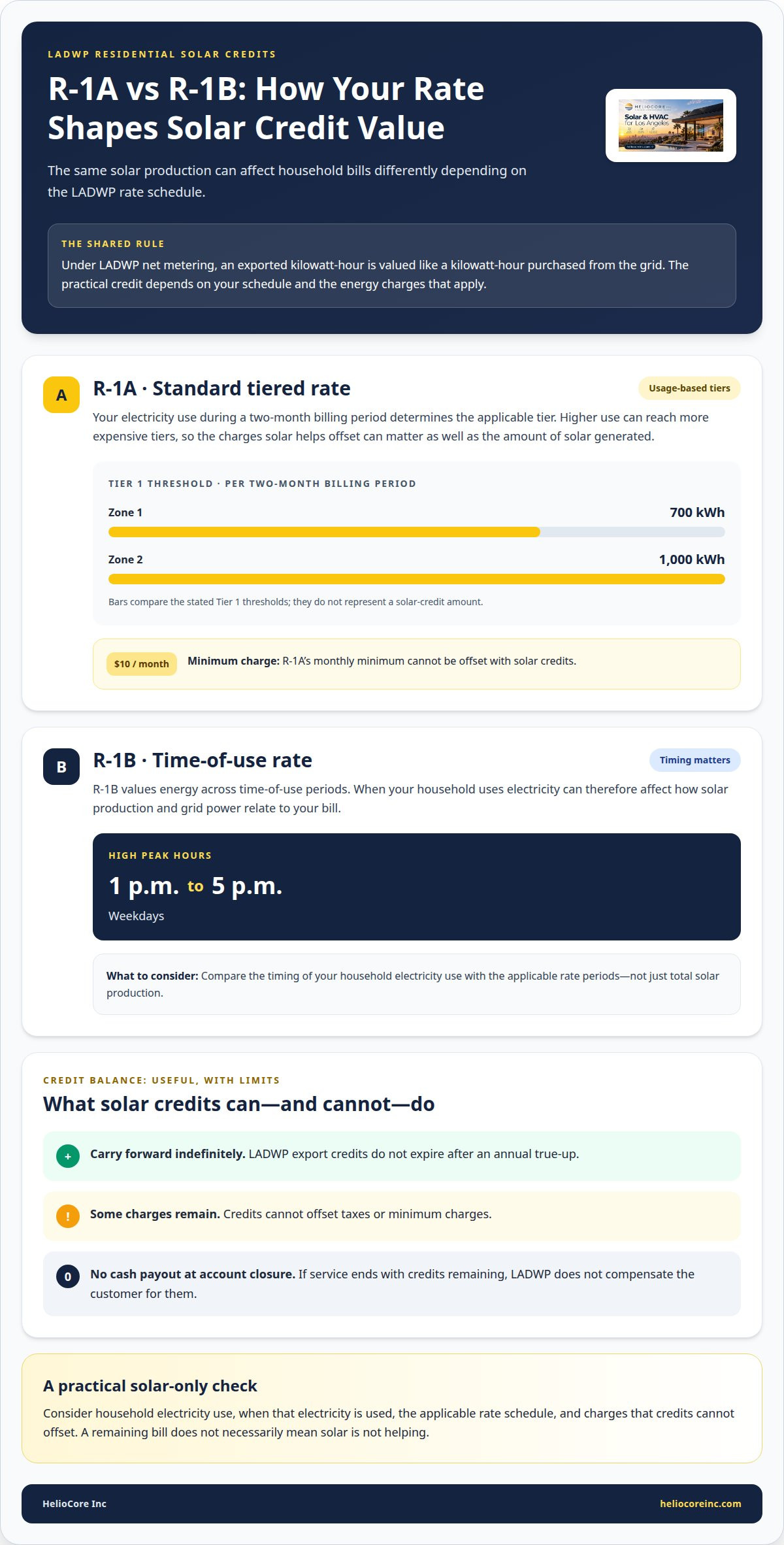
The Los Angeles Department of Water and Power applies its own residential rate schedules when valuing solar exports. Under LADWP net metering, an exported kilowatt-hour is valued like a kilowatt-hour purchased from the grid. The practical credit depends on the customer’s schedule and the energy charges that apply. R-1A uses a standard tiered structure, while R-1B uses time-of-use periods. That difference can change how the same solar production affects two household bills.
On R-1A, the amount of electricity used during a two-month billing period determines the applicable tier. Tier 1 covers the first 700 kWh in Zone 1, or the first 1,000 kWh in Zone 2. Higher use can reach more expensive tiers. As a result, the value of exported energy depends partly on the charges solar generation helps offset, not simply on the number of panels.
R-1B adds a time-of-use element. High Peak hours fall on weekdays from 1 p.m. to 5 p.m. This schedule makes the timing of household electricity use important: power used during that window is priced differently from power used outside it. Solar exports are credited within the applicable LADWP rate structure, so R-1B customers should consider their usage schedule alongside their solar production.
For example, a home on R-1A may use solar generation to reduce energy charges across its billing period, with tier placement affecting the value of the offset. A home on R-1B has a schedule that distinguishes weekday High Peak use from other periods. These examples show why comparing rate names alone won’t predict savings. The household’s zone, billing-period consumption, and rate schedule all matter. Taxes and minimum charges also remain outside the value of export credits, so a strong energy credit balance doesn’t necessarily remove every bill charge.
To compare R-1A and R-1B, focus on how each schedule prices the electricity the household uses and how exported solar power is credited under that schedule. R-1A’s tier thresholds and R-1B’s weekday High Peak window create different patterns. The best fit depends on the home’s actual use, not a general claim that one rate always produces higher solar savings.
LADWP standard and time-of-use rates
LADWP residential bills usually arrive every two months, with solar imports and exports netted across that billing period. The rate schedule shapes the energy charges that remain. R-1A is the standard residential option, with tiered energy pricing. R-1B is a time-of-use rate, so the timing of household consumption matters. For solar customers, the energy charges and fixed bill items together give a clearer picture than an export-credit total alone.
R-1A has a minimum charge of $10 per month that solar credits can’t offset. These charges are separate considerations when estimating a bill after solar credits. Even if solar production covers a home’s net energy use, the minimum charge and taxes remain outside the credits. A low energy balance, then, doesn’t automatically mean every bill item disappears.
Its time-of-use structure makes the timing of electricity use relevant to the bill. A household’s daytime and evening routines can affect how much energy it buys during different rate periods. The practical comparison is not simply the service charge against R-1A’s minimum charge. It also involves how the household’s consumption lines up with R-1B’s time-based pricing.
The example separates energy use from the full bill. Netting solar production against consumption can reduce energy charges, while the remaining balance reflects charges that credits do not erase. Read a credit balance alongside the bill’s other line items.
For a practical rate comparison, start with the household’s LADWP schedule and billing pattern. On R-1A, tiered pricing means total consumption during the billing period affects energy charges. On R-1B, time-based pricing makes the hours of consumption important. Then account for the applicable fixed charges and how credits apply to them. This gives a more grounded estimate than assuming either rate always produces greater solar savings.
Comparison with California NEM 3.0
LADWP solar customers follow a different export-credit framework from customers of California investor-owned utilities. LADWP is a municipal utility, so California’s NEM 3.0 Net Billing Tariff doesn’t set its residential export-credit rules. LADWP instead uses its own net energy metering program. The difference matters when estimating savings: the utility serving the home determines how exported solar electricity is valued.
In 2023, the California Public Utilities Commission shifted NEM pricing for California public utility companies from retail rates to avoided-cost rates. Under NEM 3.0, excess credits roll over for 12 months before an annual true-up. Export values also vary by hour, with 4-9 PM relevant to credit calculations. The result is a different calculation from LADWP’s retail-rate netting, where a kilowatt-hour exported is valued like one purchased.
The gap can be seen in 2026 export values. LADWP’s credit still depends on the customer’s rate schedule and applicable charges. The comparison isn’t a promise of a particular bill reduction; it shows why a California-wide NEM 3.0 estimate may not describe a Los Angeles household served by LADWP.
Timing matters more under NEM 3.0 because export compensation changes by hour. The 4-9 PM peak period can make stored solar energy more valuable for household use during those hours, rather than exporting it earlier. Under LADWP’s arrangement, the retail-rate netting approach can give exports a different bill impact. A battery may help a household use more of its own solar production, but the value depends on usage patterns and the applicable LADWP rate.
For a homeowner comparing the two systems, first identify the serving utility. Then distinguish the credit method: LADWP’s rate-based netting or NEM 3.0’s hourly avoided-cost credits and 12-month true-up. A solar estimate built around another California utility’s tariff can misstate LADWP export value. For a home served by LADWP, explore solar installation options using the household’s utility rate and expected consumption as the starting point.
HelioCore Inc
HelioCore Inc helps Los Angeles homeowners connect LADWP’s net-metering rules with a solar plan shaped around household use. If you’re weighing export credits, rate schedules, and whether battery storage suits your needs, a project review can help clarify the options.
HelioCore Inc manages the solar adoption process, from initial consultation and custom engineering through permitting, installation, inspections, and utility permission to operate. Homeowners can choose direct equipment ownership or solar leasing. The goal is to make the technical and utility steps clear while shaping a system around the home’s energy needs.
To discuss how solar could fit your LADWP account, contact HelioCore Inc about your project.
Make your next solar decision with confidence
Now that LADWP NEM has been explained for homeowners, connect the rules to your household’s priorities. Consider your daily energy habits, plans for the home, and whether backup power matters. These factors help shape a practical solar setup.
HelioCore Inc. can help you consider high-efficiency solar panels, battery storage, and HVAC as parts of your home’s energy needs. A focused discussion can turn utility details into a clearer plan for your property, whether you’re exploring solar or considering how storage might fit.
Contact HelioCore Inc. about solar savings to discuss a path that suits your home and priorities. A well-informed next step can make the decision feel simpler and more grounded.
Frequently Asked Questions
How does LADWP net metering work?
LADWP net metering tracks electricity your solar system sends to the grid and applies eligible credits to your utility account. If your panels produce more than your home uses during part of a billing period, the surplus can help offset electricity drawn later. Credits reduce eligible charges, not every bill item. Compare the bill’s energy balance with its remaining charges to understand the system’s effect.
Could LADWP change the rules?
Yes. LADWP operates its own net-metering program, so its program terms and credit values can change through LADWP decisions. California NEM 3.0 doesn’t automatically set LADWP’s rules. For a homeowner planning a future installation, the practical approach is to base system decisions on the applicable LADWP terms at that time, rather than assuming today’s credit structure will remain unchanged throughout the system’s life.
Does LADWP pay for extra solar at the end of the year?
No. LADWP solar export credits can roll over indefinitely, but they are not an annual cash payment. If you end LADWP service with unused credits, you receive no compensation for that balance. If you’re moving, remember that credits belong to the utility account. They are not money you can collect or take with you when service ends.
Does Los Angeles Department of Water & Power offer solar incentives?
Yes. The arrangement differs from installing a net-metered system for your own use: LADWP owns the solar equipment and receives the energy it generates. Participants cannot enroll in net metering or directly power their homes with that program’s solar energy.
Does NEM 3.0 apply to LADWP?
No. LADWP is a municipal utility with its own net-metering program, and California’s NEM 3.0 Net Billing Tariff doesn’t govern LADWP export credits. That distinction is useful when reviewing solar information for California: a tariff or estimate prepared for a home served by another utility may use different credit rules. Confirming which utility serves the property is the first step in understanding which framework applies.
How often does LADWP bill solar customers?
LADWP residential customers are usually billed every two months. Solar imports and exports are netted across the billing period, so the account reflects the combined electricity drawn from and sent to the grid. A sunny day or high-use evening alone does not show the full result. Review the complete period to understand household consumption and solar production together.
What is LADWP Net Energy Metering (NEM) and how does it work for homeowners?
LADWP Net Energy Metering is a billing arrangement for eligible customers with qualifying energy systems. It accounts for electricity exported to the grid and applies credits to the customer’s account. This differs from using solar power inside the home as it is generated: NEM addresses exported electricity on the utility bill. For homeowners, the key is how solar production and household use combine across billing periods.
Who is eligible for LADWP NEM, and what system requirements apply?
Eligible customers must be served within LADWP’s program area, which includes Los Angeles and portions of Culver City, South Pasadena, and West Hollywood. Solar systems can qualify up to 1 MW AC when located on the customer’s premises and built mainly to offset the customer’s electricity use. Interconnection requirements also depend on system size; for example, projects below 10 kW AC may qualify for a fast-tracked process under specific conditions.