
Solar
LADWP Net Metering Costs and Credits in Los Angeles
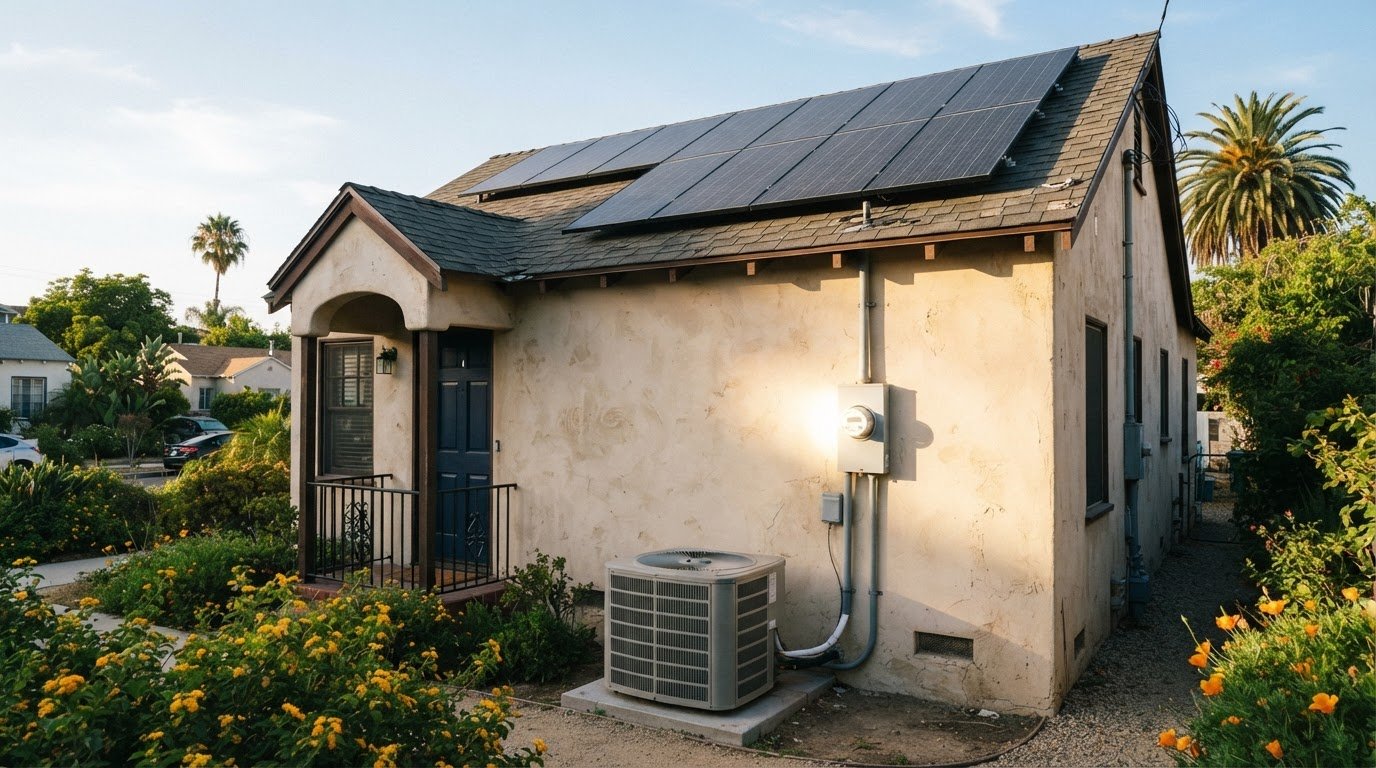
LADWP solar credits follow the city’s rules, not California’s NEM 3.0 framework. LADWP net metering, explained simply, measures electricity flowing both to and from your home, then nets imports and exports across the billing period. Most residential customers are billed every two months, and excess-energy credits are applied at the customer’s retail rate.
It’s easy to assume that every California solar customer earns credits the same way. But LADWP is a municipal utility with its own net metering program, so its credit rules differ from those used under NEM 3.0.
This guide breaks down how solar exports become bill credits, how R-1A and R-1B rates affect their value, and why credits may not erase every line on your bill. You’ll also see how minimum or fixed charges and taxes can remain, even when your solar system covers your electricity use. The goal is a clearer picture of what to expect before deciding how solar fits your home.
Key Takeaways
- LADWP runs its own municipal solar program, so California’s NEM 3.0 rules don’t set your export credits.
- Your R-1A or R-1B rate schedule affects how much exported solar power can offset electricity you use later.
- Solar credits may reduce energy charges, but minimum or fixed charges and taxes can still appear on your bill.
- Check how your service rate, solar system capacity, and meter setup affect eligibility for LADWP net metering.
- Understanding your household’s usage and rate schedule can help you assess whether solar panels or battery storage fit your energy goals.
Table of Contents
How LADWP net metering works
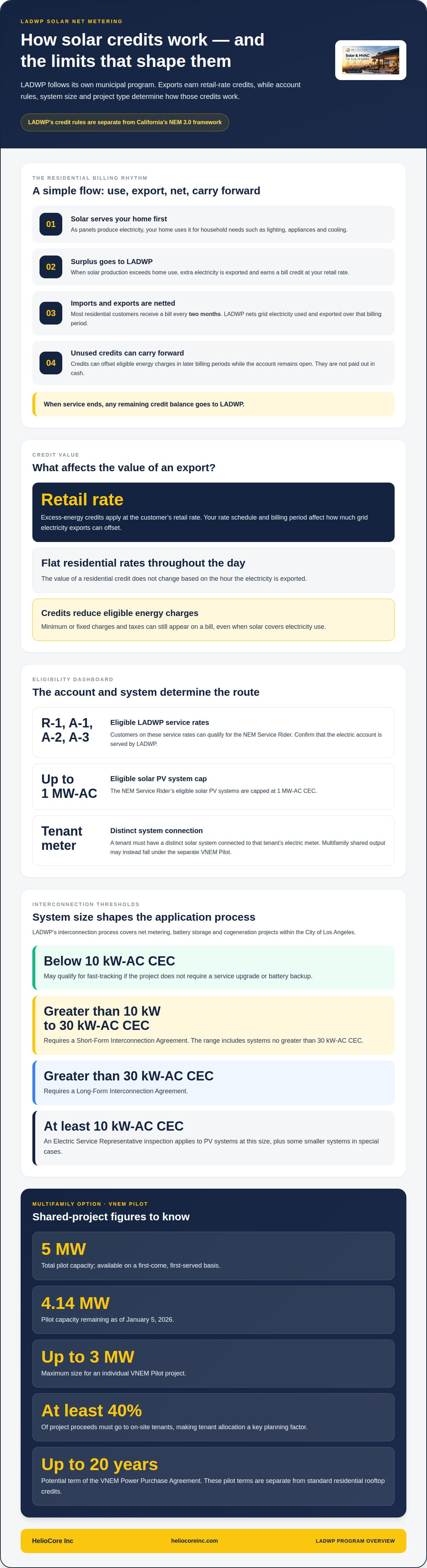
LADWP net energy metering tracks electricity flowing in both directions: from the grid to your home and from your solar system to the grid. Your panels serve household needs first, including lighting, appliances, and cooling. When they produce more electricity than your home is using, the surplus flows to LADWP and earns a bill credit. When production falls short, you draw electricity from the grid. In simple terms, LADWP net metering explained means use solar power first, export surplus, then draw from the grid as needed.
Most LADWP residential customers receive bills every two months. Imports and exports are netted over that billing period, and excess-energy credits apply at the customer’s retail rate. Residential rates are flat throughout the day, so the value of a credit does not change based on the hour you export electricity. Your billing period and rate schedule determine how much grid electricity your exports can offset. Looking at household energy flows makes LADWP net metering easier to understand than focusing on total panel production alone.
Credits do not expire while your account remains open. They can carry forward to offset eligible energy charges in a later billing period. If you end service, however, any remaining credit balance goes to LADWP. If you are moving, factor your account-closing date into your plans. Unused credits are not paid out in cash when the account closes.
Rooftop solar in Los Angeles must pass through LADWP’s interconnection process, which covers net metering, battery storage, and cogeneration projects within the City of Los Angeles. Systems greater than 10 kW use LADWP’s standard solar interconnection process. Solar PV systems greater than 10 kW-AC CEC and no greater than 30 kW-AC CEC require a Short-Form Interconnection Agreement. Systems greater than 30 kW-AC CEC require a Long-Form Agreement. An Electric Service Representative inspection applies to PV systems at least 10 kW-AC CEC, plus some smaller systems in special cases.
Smaller projects can follow a different process. Solar projects below 10 kW-AC CEC that don’t require a service upgrade or battery backup may qualify for fast-tracking. System size and the need for an upgrade or battery can affect the utility steps. These interconnection requirements describe LADWP’s process, not the full list of city building permits.
Keep these steps in mind to understand how bill credits work:
- Your home uses solar electricity as the system produces it.
- Extra generation exports to LADWP and earns credits at your retail rate.
- LADWP nets imports and exports across the usual two-month residential billing period.
- Leftover credits may carry forward, but a balance is surrendered when service ends.
LADWP’s municipal net metering program
LADWP operates a municipal net metering program for eligible residential and commercial customers in its service territory. Its rules are separate from California’s investor-owned utility NEM 3.0 framework.
Program Eligibility
Start with the electric account and system connection. Customers on LADWP service rates R-1, A-1, A-2, and A-3 can qualify for the NEM Service Rider, with eligible solar PV systems capped at 1 MW-AC CEC. A tenant must have a distinct solar system connected to that tenant’s electric meter. For multifamily buildings, distinguish individual-meter net metering from LADWP’s separate Virtual Net Energy Metering Pilot.
Interconnection and Net Metering Application
For projects within the City of Los Angeles, apply through LADWP’s interconnection process. The application route depends on system capacity and project type. LADWP’s program covers net metering, battery storage, and cogeneration. Before applying, identify the account’s service rate, the solar PV system’s capacity, and whether the project is a standard rooftop installation or a multifamily shared project. These details determine which requirements apply.
The municipal distinction matters because California Public Utilities Code §2827(b)(3) exempts a municipal utility serving more than 750,000 customers that also delivers water from that statute’s net-metering requirements. LADWP is therefore outside CPUC jurisdiction for NEM 3.0. Its net-metering rider has an effective date of September 1, 2008. This is why California’s NEM 3.0 export-credit framework does not set LADWP customer credits.
LADWP’s territory includes the City of Los Angeles and parts of Bishop, Culver City, South Pasadena, and West Hollywood. Check that the electric account belongs to LADWP before planning around this program. California has six investor-owned utilities and about 50 publicly owned utilities, including LADWP, so utility identity can change the rules that apply even within the same state.
Multifamily properties may also consider the VNEM Pilot, which handles shared project output differently from a home’s individual net-metering account. The pilot’s total capacity is 5 MW, available first-come, first-served; 4.14 MW remained available as of January 5, 2026. Individual projects can reach 3 MW. At least 40% of project proceeds must go to on-site tenants, making tenant allocation a key planning step.
The VNEM Power Purchase Agreement can run for up to twenty years. These terms apply to the pilot, not to standard residential rooftop credits.
For a home project, match the electric account, rate schedule, system capacity, and interconnection application. For a multifamily property, also review tenant distribution and pilot capacity. Clear project planning can make solar panel installation planning easier to coordinate with LADWP’s requirements.
Minimum charges, fixed charges, and taxes
Solar credits reduce eligible energy charges, but they do not remove every item on an LADWP bill. The Los Angeles Department of Water and Power lists electricity costs separately from minimum or fixed charges and taxes. So even when your panels cover your net electricity use, your bill may still include charges that credits cannot offset.
The main limitation is that you may still owe a balance after solar credits cover your energy use. LADWP net metering credits cannot offset taxes or charges unrelated to energy. A battery can store solar electricity for your household to use later, but stored power does not remove those bill items.
The R-1B residential rate instead has a $12 monthly service charge and no minimum charge. These are different rate structures, so don’t treat the R-1B service charge as an additional minimum charge. The applicable schedule determines which fixed charge appears.
LADWP sets this charge each October 1 based on the customer’s highest month of the preceding year. Because the charge uses past usage, reducing current imports with solar does not necessarily eliminate it. Check the charge alongside energy credits when reviewing a bill.
LADWP’s example shows how charges can remain after solar credits offset net electricity use. The practical takeaway: zero net power use does not mean a zero-dollar bill.
To understand the balance, separate your bill into three parts:
- Energy: electricity charges that solar credits can reduce.
- Fixed or minimum charges: amounts set by the residential rate structure.
- Taxes: charges that net metering credits cannot offset.
For a homeowner comparing bills, read the rate name first, then identify the energy-credit balance, fixed charge, and tax line. An R-1A bill may include the minimum charge and Power Access Charge; an R-1B bill has its monthly service charge. This side-by-side review shows whether the remaining balance comes from electricity use or non-energy items, rather than from a failure of the solar credits.
How R-1A and R-1B rates treat credits
LADWP’s residential rate schedule determines how exported solar power offsets electricity charges. R-1A uses tiered energy pricing, while R-1B distinguishes usage by time period. The Los Angeles Department of Water and Power applies export credits at the applicable retail rate, so the same exported kilowatt-hour can offset different amounts under different schedules.
For R-1A customers, the credit’s value depends on the energy tier and season. A two-month R-1A bill’s Tier 1 covers the first 700 kWh in Zone 1 or 1,000 kWh in Zone 2. Your household’s usage and zone therefore affect which tier an export offsets.
R-1B uses time periods instead of R-1A’s tier structure. Its High Peak hours are weekdays from 1 p.m. to 5 p.m. During summer 2026, one High Peak exported kWh can offset 1.32 kWh purchased at night. That makes the timing of household use important when comparing R-1B with R-1A.
R-1B’s High Peak hours differ from the 4-9 p.m. period identified in NEM 3.0 export-credit calculations. LADWP’s residential rates are flat throughout the day in the general residential rate structure, but R-1B has defined time periods. Don’t assume California’s NEM 3.0 hourly credit pattern applies to an LADWP account. The utility and specific rate schedule determine the calculation.
Most residential customers receive bills covering two months, with imports and exports netted across the billing period. Excess credits can carry forward without expiring while the account remains open. If you end service, any remaining balance goes to LADWP rather than being paid out in cash.
Compare the rate schedule against your actual pattern: daytime exports, weekday afternoon production, evening use, and overnight consumption. Also consider the R-1B switching rule: a customer who moves to R-1A cannot return to R-1B for 12 months. That commitment belongs in the rate decision before making a change. Solar interconnection establishes the system’s connection, but the rate schedule determines how exported energy is credited.
Who is eligible for LADWP net metering?
Eligibility depends on the electric utility serving the property, the service rate, and the solar system’s capacity. LADWP offers net metering to residential and commercial customers across its service territory, including the City of Los Angeles and parts of Bishop, Culver City, South Pasadena, and West Hollywood. A property’s location alone does not establish eligibility: its electric account must be served by LADWP.
For the NEM Service Rider, eligible service rates are R-1, A-1, A-2, and A-3. The solar PV system must have capacity no greater than 1 MW-AC CEC. Check the account’s rate schedule and the system’s rated capacity together. A project that meets one condition but not the other does not meet both listed eligibility criteria.
Tenants may also qualify, but the solar system must connect to the tenant’s own electric meter and be electrically distinct from other solar PV systems. For example, panels serving a shared building meter do not meet this tenant-specific connection criterion. A multifamily project serving several apartments may need a different arrangement, such as LADWP’s Virtual Net Energy Metering Pilot.
Use this practical sequence to assess the basic fit:
- Confirm LADWP serves the property’s electric account.
- Identify whether the account uses R-1, A-1, A-2, or A-3 service.
- Compare the solar PV system capacity with the 1 MW-AC CEC limit.
- For a tenant account, verify the distinct system connects to that tenant’s meter.
System capacity also influences the interconnection paperwork and inspection process. LADWP requires a Short-Form Interconnection Agreement for solar PV or energy storage greater than 10 kW-AC CEC and no greater than 30 kW-AC CEC. Systems greater than 30 kW-AC CEC require a Long-Form Interconnection Agreement. An Electric Service Representative inspection applies to solar PV systems at least 10 kW-AC CEC, plus some smaller systems in special cases. These steps are separate from checking the rate and account criteria.
For a household, eligibility review starts by matching the LADWP account and service rate to the proposed system design. For tenants, the meter connection is another key detail. For multifamily properties, distinguish individual net metering from shared-energy arrangements before choosing an application path.
Once you know which eligibility conditions apply, plan your solar panel installation around the account, meter, and system capacity.
HelioCore: High-Efficiency Solar Panels
HelioCore Inc. helps Los Angeles homeowners turn LADWP’s rules into a practical solar plan. Once you understand your rate schedule, export credits, and remaining bill charges, the next step is designing a system around your home’s energy use. HelioCore Inc. provides high-efficiency solar panels and installation, managing consultation, custom engineering, permitting, installation, inspections, and utility permission to operate.
Homeowners can choose direct equipment ownership or a solar lease. Battery storage may also suit households that want to store solar power for later use. The right setup depends on your home, energy use, and goals, not on credits alone.
Contact HelioCore Inc. to discuss solar for your home.
Plan Your Next Energy Step
Start your solar decision with your household priorities, not a panel count. Decide what you want to address first: electricity costs, backup power, or home comfort. Then use your LADWP account details and energy goals to shape a plan that fits your property.
Understanding LADWP net metering in practical terms can make your next decision clearer. HelioCore helps homeowners consider high-efficiency solar panels, battery storage, and HVAC needs as part of home energy planning. Your next step might be a solar consultation, a battery discussion, or a closer look at home comfort.
Contact HelioCore about solar to discuss an approach for your home. A clear plan can make the path ahead feel more manageable.
Frequently Asked Questions
How does LADWP net metering work?
LADWP tracks the electricity your home takes from the grid and sends back after using solar power. Your panels serve household needs first, and surplus generation earns a bill credit. If your home uses more electricity than your panels produce, you draw the difference from LADWP. The billing calculation accounts for these grid exchanges rather than treating all panel production as exported electricity.
Does LADWP offer other solar incentives?
LADWP is not currently offering rebates or other incentives for new solar customers. Separate programs serve specific purposes: Solar Rooftops aims to expand access for qualified residents who might otherwise face installation costs, while LADWP’s Self-Generation Incentive Program provides financial incentives to qualified residential customers installing solar and battery storage. These programs are separate from standard rooftop net metering, not universal solar rebates.
Can a solar-only system still pay off on LADWP?
Yes. A solar-only system can still be worth evaluating under LADWP’s credit structure. Exported energy earns credits at the customer’s retail rate, and an LADWP solar installation does not necessarily require a battery. To assess the household economics, compare your electricity use and rate schedule with expected system production, then account for charges that credits cannot offset.
Could LADWP change the rules?
Yes. LADWP’s municipal program is separate from the CPUC rules used by investor-owned utilities, so a change to California’s NEM 3.0 framework doesn’t automatically revise LADWP’s terms. LADWP can revise its own program or rate schedules. For planning, keep the utility’s interconnection requirements and your residential rate schedule in view as distinct parts of the solar decision.
Does LADWP pay for extra solar at the end of the year?
No. Excess solar earns credits on your LADWP account rather than an annual cash payment. Unused credits can carry forward without expiring while your account remains open. If you close the account or end service, any remaining balance goes to LADWP. Credits can offset eligible energy charges later, but they are not paid out at the end of the year.
How does LADWP credit my solar exports?
LADWP applies export credits according to the customer’s residential rate schedule. For an R-1A account, the energy tier and season affect the value; R-1B uses defined time periods, including weekday High Peak hours. The credit reduces eligible electricity charges on the account. It doesn’t apply to taxes or charges unrelated to energy, so exported power won’t necessarily erase every bill line.
How often does LADWP bill solar customers?
Most LADWP residential customers receive a bill every two months. Imports and exports are netted across that billing period, so the statement reflects the full interval rather than a separate monthly settlement. When comparing your bill with solar production records, use the statement’s start and end dates. Calendar-month totals may cover different dates from your LADWP billing cycle.
What is LADWP net metering and how does it work?
Net metering is LADWP’s method for accounting for electricity flowing between your solar system, home, and the utility grid. Solar power used immediately at home reduces the electricity drawn from the grid; surplus generation is exported and earns account credits. The bill reflects electricity exchanged with LADWP under your rate schedule, not total panel production alone.