
Solar
Ladwp Solar and Battery Program 2026 for Los Angeles Homes
For homeowners weighing the LADWP solar and battery program in 2026, a battery isn’t automatically the better choice just because solar credits differ from those at investor-owned utilities. LADWP solar exports are estimated at roughly 28¢ per kWh, near the full retail rate, while the income-qualified Residential Solar and Storage Equity pathway offers incentives for both solar and battery storage. That pathway was waitlisted as of October 2, 2026.
It makes sense to consider how your household uses electricity, whether you meet the income rules, and what a waitlist could mean for your plans. A battery may suit an eligible household, but incentive rules and export credits matter more than a simple “solar plus storage” rule of thumb.
This guide explains how LADWP credits solar exports, what the equity incentive pays, who may qualify, and how funding limits and application steps affect timing. You’ll get a clearer basis for comparing solar alone with solar and storage for your home.
Key Takeaways
- Learn how LADWP’s solar credit rules differ from those used by California’s investor-owned utilities, and what that means when comparing solar-only and battery-equipped systems.
- See how limited incentive funding and waitlists can affect application timing and why a rebate should not be treated as guaranteed savings.
- Understand the steps involved in applying, including how an installer can support system selection, installation, and paperwork.
- Explore the income-qualified Residential Solar and Storage Equity pathway and the household or property criteria that shape eligibility.
- Use your electricity use, program fit, and funding status to decide what to consider before moving forward with a home solar project.
Table of Contents
Electricity bill savings and rising rates
Solar savings depend on how much electricity your panels serve at home and how the utility credits exports. LADWP estimates residential electricity rates at about 28¢ per kWh in 2026. Its estimated solar export credit is also roughly 28¢ per kWh, close to the full retail rate. LADWP nets exported electricity against electricity drawn during each billing period, usually two months.
That structure differs from California’s Net Billing Tariff, also called NEM 3.0 or the Solar Billing Plan. NEM 3.0 applies to Southern California Edison (SCE), PG&E, and SDG&E, not LADWP. SCE off-peak solar export credits are often estimated at 5-8¢ per kWh. For an SCE customer, using solar power at home or storing it can matter more than exporting it during lower-credit periods.
Time-of-Use (TOU) rates add another layer. SCE’s daily peak window is 4-9 PM, when electricity use may cost more than during off-peak hours. A battery can store solar electricity for later household use, including evening demand. LADWP battery systems must respond to discharge signals during peak-demand windows, typically 4 p.m. to 9 p.m. on high-demand days. Compare your utility’s rate schedule with your household’s usage before weighing storage.
Multifamily residents may also consider LADWP Shared Solar. It lets residential customers in multifamily dwellings fix a portion of their electric bill for 10 years. This is a subscription option, not the same arrangement as rooftop panels serving one home.
LADWP rates have risen roughly 4-6% annually in recent years. That makes future utility costs part of a solar decision, alongside current credits and household consumption. Review 12 months of electric bills to see seasonal use and identify when demand is highest. Then compare the value of solar credits with the electricity you can use directly.
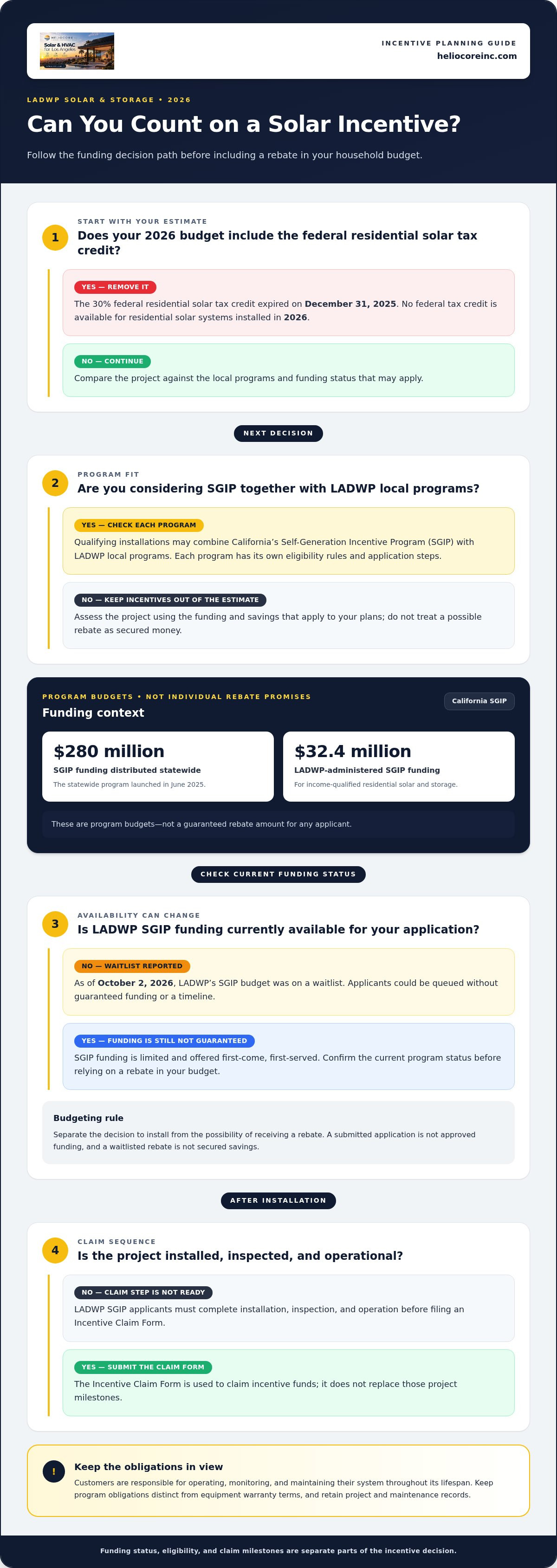
Federal incentives also affect the calculation. According to the Internal Revenue Service, the 30% federal residential solar tax credit expired on December 31, 2025, and no federal tax credit is available for residential solar systems installed in 2026. Build a savings estimate around the credits and programs that apply, rather than including that expired tax credit.
Funding availability and waitlists
Yes, qualifying installations may combine California’s Self-Generation Incentive Program (SGIP) with LADWP local programs. No federal residential solar tax credit is available for systems installed in 2026, so don’t include it in a funding estimate.
Funding exists, but availability depends on the program and its current budget. California’s SGIP launched in June 2025 and distributes $280 million statewide. LADWP administers $32.4 million in SGIP funding for income-qualified residential solar and storage. These figures describe program budgets, not a promised rebate for each applicant.
Timing is the key constraint. LADWP states that SGIP funding is limited and offered first-come, first-served, and rebates aren’t guaranteed. As of October 2, 2026, LADWP’s SGIP budget was on a waitlist. Applicants could be queued without guaranteed funding or a timeline. A submitted application therefore shouldn’t be treated as approved funding or money available by a particular date.
Waitlist status also matters when planning your household budget. Separate the decision to install a project from the possibility of receiving a rebate: consider whether the system works for your home without assuming incentive funds will arrive. Review current program status before relying on a rebate in your budget. California’s SGIP may be available alongside LADWP local programs for qualifying installations, but each program has its own eligibility rules and application steps.
There are also requirements after installation. LADWP SGIP applicants must have the project installed, inspected, and operational before filing an Incentive Claim Form. This form is used to claim incentive funds; it does not replace those project milestones. Customers are responsible for operating, monitoring, and maintaining their system throughout its lifespan. Keep program obligations separate from equipment warranty terms, and retain project and maintenance records.
When weighing program funding against long-term energy use, focus on confirmed funding status, eligibility, and the claim sequence. You can include a waitlisted rebate in an estimate, but don’t treat it as secured savings. This helps clarify what your household can fund now and what depends on program availability.
Mapping those funding steps alongside system choices can make the decision easier. Explore solar project planning as you compare the project timeline with program requirements.
Applying through approved solar developers
For Los Angeles homeowners, an SGIP application involves more than choosing a solar system. LADWP recommends finding an installer who can help select technology, complete installation, and assist with the application. Customers may also apply directly through the SGIP Online Application Database. Both routes require applicants to understand the program steps and the proposed system.
LADWP also recommends getting at least three quotes from certified solar contractors. Compare what each quote includes, such as equipment, system design, installation work, and application support. Look beyond the headline estimate: clarify which tasks the contractor handles and which remain with you, including utility paperwork and program documents.
Keep the incentive application separate from LADWP’s interconnection process. The utility’s Interconnection Request is the starting point for NEM solar, battery energy storage, and cogeneration projects. That request concerns connecting the installation to LADWP’s grid. SGIP paperwork concerns program eligibility and incentive claims. A solar system with battery storage may involve both tracks, so owners should keep each application’s status and required documents organized.
A practical sequence for homeowners is:
- Gather electric bills and identify the home’s energy needs before discussing system options.
- Request at least three quotes from certified solar contractors, as LADWP recommends.
- Compare the technology, installation scope, and application assistance described in each quote.
- Track the SGIP application separately from the LADWP Interconnection Request.
For LADWP customers, it’s important to know who handles each step. Ask the installer what support they provide with technology selection, installation, and the SGIP application. Then establish who submits the Interconnection Request and tracks its status. Keeping utility connection tasks separate from incentive paperwork can help prevent a missing document from delaying progress.
Application readiness also depends on timing. SGIP funding is limited, and LADWP’s residential budget was waitlisted on October 2, 2026. A developer can help prepare the project and application, but the waitlist does not provide a guaranteed funding date. Keep the quote, design details, application records, and utility correspondence together so owners can follow each stage without confusing an incentive review with permission to connect.
Choosing an installer is about practical coordination, not just selecting panels. Look for a clear explanation of the proposed solar system, installation responsibilities, and application pathway. When comparing proposals, favor the one that makes the project scope and LADWP steps clear before work begins.
Residential Solar and Storage Equity program update
LADWP’s 2026 SGIP participation is limited to the income-qualified AB 209 Residential Solar and Storage Equity pathway. Battery systems must respond to discharge signals during peak-demand windows, typically from 4 p.m. to 9 p.m. on high-demand days.
Eligibility for Solar and Battery Incentives
This incentive program supports qualifying residential solar and battery storage projects, with eligibility tied to household income or property criteria. A single-family household must have income at or below 80% of Area Median Income. For multifamily properties, LADWP’s rules focus on qualifying low-income housing and specified location or household-income tests.
LADWP administers $32.4 million in SGIP funding for income-qualified residential solar and storage. New applications to the AB 209 pathway are automatically placed on a waitlist, and applying doesn’t guarantee funding. Treat eligibility and budget status as separate questions: meeting income criteria does not remove the waitlist or promise a payment date.
These are program incentive rates, not a project quote. The proposed system’s eligible solar and storage capacity determines the calculation, and cost-verification documents may also be required.
Storage Rules and Approved Equipment
For battery storage, LADWP requires systems to respond to discharge signals during peak-demand windows. Consider whether the proposed battery setup can meet this operating requirement as part of the project. Choose equipment and system design with that function in mind rather than treating battery capacity alone as the deciding factor.
On February 20, 2026, the California Public Utilities Commission issued a ruling requiring SGIP program administrators, including LADWP, to request additional cost-verification documentation for qualifying proposed projects. That can add a documentation step to an application. Keep project cost records and proposed equipment details organized so the application can address the requested verification.
The pathway’s payment structure makes combined solar and storage relevant: the incentive uses separate rates for solar capacity and battery storage.
Review the project as a whole: eligibility, solar capacity, storage function, and supporting cost documents. LADWP applicants may need additional verification, so align the equipment proposal and paperwork before filing. This clarifies both the technical requirement and the program’s application demands.
Who qualifies for LADWP solar and battery incentives in 2026?
LADWP’s SGIP eligibility centers on income, housing type, and property qualifications. The program participates only in the income-qualified AB 209 Residential Solar and Storage Equity pathway, so identify whether the project is single-family or multifamily before reviewing its criteria.
For a single-family home, household income must be at or below 80% of Area Median Income. A family of four in Los Angeles qualifies at an income of $121,150 or less. Compare household size and income with the applicable threshold, rather than assuming that owning a home alone establishes eligibility.
Multifamily applications follow property-based criteria. According to the Los Angeles Department of Water and Power, a qualifying property must contain at least five rental housing units operating as deed-restricted low-income housing. The property may also meet the income criterion when at least 80% of households in the building have incomes at or below 60% of the Area Median Income.
Location can also matter for the multifamily pathway. A qualifying property may be in a Disadvantaged Community identified by CalEnviroScreen or within Indian Country, or it may meet the specified household-income criterion. Property owners should distinguish these alternatives from the single-family income test, which compares household income with the Area Median Income threshold.
Use this initial review to organize the application:
- Identify whether the project serves a single-family home or a multifamily property.
- For a single-family home, compare household income with the 80% Area Median Income limit.
- For multifamily housing, document the rental-unit and deed-restricted low-income housing criteria.
- Review the building’s income profile and location against the applicable pathway criteria.
LADWP’s Solar Rooftops program aims to expand access for qualified residential customers who may not be able to afford panel installation. This is separate from SGIP’s income-qualified pathway. Clarify which program applies to your household or property before planning around a specific incentive.
Eligibility and funding status are separate. New applications to the AB 209 pathway are automatically placed on a waitlist, and submitting an application does not guarantee funding. A household that appears to meet an income test should still treat the waitlist as part of its planning, not as confirmation of an award. Keep income and property details together to make the applicable criteria easier to assess. Plan a solar project for your home with those eligibility factors in view.
HelioCore: High-Efficiency Solar Panels
HelioCore Inc helps Los Angeles homeowners plan solar panel installation and battery storage around their home and utility needs. If you’re comparing solar alone with a battery or preparing for installation, HelioCore Inc coordinates the process from initial consultation and custom engineering through permitting, installation, inspections, and utility permission to operate.
High-efficiency solar panels and battery storage can be planned together as a home energy project. HelioCore Inc also helps homeowners explore solar leasing as an alternative to direct equipment ownership. Program eligibility and funding are separate from system design, so include application requirements in your planning.
For a practical next step, visit HelioCore Inc's website to discuss your home solar plans.
Make Your Next Energy Decision With Clarity
Your next step is to shape a plan around your household’s energy use, not just a rebate headline. Decide which priorities matter most: managing utility costs, preparing for future household changes, or adding storage for greater flexibility. The right questions can help you compare options without treating a program application as the whole decision.
As you consider LADWP’s solar and battery program for 2026, bring your goals and project priorities into one conversation. HelioCore offers High-Efficiency Solar Panels, Battery Storage, and HVAC solutions for homeowners. A project discussion can help connect those home needs with a practical path forward.
Contact HelioCore about your options when you’re ready to explore what could work for your home. A clear plan starts with your priorities, and each informed step can make the decision feel more manageable.
Frequently Asked Questions
Is a battery worth it if LADWP solar credit rules differ from the IOUs?
A battery’s value depends on when your home uses electricity, not just on export credits. For example, a household that uses more power after sunset may value storing daytime solar for evening use. Compare that pattern with the electricity your system would export and the applicable utility rates. If you’re an LADWP customer, consider the battery’s peak-demand response requirements alongside household use before deciding whether storage suits your project.
What LADWP solar and battery programs are available in 2026?
Residential options include the income-qualified SGIP pathway, LADWP Solar Rooftops, and Shared Solar for multifamily residents. These programs serve different needs: Shared Solar fixes a portion of a multifamily customer’s bill, while Solar Rooftops targets qualified residential customers who may not be able to afford panel installation.
What are the 2026 LADWP solar and battery rebate amounts and incentive limits?
The SGIP calculation depends on eligible system capacity, while waitlist status affects access to funding. No federal residential solar tax credit applies to systems installed in 2026.
How does LADWP net metering or solar billing work in 2026?
LADWP nets exported solar electricity against electricity drawn during each billing period, usually two months. A practical way to understand your bill is to compare electricity imported from the grid with solar energy exported over that period. This differs from California’s NEM 3.0, which applies to SCE, PG&E, and SDG&E, not LADWP. LADWP customers should use LADWP’s interconnection process for grid-connected solar projects.
How do I apply for LADWP solar and battery incentives, and what documents are required?
You can apply through the SGIP Online Application Database or work with an installer who assists with technology selection, installation, and the application. For an incentive claim, the system must first be installed, inspected, and operational. LADWP applicants may also need cost-verification documents for the AB 209 pathway. Keep project records organized, and distinguish SGIP paperwork from the separate LADWP interconnection request.
What are the LADWP solar and battery program deadlines and funding availability in 2026?
LADWP’s SGIP budget was on a waitlist on October 2, 2026. The program offers limited funding on a first-come, first-served basis, and applicants on the waitlist have no guaranteed funding or timeline. Treat the waitlist status as a key planning factor, rather than assuming an application will produce a rebate by a particular date. The program’s funding position can affect when incentive money becomes available.
How do LADWP solar and battery incentives compare with SCE and other California utility programs?
The main difference is the billing framework. California’s NEM 3.0 applies to SCE, PG&E, and SDG&E, but not LADWP. SCE off-peak solar export credits are often estimated at 5-8¢ per kWh, and its daily peak window is 4-9 PM. LADWP uses its own interconnection and export-credit rules, so compare the utility-specific billing structure and your household’s usage before applying another utility’s assumptions.