
Solar
LADWP Solar Contractors: Is LA Solar Worth It?
Yes, solar can make sense in Los Angeles. Choosing a solar contractor in the LADWP service area matters because LADWP has its own net-metering and interconnection rules. LADWP nets kilowatt-hours over each billing period, and solar credit balances can carry forward to later bills, except for taxes and minimum charges.
The decision involves more than sunny weather. Your roof, household electricity use, system design, and LADWP’s credit rules all shape how solar may work for your home. This guide explains where LADWP serves residential customers, how its solar billing works, and what to expect from the roof assessment through installation, inspection, and permission to operate. You’ll get a clearer view of the practical steps and billing details before deciding whether solar fits your home.
Key Takeaways
- Solar can be worthwhile in Los Angeles, but your roof, electricity use, and utility’s billing rules all shape the value.
- LADWP serves most of the City of Los Angeles; nearby communities may have a different electric utility, so service territory affects solar credits and interconnection.
- LADWP nets solar energy over each billing period, while minimum charges and taxes remain outside the credits.
- The Internal Revenue Service says the federal solar tax credit is 30% of solar installation costs until the end of 2032.
- A roof, shade, and electrical assessment can clarify how a system may fit your home before permitting and utility interconnection begin.
Table of Contents
- Solar Installation in Los Angeles and LA County
- Roof, shade, and electrical panel assessment
- What areas does LADWP serve for residential electric service?
- Can solar contractors outside the LADWP service area install solar systems in Los Angeles?
- What incentives, rebates, or tax credits are available for solar customers in LADWP territory?
- HelioCore: High-Efficiency Solar Panels
Solar Installation in Los Angeles and LA County
Solar projects in Los Angeles depend on the home, its utility, and the system design. LADWP’s billing and interconnection process applies to its customers, while nearby communities may follow different utility procedures.
LADWP Service Area Coverage
LADWP provides residential electric service across most of the City of Los Angeles, serving over one million homes and apartments. Many surrounding communities use another utility, so a Los Angeles County address alone doesn’t establish which billing and solar-credit rules apply.
That distinction matters before system design begins. The serving utility determines the interconnection process and how exported solar energy is credited. Check the utility named on the household electric bill to put the project on the right track from the start.
Installation Steps and Timeline
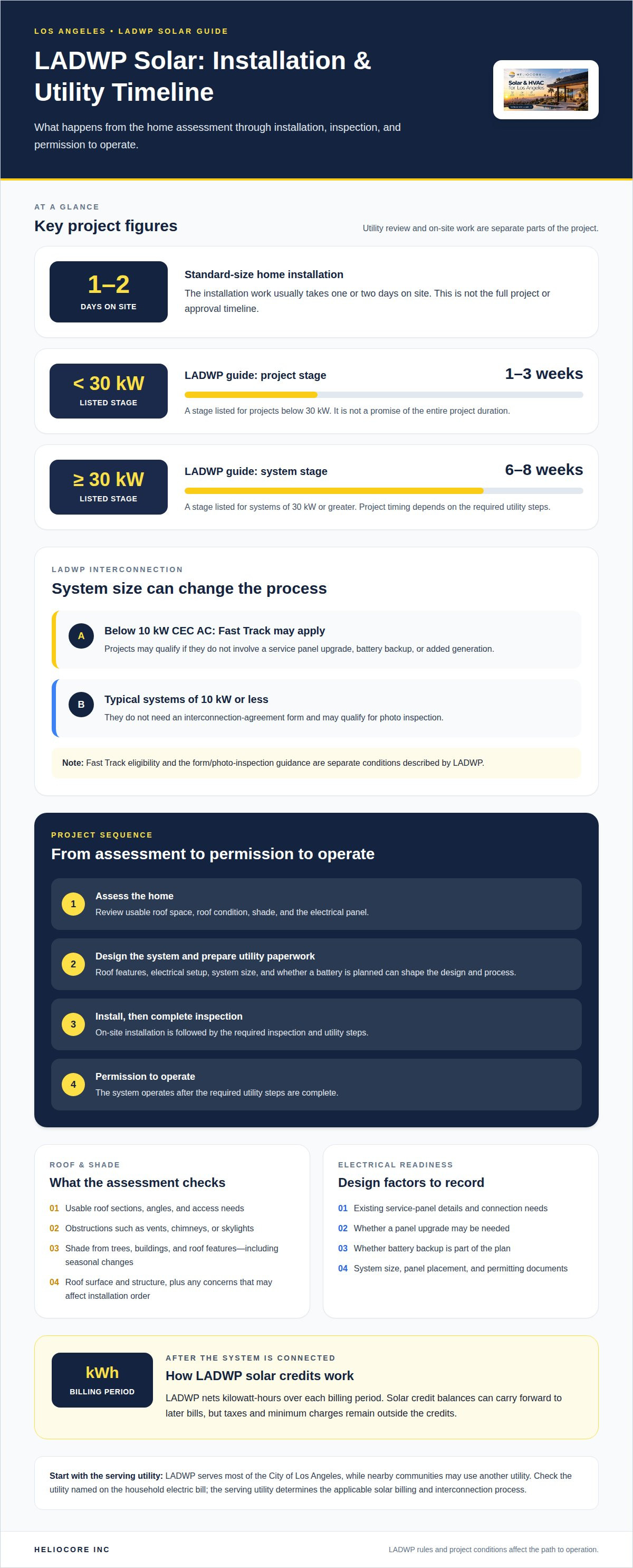
A solar project moves from system design and utility paperwork to installation, inspection, and permission to operate. A standard-size home solar installation usually takes one or two days on site, but that is only the installation work, not the full approval timeline.
LADWP’s process depends partly on system size. Projects below 10 kW CEC AC may qualify for Fast Track if they don’t involve a service panel upgrade, battery backup, or added generation. Typical systems of 10 kW or less don’t need an interconnection-agreement form and may qualify for photo inspection. LADWP’s guide lists a 1-3 week stage for projects below 30 kW, and a 6-8 week stage for systems of 30 kW or greater. Permission to operate follows the required utility steps.
Contractor Licensing and Workmanship
Licensing, installation scope, and workmanship coverage are separate parts of a solar project. The written scope should identify the planned panels, electrical work, any battery, inspections, and utility coordination. These details help you understand what the installation includes.
Workmanship terms explain how installation-related concerns are handled; equipment warranties cover the equipment itself. Review the written project terms to see what each covers and for how long. Enphase may appear in equipment or monitoring documents, but a brand name alone does not explain the contractor’s workmanship responsibility.
LADWP’s Net Energy Metering rider nets a customer’s kilowatt-hours over each billing period. Credit balances can carry forward to later bills, except for taxes and minimum charges. Household energy use, system output, and billing-period credits all affect how to understand the bill after solar is connected.
Solar is only one part of household energy planning. LADWP offers rebates of up to $4,000 for qualifying used electric vehicles purchased within 12 months of application submission, according to the Los Angeles Department of Water and Power. This is an electric-vehicle rebate, not a solar installation rebate.
Roof, shade, and electrical panel assessment
A roof assessment connects the home’s physical condition with the solar system’s layout. The review considers usable roof space, surface condition, shade, and the electrical panel. Together, these details help determine where panels could fit and what work may be needed before installation and utility approval.
Roof space is not simply the total roof area. The layout must account for roof sections, angles, obstructions, and access needs. A vent, chimney, or skylight can interrupt a panel arrangement. The assessment records these features so the system design reflects the actual roof, not just the home’s footprint.
Shade matters because nearby trees, buildings, and roof features can block sunlight at different times. An assessment identifies where shadows fall and how they may affect panel placement. For example, if a tree shades one roof section while another remains open, the design can consider the clearer area first. Seasonal changes in tree cover also matter, so the review should account for the setting throughout the year.
Roof condition is part of the same review. The installer considers whether the surface and structure appear suitable for the planned equipment. If repairs or roof work are needed, they can affect the installation sequence. Because solar panels remain on the roof for years, addressing known roof concerns beforehand can help avoid disturbing the array later. A solar installation assessment is not the same as a standalone roofing inspection.
The electrical review focuses on the existing service panel and the home’s setup. The installer records panel details and considers how the solar system connects to the home’s electrical equipment. A panel upgrade can change the project design and LADWP process. Battery storage also affects planning, so the assessment should reflect whether you want backup power.
These findings shape the proposed system size, panel placement, electrical design, and permitting documents. They also clarify what the installation includes and which project conditions may affect the schedule. The assessment is more than a roof measurement: it connects roof space, shade, electrical readiness, billing goals, and the steps required before the system can operate.
For Los Angeles homeowners, a thorough review makes trade-offs easier to see: a shaded roof section may offer less useful space, while a clear section may better suit the design. If you’re considering panels, explore solar panel installation as the next step toward a home-specific assessment.
What areas does LADWP serve for residential electric service?
LADWP provides residential electric service across most of the City of Los Angeles, but not every home in Los Angeles County. The serving utility matters because it sets the applicable solar billing and interconnection process.
City boundaries and utility territory
LADWP serves over one million homes and apartments in Los Angeles. Homes inside the city are often LADWP customers, while many surrounding communities receive electric service from Southern California Edison (SCE). That makes the city name or county name a useful starting point, not a substitute for identifying the utility at a specific address.
Los Angeles County includes the City of Los Angeles and surrounding communities. A home elsewhere in the county may follow a different utility’s solar rules, even if the homeowner describes the location as Los Angeles. Two nearby homes, for example, can have different utilities and procedures.
How to identify the serving utility
Start with the electric bill for the property. The utility named on it identifies which service territory applies to that account. This is more reliable than relying only on a postal address, city label, or neighbor’s experience, since nearby properties may have different electric providers.
For a household considering solar, the utility name identifies which billing and interconnection rules govern the project. LADWP customers use LADWP’s solar process; homes served by SCE follow that utility’s process instead. A solar design should not assume one utility’s credit structure or paperwork applies throughout the county.
Why the service area matters for solar
The utility territory affects more than the roof’s location. It determines which utility receives the interconnection application and how solar credits appear on the customer’s bill. Identifying the utility before planning advances helps align the design and application with the right process.
This distinction explains why general advice about “Los Angeles solar” can be too broad. Guidance for an LADWP home may not describe the experience of an SCE customer in a nearby community. The serving utility, not the county label alone, is the practical starting point for understanding solar rules.
For residents comparing properties, check the utility shown on each home’s electric account. Do not assume a familiar neighborhood or a nearby LADWP customer proves the service territory. The property’s provider connects its location to the correct solar billing and interconnection requirements.
Can solar contractors outside the LADWP service area install solar systems in Los Angeles?
Yes. A contractor’s office location does not determine which utility serves a Los Angeles home; the property’s electric service address does. If LADWP serves the home, the solar project must follow LADWP’s interconnection and billing process, regardless of where the installer is based. HelioCore Inc works with LADWP procedures for homes in its service area.
The property determines the utility process
For example, a homeowner in the City of Los Angeles may receive LADWP service, while a nearby home may receive service from Southern California Edison. The contractor’s address does not change which utility’s rules apply. Project paperwork and system design must match the utility serving that specific property.
This distinction matters from the first design stage. The installer needs to prepare the project for the correct utility, rather than use a generic application for every Los Angeles County home. LADWP customers follow LADWP requirements; customers served by another utility follow that utility’s process.
What local coordination involves
For an LADWP-served home, the project must account for LADWP’s interconnection steps. This connects system design with utility review, applicable permits, inspections, and permission to operate. The installation address, not the contractor’s office, determines which utility receives the project information.
Local approvals also matter. A home within the City of Los Angeles may involve the Los Angeles Department of Building and Safety for applicable permits and inspections. A property elsewhere in Los Angeles County may fall under a different local jurisdiction. The project address informs both utility coordination and the relevant building process.
Why experience with LADWP procedures matters
A contractor unfamiliar with LADWP’s requirements may need to learn its forms, review stages, and interconnection process while managing the project. A solar contractor serving the LADWP service area can align system design and submissions with the utility’s procedures from the outset. This is especially useful when a project includes a battery, a service panel upgrade, or other details that affect the application path.
The contractor’s location alone does not determine how smoothly a project proceeds. The key distinction is between the installer’s base and the homeowner’s utility territory. Choosing a solar contractor in the LADWP service area means focusing on whether the project is prepared for LADWP’s process, not simply where the contractor’s office is.
For homeowners, the sequence is straightforward: identify the utility on the property’s electric account, match the project to that utility, then coordinate permits, inspections, and interconnection. The home’s address and serving utility determine the process, not simply the installer’s office location.
What incentives, rebates, or tax credits are available for solar customers in LADWP territory?
LADWP customers can consider several distinct programs, but they work in different ways. Some pay eligible homeowners for rooftop use, while others provide shared solar credits or support qualifying income-based battery projects. Federal tax treatment is separate from LADWP programs and should be considered on its own.
The LADWP Solar Rooftops program offers eligible, owner-occupied homes systems ranging from 1 to 10 kW. LADWP owns the installed system and receives the energy it generates. Payments are for rooftop use, regardless of how much energy the system produces. Eligibility depends on the home, its rate schedule, and LADWP’s evaluation.
Shared Solar works differently. Subscribers can receive either 50 or 100 kWh of solar energy per month and fix a portion of their electric bill for 10 years. This program doesn’t install a privately owned rooftop system at the subscriber’s home. It offers an alternative for customers who want access to solar energy without relying on their own roof.
For battery support, LADWP participates only in the income-qualified AB 209 Residential Solar and Storage Equity pathway for the Self-Generation Incentive Program (SGIP). New applications to this pathway are automatically added to a waitlist. That makes the program distinct from a general rebate available to every customer. Eligibility and the application pathway are central to understanding whether it fits a household.
Federal tax treatment is separate from these utility programs. The federal solar tax credit is 30% of solar installation costs until the end of 2032, according to the Internal Revenue Service. A tax credit and an LADWP payment aren’t the same benefit: one concerns federal taxes, while the other comes through a utility program. Homeowners should keep those categories separate when comparing project options.
There is also an LADWP rebate unrelated to rooftop solar. The Los Angeles Department of Water and Power offers rebates of up to $4,000 for qualifying used electric vehicles purchased within 12 months of application submission. It applies to qualifying vehicle purchases, not solar equipment or installation.
For a clear comparison, separate programs by purpose: rooftop ownership, shared solar access, income-qualified battery support, and federal tax treatment. Explore residential solar options as you consider which path best fits your home.
HelioCore: High-Efficiency Solar Panels
HelioCore helps Los Angeles homeowners move from solar assessment to an installed system. The team manages custom engineering, permitting, installation, inspections, and coordination for LADWP permission to operate. This support is useful when you want one team to guide the project through home and utility requirements.
High-efficiency solar panels can be considered alongside battery storage, depending on your home and energy goals. The roof, electrical setup, and LADWP process all inform the project plan. Discuss these details before deciding how solar should fit your household.
Contact HelioCore to talk through your home’s solar project.
Turn your solar research into a home plan
The next step is to connect your household priorities with a practical project plan. Consider how you use electricity, whether backup power matters, and how your heating or cooling needs may change. These priorities can help shape a system that supports daily life, not just the roof.
A solar contractor in the LADWP service area can translate those priorities into a design and a clear project path. HelioCore offers high-efficiency solar panels, battery storage, and HVAC solutions, helping homeowners consider energy generation, storage, and home comfort together.
You do not need to settle every detail before starting the conversation. A home-specific discussion can clarify the decisions ahead and identify a sensible next step for your property.
Contact HelioCore about your solar project, and take the next step toward an energy plan that feels right for your home.
Frequently Asked Questions
Bottom line: Is it a good idea to install solar in Los Angeles?
Solar may suit a home with usable roof space and household electricity use that aligns with the system design. The decision also depends on LADWP’s treatment of exported energy and the project’s costs. A useful evaluation considers roof condition, shade, electrical setup, and whether battery backup matters to your household. Compare those factors with your energy goals before choosing a system.
How long does installation take?
A standard-size home solar installation usually takes one or two days on site. That is not the full project timeline, which also includes design, permitting, utility review, inspection, and permission to operate. The schedule depends on system design and the approval path. A battery or service panel upgrade can affect which LADWP process applies, so on-site installation time and total project time are different measures.
How can I check whether my address is in LADWP's service area?
Check the property’s electric bill and identify the utility named on the account. LADWP serves most of the City of Los Angeles, while some nearby communities receive service from Southern California Edison. A city or postal address alone may not settle the question, especially near service boundaries. For a rental or recently purchased home, use the bill for that specific service address.
How do I find licensed solar contractors that work in LADWP territory?
Look for a residential solar contractor who works with LADWP applications and can explain permitting, inspection, and utility steps. Ask for the contractor’s California license details and verify them through the state’s contractor licensing authority before signing. Review the written scope for design, installation, electrical work, and utility coordination. For an LADWP-served home, familiarity with LADWP’s process is also relevant.
What are LADWP's solar interconnection and net billing requirements?
LADWP’s Net Energy Metering program covers customer-owned solar systems up to 1 MW. Its rider nets kilowatt-hours over each billing period, and eligible credit balances can carry forward, except taxes and minimum charges. System size and project features affect the interconnection path. For example, a service panel upgrade or battery backup can make a project ineligible for Fast Track, so design details matter before submission.
What permits and inspections are required for rooftop solar in Los Angeles?
Rooftop solar involves local building approvals and utility interconnection steps, which serve different purposes. In LADWP’s Solar Rooftops program, the Los Angeles Department of Building and Safety inspects and approves installations. The property address and system design shape the applicable permitting path. System size, battery backup, and electrical panel work can also affect project review and inspections.
What are LADWP solar interconnection fees and application costs?
Account for utility application and interconnection charges separately from the solar installation contract and local permit work. System size, electrical service configuration, and the need for panel work or battery backup affect the application path and project scope. A written estimate should distinguish these cost categories so homeowners can see utility-related charges separately from equipment, design, and installation expenses.
How long does LADWP solar approval and interconnection take?
LADWP’s guide lists Fast Track Solar Process timeline stages of 2-5 days and 1-2 weeks. It also lists a 1-3 week stage for projects below 30 kW CEC AC, and a 6-8 week stage for systems of at least 30 kW CEC AC. These are utility-process stages, not the time crews spend installing panels. Project design and eligibility determine the applicable path.