
Solar
Los Angeles solar panel incentives and potential long-term savings
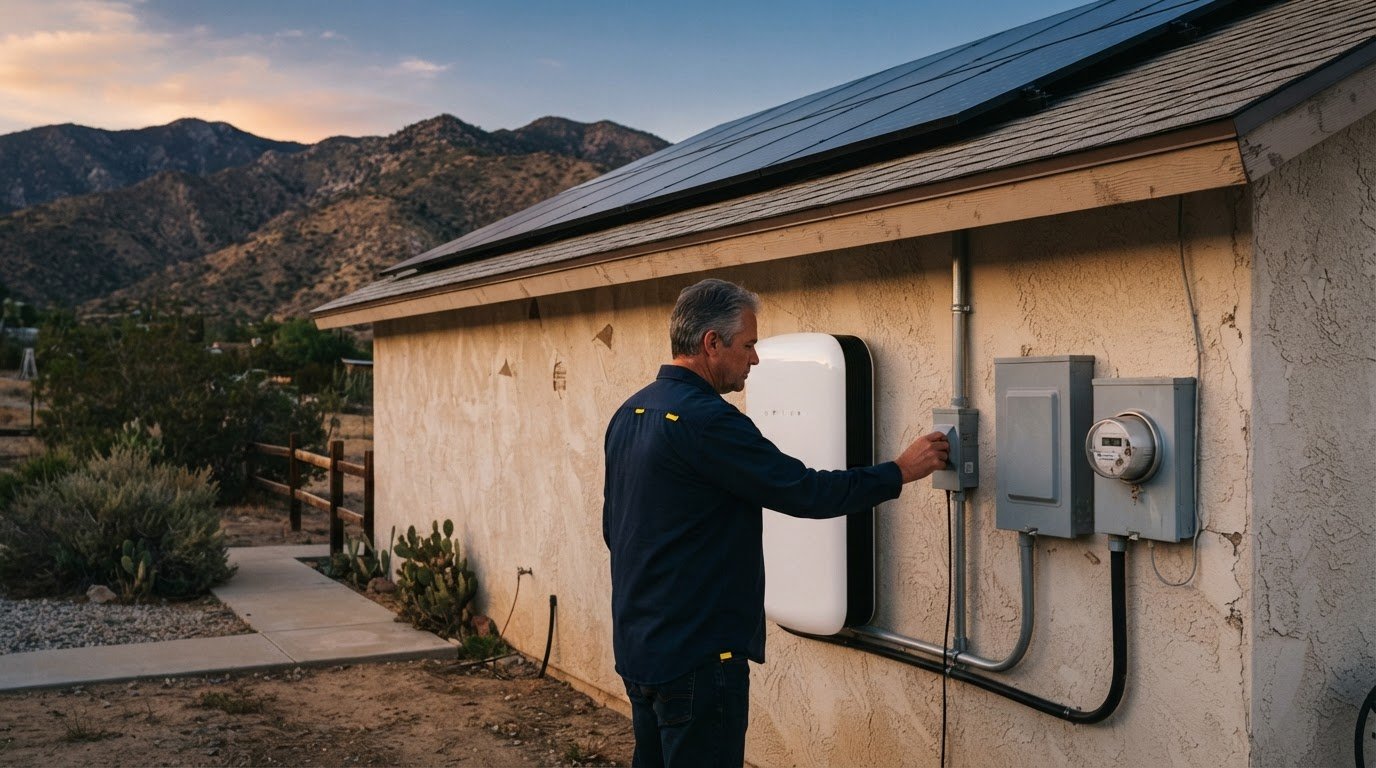
The federal homeowner solar tax credit ended for systems completed after December 31, 2025, according to the Internal Revenue Service. For homeowners in Los Angeles and nearby communities, California incentives and utility rules still shape the decision. A look at regional solar panel incentives can also clarify how local program eligibility and project details affect solar planning.
It’s reasonable to want a clear picture before making a long-term home upgrade. Solar incentives vary: some apply to solar panels, while others focus on battery storage or eligible households. Your home’s utility service area and project type help determine which details matter.
This guide from HelioCore Inc explains the Los Angeles solar panel incentives landscape and puts estimated payback and long-term savings in context. Use it to understand the factors behind solar decisions, then consider how your home, utility, and project plans may differ.
Key Takeaways
- Separate incentives for solar, batteries, and property taxes to see which may fit your project.
- Understand how eligibility and available program funding can affect the rebates a household may receive.
- See why Palmdale’s streamlined solar permit option applies to some rooftop projects, but not every property type.
- Compare estimated payback and long-term savings with the factors that shape your household’s results.
- Learn how Southern California Edison’s net billing rules affect the value of excess solar electricity.
Table of Contents
- What Solar Tax Credits, Incentives, and Rebates are Available in Palmdale?
- Federal residential clean energy tax credit
- Eligible single-family and duplex rooftop solar projects
- Estimated payback period and long-term savings
- How does net energy metering work for Southern California Edison customers in Palmdale?
- HelioCore: High-Efficiency Solar Panels
What Solar Tax Credits, Incentives, and Rebates are Available in Palmdale?
For homeowners in Los Angeles and nearby communities, incentive eligibility depends on the project, household, and utility service area. California programs may apply statewide, but local utility arrangements and funding availability shape which benefits are relevant.
California and Federal Residential Tax Credits
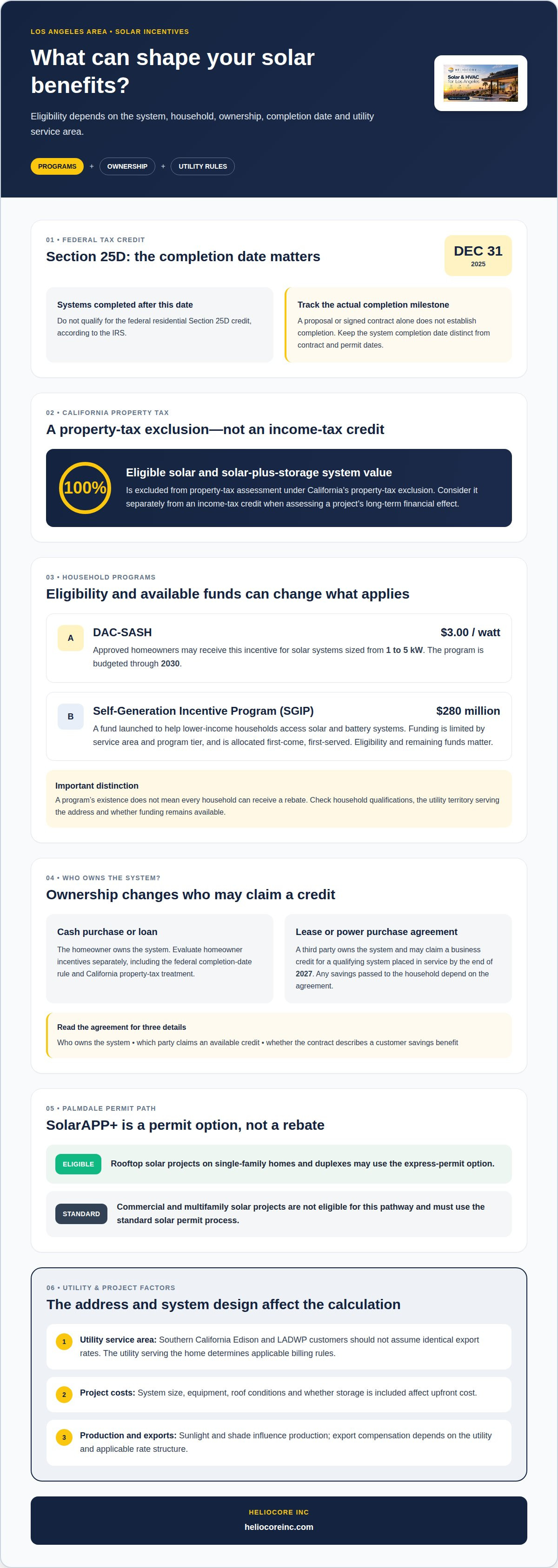
The federal residential solar tax credit reduced eligible federal tax owed, while California programs offer different forms of support. The Internal Revenue Service states that Section 25D ended for solar systems completed after December 31, 2025. That rule matters to homeowners planning a new system: a later completion date does not qualify for that residential credit. State incentives and third-party ownership arrangements are separate considerations.
Solar Property Tax Exclusion
California’s property-tax exclusion exempts 100% of the value of eligible solar and solar-plus-storage systems from property-tax assessment. It is distinct from an income-tax credit because it concerns assessed property value. Homeowners should consider it separately when estimating the long-term financial effect of a solar project, including homes in Los Angeles-area communities.
Buying with cash or a loan means the homeowner owns the system. Leasing or using a power purchase agreement places ownership with a third party, which may claim a business credit for a qualifying system placed in service by the end of 2027. Any savings passed to the household depend on the agreement. These ownership choices affect how incentives may reach the homeowner.
California’s low-income programs have separate eligibility rules. Under DAC-SASH, approved homeowners may receive $3.00 per watt for solar systems sized from 1 to 5 kW; the program is budgeted through 2030. The California Public Utilities Commission’s Self-Generation Incentive Program launched a $280 million fund to help lower-income households access solar and battery systems. SGIP funding is limited by service area and allocated first-come, first-served, so location and remaining funds matter.
For battery rebates, SGIP may be relevant, but funding and eligibility vary by service area and program tier. A program’s existence does not mean every household can receive a rebate. Consider both household qualifications and whether funds remain available in the utility territory serving your address.
California solar project costs vary with system size, equipment, roof conditions, and whether storage is included. These factors affect the upfront amount, while sunlight and shade influence production. Export compensation also depends on the utility and applicable rate structure. Southern California Edison and LADWP customers should not assume they receive identical export rates. The utility serving the home determines which billing rules apply.
Federal residential clean energy tax credit
A federal residential clean energy tax credit reduces a homeowner’s federal tax bill for qualifying improvements. For homeowners in Los Angeles and nearby communities, the key point is the system completion date. The Internal Revenue Service states that the federal Section 25D credit ended for solar systems completed after December 31, 2025.
This changes how a new solar installation should be evaluated. A household buying or financing a system should not count on Section 25D to reduce its costs if the system was completed after that date. A proposal or signed contract alone does not establish completion; the stated rule turns on when the system was completed.
Ownership also affects which federal credit may apply. For a third-party-owned system, such as a lease or power purchase agreement, the provider may claim a business credit for a system placed in service by the end of 2027. That is separate from the homeowner’s Section 25D credit. A provider may pass some savings to customers, but the agreement determines whether and how that benefit affects payments.
Read the agreement with those distinctions in mind. Identify who owns the solar panel system, which party claims any available credit, and whether the contract describes a customer savings benefit. A credit claimed by the system owner is not automatically a tax credit claimed by the homeowner. Keep the system completion date distinct from the contract and permit dates.
Electric appliance upgrades are another category, but they should not be treated as part of Section 25D for residential solar. Solar panels, battery equipment, and household appliances can have different eligibility rules and tax treatment. A homeowner considering an electric heat pump or another appliance should assess that improvement separately rather than adding its cost to a solar credit calculation.
For a Los Angeles-area project, confirm ownership, understand the contract, and track the system completion milestone. Then separate any state incentive or property-tax treatment from federal tax benefits. This keeps the estimated upfront cost grounded in benefits that fit the project’s structure and timing.
Planning a system around current federal rules starts with a clear installation scope and ownership model. Explore residential solar installation planning to see how project design and completion fit into the decision.
Eligible single-family and duplex rooftop solar projects
Palmdale offers SolarAPP+ as an express-permit option for eligible rooftop solar projects on single-family homes and duplexes. The City partnered with the U.S. Department of Energy’s National Renewable Energy Laboratory to launch the program. Commercial and multifamily solar projects are not eligible for this pathway and must use the standard solar permit process.
SolarAPP+ is a permitting route, not a solar rebate or tax credit. It can streamline permit review for an eligible rooftop photovoltaic project through automated compliance checks. The program changes the permit process, not the purchase price, financing terms, or amount of solar energy a system produces.
The application involves two connected online steps. The applicant completes an application through the SolarAPP+ website, then continues through the City of Palmdale’s Accela Citizens Portal. A contractor uploads the SolarAPP+ confirmation to Accela as evidence that the project design meets codes. The city then issues the solar permit in real time.
Eligibility depends first on property type and project scope. A rooftop solar installation on a single-family home or duplex may use SolarAPP+ if it meets the program’s requirements. Multifamily buildings and commercial properties cannot use this express option; they follow Palmdale’s standard solar permitting process. The route does not depend on whether a homeowner plans a cash purchase, loan financing, or another ownership arrangement.
Financing affects the household budget, even though it does not define SolarAPP+ eligibility. A purchase funded with a loan has interest and repayment terms; a cash purchase has a different upfront impact. Borrowing costs and interest rates can change over time, so evaluate them separately from permit eligibility. A permit pathway does not reduce loan interest or create a federal tax credit.
The practical distinction is simple: identify the home type, confirm the project is rooftop solar, and use the relevant city application path. A single-family homeowner may use the express route if the design qualifies. A duplex owner can consider the same pathway, while multifamily owners need the standard process. Keeping these categories clear helps with permit planning and avoids mistaking a faster review option for a financial incentive.
Estimated payback period and long-term savings
Payback estimates compare a solar system’s upfront cost with the utility bills it helps offset. Payback estimates for Palmdale solar systems can provide a planning reference, but the actual timeline varies. That estimate is a useful planning reference, not a universal timeline. Household electricity use, system size, financing, and the value of exported power all affect the calculation.
Long-term estimates show why the payback date is only one part of the decision. A typical 7.99 kW system is estimated to save $111,538 over 25 years after its upfront cost. A typical solar loan is estimated to save $98,703 over 25 years. These figures use different ownership and payment assumptions, so they should not be compared as identical offers.
System size can change the model. A 4 kW Palmdale system has an estimated full payback period of 7.6 years. A 5 kW system has an estimated 9.6-year payback and $16,118 in net savings over 20 years. The larger system does not automatically pay back sooner; generation, household demand, and project costs shape the outcome.
Electricity prices also influence projected savings. The average Palmdale electricity price is 24.55 cents per kWh, and local electricity prices are estimated to rise about 3% annually. If utility rates increase, avoided purchases may become more valuable over time. The estimate depends on how much solar electricity the household uses directly and how much it sends to the grid.
Net metering and California’s Net Billing framework affect the value of exported electricity. A home that uses more solar power while it is being produced may offset more utility purchases directly. A home that exports a larger share relies more on applicable export compensation. That difference can change monthly bills and the payback estimate, even with the same system size.
Financing changes cash flow, too. A cash purchase puts more cost upfront, while a loan spreads payments over time and includes interest. A payback calculation should account for loan payments rather than treating financed equipment as if it were paid for in cash. Lease and power purchase agreement estimates use different payment structures, so compare their projected savings separately.
For a practical estimate, compare quotes using consistent assumptions: system size, expected production, household use, financing terms, and utility export treatment. Then review monthly bill changes and projected savings across the system’s modeled period. A single payback number cannot show whether monthly payments fit your household budget.
Solar panels typically last 25-30 years, so savings estimates often extend beyond the payback point. A 25-year projection helps show the longer view, while actual value depends on production and electricity use over time. Compare the estimate’s assumptions with your household’s goals before deciding what system size and payment structure make sense.
How does net energy metering work for Southern California Edison customers in Palmdale?
Net energy metering tracks electricity a solar home receives from and sends to the utility. For Southern California Edison customers, the arrangement connects the rooftop system to the grid, so electricity can flow in both directions. Qualifying California customers with home solar systems smaller than 1 megawatt can enroll in the described net energy metering system.
During sunny periods, panels may produce more electricity than the household uses at that moment, and the excess goes to the grid. When the home needs more power than its system produces, it draws electricity from the utility. The bill reflects both grid imports and exports under the applicable program rules.
California’s current residential framework is Net Billing, also called NEM 3.0. It is not enough to compare total annual solar production with household use. The timing of generation, household demand, and electricity exports also affects the value a home receives. Using more solar power in the home as it is generated can reduce grid purchases; exported power is treated under the applicable compensation rules.
For SCE customers, the time of use plan can make timing especially relevant. The SCE TOU-D-PRIME rate has its highest-priced window from 4 to 9 p.m. Household energy use during that period and the system’s production pattern shape the bill calculation. A battery can store some solar electricity for later household use, changing how much energy is exported or drawn from the grid.
Interconnection also involves utility and permit steps. Electric Rule 21 describes requirements for generation facilities connected to a utility distribution system under California Public Utilities Commission jurisdiction. SCE’s net energy metering application has separate categories for systems under 10 kW and systems over 10 kW. The system’s size therefore matters when the application is prepared.
After installation, SCE issues a Permission to Operate letter within 30 working days after receiving all required documents. Permission to Operate confirms the utility process has reached its operating stage. Until that step is complete, installed equipment and an active grid connection are not the same milestone.
To understand the likely bill effect, consider production by time of day, household usage, system size, and export compensation together. An annual production estimate alone cannot show how much electricity the home uses directly. For an SCE-connected project, plan a solar installation around the home’s energy use, system design, and utility interconnection requirements.
HelioCore: High-Efficiency Solar Panels
HelioCore Inc. helps Palmdale homeowners turn incentive research into a residential solar plan. Its High-Efficiency Solar Panels and Solar Panel Installation support rooftop projects, while Battery Storage can be considered alongside solar when household needs call for it.
Turn to HelioCore Inc. when you’re ready to connect system design with permitting, installation, inspections, and utility permission to operate. The team manages these parts of the solar adoption process and can explain how ownership or solar leasing fits the project. Incentives and projected savings depend on eligibility, system details, and utility arrangements, so a clear project plan helps put the numbers in context.
For a steady next step, contact HelioCore Inc. to discuss your Palmdale home and solar goals.
Make your next solar decision with a clear plan
Connect incentive eligibility with your home’s energy use, project design, and preferred ownership structure. Treat Palmdale solar panel incentives as one part of the decision, alongside how a system will fit your household’s routine and utility needs. A clear plan helps identify the questions that matter before moving forward.
HelioCore helps homeowners consider solar options alongside broader home energy needs, including HVAC. Start with a conversation about your goals, property, and the kind of project you have in mind. From there, the next steps can be shaped around your home rather than assumptions.
Contact HelioCore about your solar options and take the next step at a pace that feels right for your household.
Frequently Asked Questions
What solar incentives are available to Palmdale, California homeowners in 2026?
Palmdale homeowners may qualify for California’s solar property-tax exclusion, DAC-SASH, or battery support through SGIP, depending on project and household eligibility. DAC-SASH offers approved homeowners $3.00 per watt for systems sized from 1 to 5 kW and is budgeted through 2030. The general SGIP residential budget in SCE territory was closed at the last check, while income-qualified tiers were on waitlists.
Does the federal residential clean energy tax credit apply to solar installations in Palmdale in 2026?
No. The Internal Revenue Service states that the federal Section 25D credit ended for solar systems completed after December 31, 2025. A contract signed earlier does not change the completion-date rule. A different arrangement may apply to third-party-owned systems: the provider may claim a business credit for a system placed in service by the end of 2027. Any customer benefit depends on the agreement’s terms.
What California solar rebates or tax credits are available to Palmdale residents?
California’s property-tax exclusion and targeted programs are the main options to consider. The exclusion covers the value of eligible solar and solar-plus-storage systems for property-tax assessment. DAC-SASH supports approved qualifying homeowners with solar incentives, while SGIP focuses on battery storage. These programs have separate eligibility and funding rules, so a household may qualify for one without qualifying for another.
Does Palmdale offer local solar panel rebates, grants, or property tax exemptions?
Palmdale’s SolarAPP+ is a permitting option, not a rebate or grant. It applies to eligible rooftop solar projects on single-family homes and duplexes; commercial and multifamily projects use the standard permit process. The property-tax exclusion is a California state incentive, not a Palmdale city rebate. Keeping permitting benefits separate from financial incentives helps homeowners assess a project accurately.
What are typical solar panel installation costs in Palmdale before and after incentives?
Project costs depend on system size, equipment, roof conditions, and whether battery storage is included. Incentives can change the net amount only when the project and household meet program rules, and funding remains available. HelioCore quotes are estimates based on project information and remain valid for 30 days unless otherwise specified. Requesting a quote doesn’t obligate you to purchase services.
What incentives are available for adding a home battery to a Palmdale solar system?
SGIP is California’s primary battery incentive program to review. The California Public Utilities Commission launched a $280 million fund to help lower-income households access solar and battery systems. Funding is limited by service area and allocated first-come, first-served. In SCE territory, the general residential budget was closed at the last check, and income-qualified tiers were on waitlists, so funding status affects eligibility in practice.