HVAC
Quiet Central Air Conditioners in Los Angeles: What Affects Noise
A mini-split isn’t automatically quieter than central air. A quiet central air conditioner in Los Angeles depends on the equipment, system sizing, and placement of indoor and outdoor components. A mini-split may reduce noise in some rooms, but the better option depends on the home and system design.
It makes sense to consider sound before choosing a system. Outdoor equipment can be more noticeable in a close-set neighborhood, while duct airflow and the air handler affect what you hear indoors.
This article explains how compressors, blower motors, home layout, air-handler placement, ductwork, and system sizing affect AC noise. It also covers when a mini-split may be quieter and why thoughtful system design matters as much as the equipment itself.
Key Takeaways
- Compare outdoor sound ratings and indoor airflow when weighing AC options; equipment placement can change how noticeable the system feels.
- Variable-speed compressors and ECM blower motors can shape the sound of a system as it runs.
- In close-set neighborhoods, condenser location matters, especially when outdoor noise carries toward nearby homes at night.
- According to ENERGY STAR, a noisy central AC could have undersized ductwork or a problem with its indoor coil.
- A mini-split may be quieter in some rooms, while a well-matched central system can also support a calmer home.
Table of Contents
- Variable-speed compressors and ECM blower motors
- How close-set Los Angeles homes can make outdoor AC noise disruptive
- Indoor air-handler placement and ductwork noise
- Proper system sizing and load calculations
- How can an HVAC professional recommend the best quiet central air conditioner brands and models for a home?
- HelioCore
Variable-speed compressors and ECM blower motors
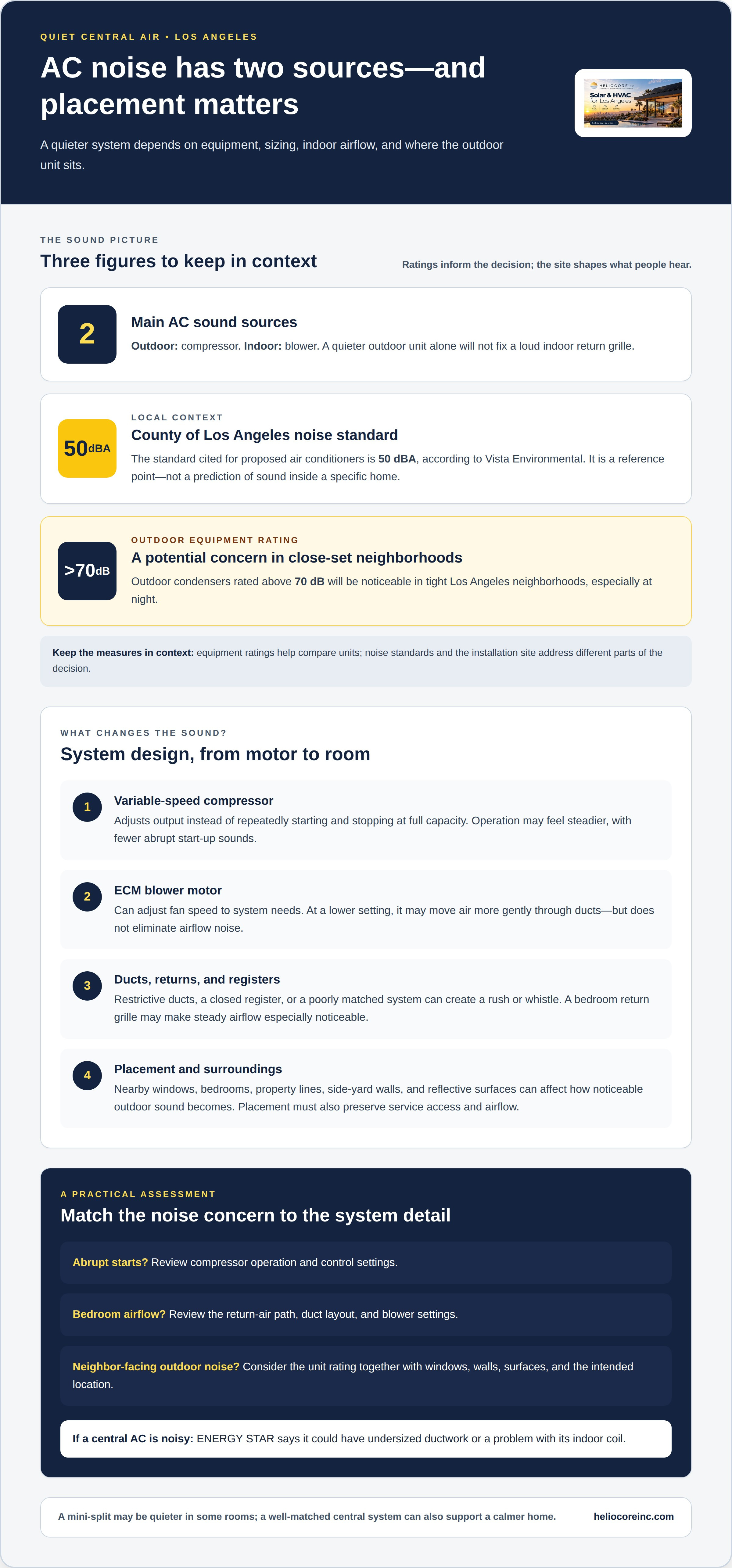
A central air conditioner has two main sound sources: the outdoor compressor and the indoor blower. A variable-speed compressor adjusts its output rather than repeatedly starting and stopping at full capacity. This can make operation feel steadier and reduce abrupt start-up sounds. Actual noise still depends on equipment design, installation, and the home’s surroundings.
An ECM blower motor, or electronically commutated motor, can adjust fan speed to suit system needs. At a lower setting, it may move air more gently through the ducts than a blower running at one fixed speed. That does not eliminate airflow noise. Restrictive ducts, a closed register, or a poorly matched system can still cause a noticeable rush or whistle.
Controls matter, too. When conditions allow, a variable-speed system can run at a lower output for longer periods. Residents may hear a softer, more consistent sound instead of a sharp cycle followed by silence. In a bedroom near a return grille, steady airflow may be more noticeable than compressor noise. An HVAC assessment should consider both.
Sound ratings help compare equipment, but they don’t describe every sound a homeowner may hear. The County of Los Angeles noise standard cited for proposed air conditioners is 50 dBA, according to Vista Environmental. That figure provides local context; it does not, by itself, predict the sound inside a specific home. Placement, nearby surfaces, and operating conditions also affect what reaches a listener.
Ask how the proposed system’s compressor and blower operate at their available settings. Compare the equipment’s published sound information with the planned installation location. An HVAC professional can also review duct layout, return-air paths, and control settings. A quieter outdoor unit will not solve a loud indoor return grille, just as a quieter blower will not silence a poorly placed condenser.
Review warranty terms as carefully as sound performance. Compressor and parts coverage may have different conditions, so the written warranty should explain what each covers and how claims are handled. Keep the equipment model and warranty documents with the home’s service records. A warranty covers specified repairs, not the system’s sound level after installation.
Noise goals are most useful when linked to specific rooms and routines. If sound disrupts sleep, prioritize the bedroom return path and outdoor-unit location. If abrupt starts are the concern, focus on compressor operation and controls. These details help an HVAC professional weigh motor type, equipment placement, duct design, and warranty terms as parts of one system choice.
How close-set Los Angeles homes can make outdoor AC noise disruptive
In Los Angeles neighborhoods, nearby walls and windows can make outdoor equipment more noticeable. Replacement planning should account for sound as well as local project requirements.
An HVAC professional should identify which permits and building-code requirements apply to the replacement. They should also coordinate relevant paperwork and required inspections before work proceeds.
Noise from Nearby Outdoor Units
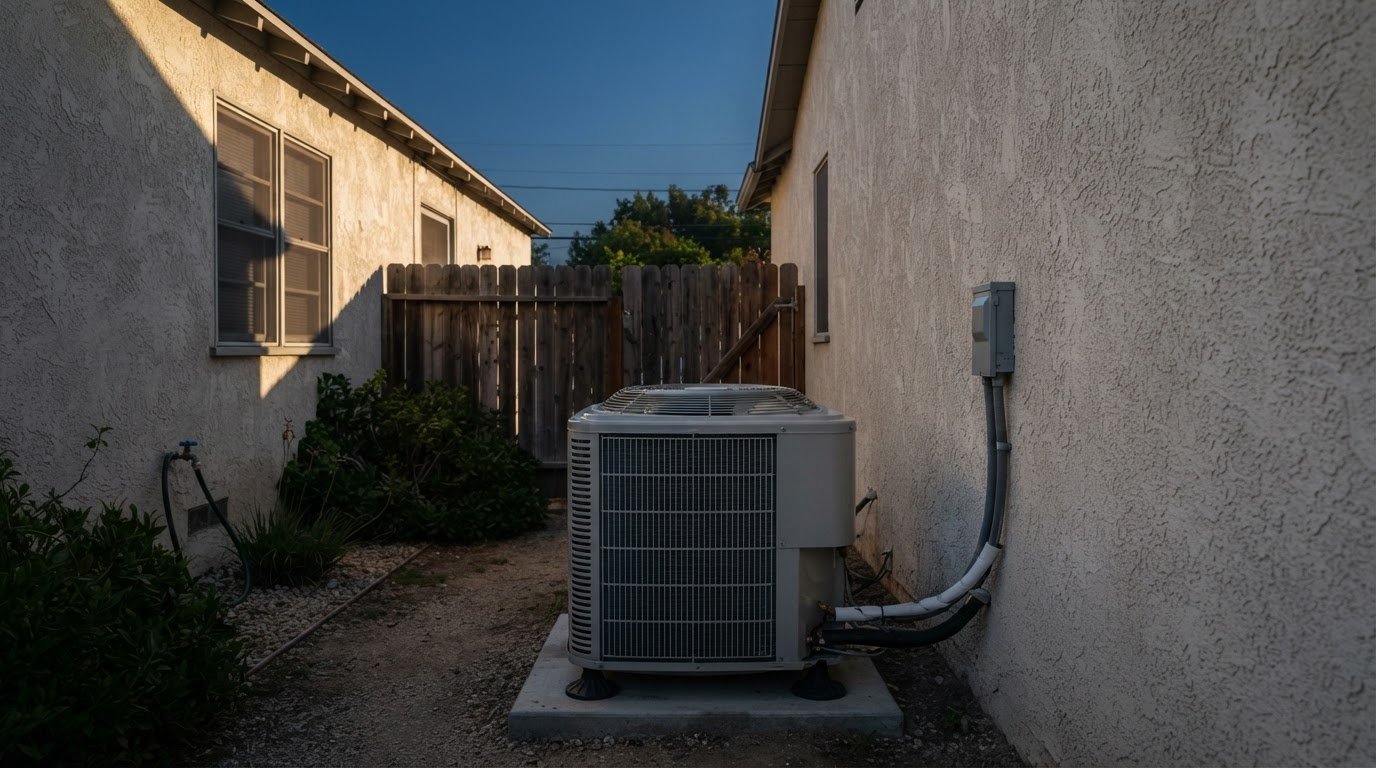
Close-set homes may leave little space between an outdoor condenser and a neighbor’s window, patio, or bedroom. Sound can seem more noticeable at night, when household activity quiets. A unit beside a side-yard wall may also direct sound toward nearby living spaces. Placement matters as much as the equipment rating.
Outdoor condensers rated above 70 dB will be noticeable in tight Los Angeles neighborhoods, especially at night. That makes the equipment’s rated sound level a useful part of planning, not the only consideration. A professional can assess nearby windows, property lines, walls, and the intended installation area together.
For example, a condenser beside a bedroom window may be disruptive even if another placement is possible. A narrow side yard can limit equipment locations and affect how sound travels. Solid surfaces may reflect sound toward a neighbor’s home instead of allowing it to disperse. These site conditions shape the impact of outdoor operation.
Placement must also preserve service access and allow the system to operate as designed. A quiet location that blocks access or airflow is not a good solution. The professional considers nearby rooms, surfaces, and workable equipment positions, then weighs their effects on sound and installation needs.
Residential Outdoor Unit Noise Limits
Noise limits are standards used to assess outdoor sound in a particular setting. The County of Los Angeles noise standard cited for proposed air conditioners is 50 dBA, according to Vista Environmental. This figure gives a project a local reference point. It should not be treated as a guarantee that every placement will sound equally quiet.
Equipment ratings and noise standards describe different parts of the decision. A unit’s rating helps compare equipment, while the site affects how sound reaches nearby homes. An HVAC professional should consider applicable project requirements alongside the selected unit and its planned location.
If replacing a system near neighboring windows, ask for the sound ratings and site layout to be considered together. The assessment can account for the condenser’s direction, nearby reflective surfaces, and the rooms people use most. This helps avoid choosing equipment by a single figure while overlooking how a narrow Los Angeles lot affects what residents hear.
HelioCore Inc’s HVAC installation and replacement can address equipment selection and placement as part of a replacement project.
Indoor air-handler placement and ductwork noise
Indoor central AC noise can come from the air handler, indoor coil, blower, or airflow through ducts. Outdoors, the condenser, its location, and nearby surfaces shape the sound residents hear.
An air handler near a bedroom, home office, or quiet living room can make normal operation more noticeable. During replacement planning, the professional considers where people spend time and how sound may travel from the equipment area. A utility space farther from sleeping areas may be preferable if the home’s layout and system design allow it.
Blower noise also depends on how air moves through the home. A return grille that is too small for the airflow can cause a rush or whistle. A supply register near a desk may make airflow noticeable during work calls. Identifying the location helps pinpoint the source instead of treating every indoor noise as a motor problem.
Duct size and condition affect airflow noise throughout the system. ENERGY STAR notes that a noisy central air conditioner could have an undersized duct system or an indoor-coil problem. An HVAC professional can examine both during diagnosis. Replacing equipment alone may not address noise caused by a duct restriction or coil issue.
Vibration provides another path for sound. If an air handler or duct section transfers vibration to a nearby wall, ceiling, or framing, occupants may hear a hum beyond the equipment room. The installer considers support points and duct connections. A rattling panel or loose connection can also make a distinct sound during operation.
Choosing where to place equipment involves more than finding the quietest corner. The air handler needs service access, and its connections must work with the home’s duct layout. A basement, attic, closet, or garage each presents different access and sound-transfer conditions. The professional weighs these against nearby rooms and airflow needs.
With an existing system, when and where a sound occurs can help narrow its cause. A whistle at one register points to that airflow path. A hum near the air-handler closet may direct attention to the unit or its support. A sudden change in sound warrants closer inspection of the coil, blower, and duct connections.
A complete assessment traces sound from its source to the room. The professional evaluates the air handler, indoor coil, return path, supply ducts, and registers as connected parts. This helps distinguish equipment noise from airflow or vibration noise and gives the replacement design a clearer basis. Quiet operation should be considered across the home, not just at one component.
Proper system sizing and load calculations
System size affects how often equipment runs, how much air it moves, and how noticeable it sounds. A professional load calculation estimates a home’s cooling needs instead of selecting equipment by floor area alone. This matters in Los Angeles, where homes with similar layouts can have different cooling demands.
The calculation considers the home’s construction and use. Window area, insulation, ceiling height, shade, and room layout all affect heat gain. For example, a sunny living room with large west-facing windows may warm faster than a shaded bedroom. Accounting for these differences gives equipment selection a more useful foundation.
Oversized equipment may cool a space quickly, then stop before running steadily. Repeated starts and stops can make operation sound more abrupt and create uneven comfort. A small bedroom may cool rapidly while a sunlit room stays warm. The professional considers how the system will serve the whole home, not just its largest or warmest room.
An undersized system may run for long periods while struggling to meet the home’s cooling needs. Longer operation can mean more time hearing the blower and outdoor unit. The professional compares the home’s heat gain with the system’s capacity and considers whether the ducts can deliver the required airflow. Capacity and distribution need to work together.
Load calculations also explain why a replacement should not simply copy an older unit’s size. The home may have changed since that equipment was installed. New windows, added insulation, a converted room, or a changed floor plan can shift cooling needs. Converting an enclosed porch into living space, for example, changes the area the system must serve.
Equipment selection connects sizing with sound preferences. A suitable system should meet the home’s cooling needs without relying on poor airflow or frequent abrupt operation. The professional can explain how capacity, blower settings, and available controls work together. This helps homeowners understand the trade-offs involved in choosing a quiet central air conditioner in Los Angeles.
During replacement planning, the professional gathers details about the building and current comfort patterns. Rooms that stay warm, spaces that cool quickly, and changes to windows or insulation can all inform the assessment. The calculation supports a system choice suited to the home’s actual demands, rather than a guess based only on the previous equipment.
Ask how the load calculation informed the proposed capacity and room-by-room plan. A clear explanation should connect home features to the equipment choice. For example, the professional can explain how sun exposure affects a living room or why a converted space changes cooling needs. Linking the calculation to the design makes the sizing decision easier to understand.
How can an HVAC professional recommend the best quiet central air conditioner brands and models for a home?
A useful recommendation starts with the home, not a brand name. The professional considers cooling load, duct layout, indoor equipment location, and outdoor installation space. A model suited to a compact Los Angeles home may not fit a larger property with different airflow needs. These details narrow the options to systems designed to serve the home.
Sound ratings provide a practical comparison between outdoor condensers. For a Los Angeles home, a quiet condenser should be rated below 60 dB. The quietest outdoor condensers described for 2026 operate in the low-to-mid 50s dB. Those figures help identify quieter candidates, but the site still affects how sound reaches nearby rooms and homes.
The professional should compare sound ratings for the specific model under consideration, rather than relying on a brand’s general reputation. A manufacturer may offer models with different sound ratings and operating features. The equipment’s capacity must also match the home’s cooling needs. A low sound rating alone does not make a model the right choice.
For example, a condenser planned beside a bedroom window calls for careful attention to its sound rating and placement. A unit farther from frequently used rooms may create a different experience. The professional weighs the proposed location alongside the model’s rating, nearby surfaces, and available installation space. This makes the comparison relevant to the property.
Indoor sound needs its own review. The air handler, blower, indoor coil, ducts, and registers all affect what occupants hear. A condenser with a low outdoor rating cannot fix a whistling register or noisy return path. The recommendation should consider the complete central system, including how the selected equipment works with existing or replacement ductwork.
A mini-split may be quieter in a particular room because it avoids central duct airflow there. However, it still has indoor and outdoor components, and its suitability depends on the home’s layout and cooling needs. An HVAC professional can compare it with central air based on the rooms served, equipment locations, and the homeowner’s noise priorities.
Ask the HVAC professional to explain how the proposed model fits the home’s load, duct design, and equipment locations. The recommendation should link each choice to a practical reason, such as the condenser’s sound rating or the air handler’s placement. This gives homeowners a clear basis for comparing models without treating a familiar brand name as proof of quiet operation.
Before installation, the professional can review the equipment and planned locations together. This helps determine whether the model’s sound profile, capacity, and system arrangement suit the property. A considered recommendation balances cooling needs, indoor airflow, and the outdoor setting around the home.
HelioCore
HelioCore helps Los Angeles homeowners plan air conditioning replacement with comfort and sound in mind. Its HVAC services consider a home’s cooling needs, equipment locations, and how the system may sound indoors and outdoors. This is useful when comparing central air with a mini-split or replacing a noisy system.
A professional assessment brings equipment selection and installation considerations together, including the home’s layout and existing ductwork. HelioCore also installs high-efficiency solar panels and battery storage for homeowners considering broader energy improvements alongside an HVAC project.
If you’re planning an air conditioning replacement in Los Angeles, contact HelioCore to discuss your home and priorities.
Make your next AC decision with sound in mind
A quieter home starts with identifying what comfort sounds like in your daily routine. Is your priority a restful bedroom, a calm workspace, or less outdoor noise near a patio? Naming that priority gives an HVAC professional a practical starting point for discussing system choices and your home’s layout.
For a quiet central air conditioner in Los Angeles, start with a conversation about your home rather than a generic model recommendation. Share which rooms matter most, when equipment noise bothers you, and what you hope to improve with a replacement. Those details can help shape a recommendation around how you live.
HelioCore offers HVAC, high-efficiency solar panels, and battery storage for homeowners considering home comfort and energy improvements. If you’re ready to discuss quieter AC options for your home, contact HelioCore about quieter AC. A thoughtful plan can make your next decision feel clear and manageable.
Frequently Asked Questions
Are ductless mini-splits quieter than central AC systems?
A mini-split may be quieter in a particular room, especially if that room has no central duct airflow, but neither system is always quieter. A mini-split’s indoor unit still has a fan, and its outdoor unit still makes operating sound. Central AC adds sound from the air handler and airflow through ducts. In a bedroom addition, a mini-split may avoid noise from a long duct run. Compare the room’s indoor sound sources and outdoor-unit placement.
Can installation location affect how loud my AC sounds?
Yes. A condenser near a bedroom window or enclosed side yard can be more noticeable than one positioned farther from living areas. Walls and other surfaces may reflect sound toward a neighbor’s home. Across Los Angeles, including Inglewood, South Los Angeles, Crenshaw, Leimert Park, Baldwin Hills, Westchester, Van Nuys, North Hollywood, Reseda, Northridge, Woodland Hills, and San Pedro, each property’s layout affects placement options.
Do variable-speed AC systems really make less noise?
Variable-speed systems can sound steadier because the compressor and blower adjust their output instead of always operating at one fixed level. This may reduce abrupt changes in sound. It does not make every installation quiet: duct airflow, equipment location, and system setup still matter. A variable-speed unit, for example, cannot eliminate a whistle caused by a restrictive return path.
How do I know if my current AC is too loud?
Notice whether the sound has changed, where it occurs, and when it happens. A new rattle, persistent hum, whistle at a register, or repeated loud start-up can help an HVAC professional narrow down the cause. Note whether it comes from the outdoor unit, an air-handler area, or one room. A sudden change or sound that disrupts sleep is a practical reason to arrange an inspection.
What is a good decibel level for a quiet outdoor AC condenser?
For a Los Angeles home, an outdoor condenser rated below 60 dB is a useful target for quieter equipment. The quietest outdoor condensers described for 2026 operate in the low-to-mid 50s dB. Use the rating to compare specific models, then consider the planned location. A condenser’s rating alone can’t describe how nearby walls, windows, and outdoor spaces affect what people hear.
What central air conditioners are quietest, and how many decibels do they produce?
Look for specific central AC models with outdoor sound ratings below 60 dB; the quietest outdoor condensers described for 2026 operate in the low-to-mid 50s dB. Brand name alone doesn’t establish how loud a model will be. Compare the proposed condenser’s rating and operating characteristics, then consider the air handler and ducts. The quietest fit depends on the home’s cooling needs and equipment placement.
How does an HVAC professional determine the right central AC size and SEER2 rating for a Los Angeles home?
A professional assesses the home’s cooling load, considering features such as windows, insulation, shade, ceiling height, and room use. The equipment size should suit that calculated demand and the system’s ability to move air through the ducts. SEER2 is a seasonal efficiency rating used to compare cooling equipment. The professional can explain how candidate ratings relate to the home’s needs without choosing capacity by floor area alone.
How do variable-speed and two-stage central AC systems compare for noise and efficiency?
A variable-speed system can adjust output across a range of operating levels. A two-stage system has two settings, typically a lower and a higher stage. Both can operate below full output when conditions allow, but their sound and efficiency depend on the equipment and installation. For a home office near a return grille, the professional should consider airflow noise as well as compressor operation.