
Solar
Reduce LADWP bill solar costs with rooftop panels

Solar can help you reduce your LADWP bill when rooftop panels produce electricity that offsets your home’s use, but they may not remove every charge. The federal solar tax credit is 30% for qualifying installations through the end of 2032, according to the Internal Revenue Service.
It’s reasonable to want a clear picture before making a major home upgrade. How much you can reduce your LADWP bill with solar depends on when you use electricity, how your system fits LADWP’s billing rules, and whether your roof is suitable for panels. This guide explains how net metering handles electricity sent to and drawn from the grid, what LADWP solar programs mean for homeowners, and how federal tax rules may affect your decision. You’ll also see why a full year of electricity use and your roof’s suitability matter when assessing solar for your home. The goal is practical: understand what can lower your bill, what charges may remain, and how to judge whether rooftop solar fits.
Key Takeaways
- Compare solar production with the timing of your household’s electricity use to understand how net metering may affect your bill.
- Learn how electricity sent to the grid differs from power your home draws back, and why some charges can remain.
- Explore how LADWP solar programs work and which participation options may fit your household.
- Use a full year of electricity-use records and assess roof suitability before estimating the value of rooftop panels.
- See how HelioCore’s solar installation and battery storage offerings can support a plan tailored to your home’s energy needs.
Table of Contents
LADWP net metering: How does it work?
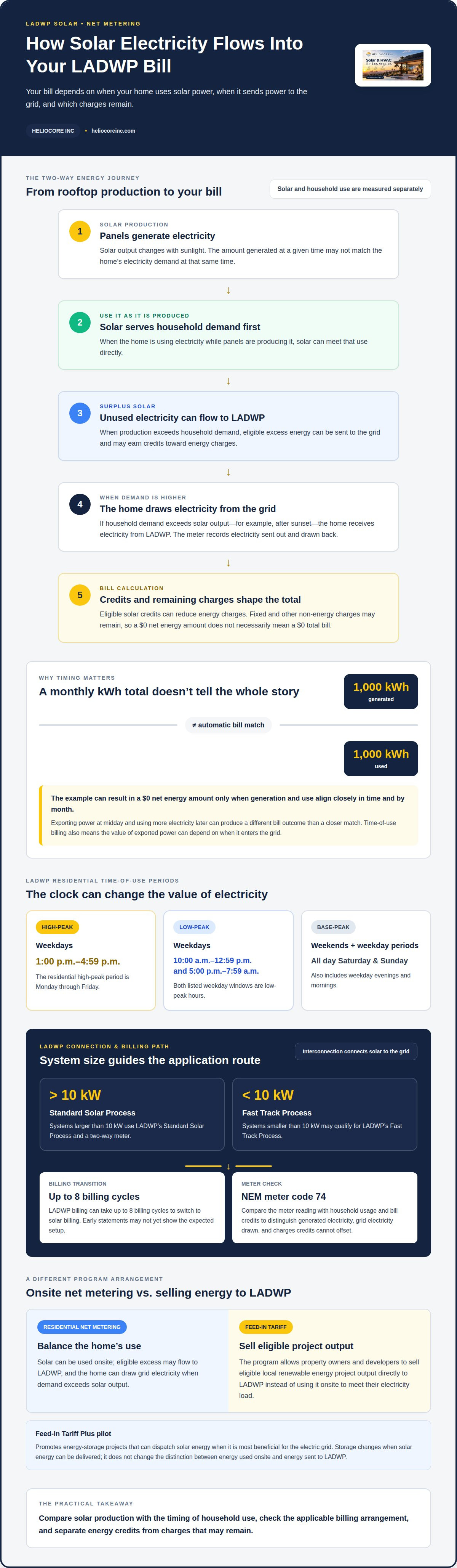
LADWP net metering tracks electricity flowing from a solar system to the grid and electricity drawn back. Your bill impact depends on when household use matches solar production, which billing plan applies, and which charges solar credits cannot cover.
Matching Solar Generation to Electricity Use
Net metering compares the electricity your panels send to LADWP with the electricity your home receives from the grid. Timing matters: solar power can meet daytime use as it is produced, while electricity used later may come from the grid.
As an illustration, 1,000 kWh generated and 1,000 kWh used can result in a $0 net energy amount only when generation and use align closely in time and by month. A monthly total alone doesn’t show that match. A home that exports power at midday and uses more electricity later can have a different bill outcome than one with a closer match.
Time-of-use billing adds a timing-based comparison. LADWP’s residential high-peak period is Monday through Friday, 1:00 p.m. to 4:59 p.m.; low-peak hours run Monday through Friday, 10:00 a.m. to 12:59 p.m. and 5:00 p.m. to 7:59 a.m. Base-peak hours include weekday evenings and mornings, plus all day Saturday and Sunday. The value of exported power can therefore depend on when it enters the grid.
Credits, Rates, and Fees
Net metering credits reflect eligible excess solar energy delivered to LADWP and can help offset energy charges when your home draws electricity. Credits for excess solar generation may help reduce energy charges, but they may not cover every item on a utility bill.
That distinction matters when estimating a bill. An energy credit can reduce energy charges without eliminating every item on the statement. Under time-of-use billing, excess energy during a billing period may result in a $0 bill, but fixed and non-energy charges remain relevant to the final amount.
Residential Rates and Fixed Charges
As utility rate structures evolve, homeowners partnering with HelioCore Inc to reduce LADWP bill solar expenses should account for ongoing fixed fees and non-bypassable charges.
These fixed charges help explain why matching solar generation with household use doesn’t necessarily erase the full bill. Your applicable rate plan also matters: time-of-use periods assign different value to electricity depending on when it is used or exported. Review the energy balance separately from any charges that remain.
Applications and Solar-Bill Tracking
Interconnection connects a solar system to LADWP’s grid and establishes the applicable process. Systems larger than 10 kW use LADWP’s Standard Solar Process and a two-way meter; systems smaller than 10 kW may qualify for the Fast Track Process.
System size guides the application route. After interconnection, LADWP billing can take up to 8 billing cycles to switch a customer to solar billing, so early statements may not yet show the expected billing setup.
To check solar meter readings, look for LADWP NEM meter code 74. Compare the meter reading with household usage and the credits shown on your bill. That view helps distinguish electricity generated, electricity drawn from the grid, and charges that credits cannot offset.
Solar energy delivered to and received from LADWP
LADWP-connected solar systems exchange electricity with the grid as household production and demand change. Panels supply the home first; when production exceeds demand, eligible electricity can flow to LADWP. When demand exceeds solar output, the home draws electricity from the grid. This two-way flow explains why a solar home remains connected to utility service.
The same system can send power out at one time and receive it later. For example, a home may export unused solar electricity on a sunny afternoon, then draw grid power after sunset. The meter records those flows, while the applicable billing arrangement determines how exported energy is treated. Solar generation and household consumption are measured separately, so an exported unit is not guaranteed to offset a later unit identically.
LADWP’s Feed-in Tariff program follows a different arrangement. It allows property owners and developers to sell eligible local renewable energy project output directly to LADWP instead of using that output onsite to meet their electricity load. The distinction matters: a Feed-in Tariff project delivers energy for sale rather than primarily balancing the property’s own consumption through onsite use.
For a residence, the practical question is how much solar electricity the home uses as it is produced and how much it sends to the grid. Household demand changes through the day as appliances, cooling, and other equipment run. Solar output also changes with sunlight. Comparing production with household use over time shows whether the home can use a large share directly or relies more on grid electricity.
Is leasing or buying solar better for LADWP customers? Buying means you own the solar equipment; leasing means you use equipment under a lease agreement. Neither option changes the basic flow of electricity to and from LADWP. Compare ownership and contract terms alongside how the system’s expected output relates to household use.
LADWP’s Feed-in Tariff Plus pilot promotes energy-storage projects that can dispatch solar energy when it is most beneficial for the electric grid. Storage changes when solar energy can be delivered; it does not change the distinction between energy used onsite and energy sent to LADWP. For homeowners weighing system ownership or leasing, reviewing solar panel installation and leasing options can help connect those choices to the home’s energy needs.
Solar program participation and bill savings
LADWP program participation can change how solar affects household charges, but programs work differently. Some support rooftop solar, while others apply to shared solar or stored energy.
Reducing Electricity Bills with Solar
Solar can reduce electricity bills by supplying power for household use and, where applicable, through participation in a specific LADWP program. The program’s structure matters because not every option works like a privately owned rooftop system.
LADWP’s Solar Rooftops program is designed to expand access for qualified residential customers. Participating homes must be owner-occupied and meet LADWP evaluations. Systems are sized from 1-10 kW, but LADWP owns each system and receives all the energy it generates.
This arrangement differs from owning panels that generate electricity for the home. With Solar Rooftops, the payment is for rooftop use, not a credit based on the household’s solar production. LADWP residential customers with rate schedules R1-A, R1-B, R1-D, or R1-E may qualify. The program’s owner-occupancy and evaluation requirements also shape eligibility.
Shared Solar offers another route for some households. It enables residential customers in multifamily dwellings to fix a portion of their electric bill against rising utility costs for 10 years. LADWP EZ-SAVE customers enrolled in a qualifying discount program are eligible for a special Discounted Shared Solar Rate. That connection between discount-program status and Shared Solar eligibility is important when comparing program options.
Battery Effects on Savings and Backup Power
A solar battery stores electricity for use when panels aren’t producing, which can change how much solar energy a household uses directly. For LADWP customers, storage can also matter to the grid: the Feed-in Tariff Plus pilot promotes projects that dispatch stored solar energy when it is most beneficial for the electric grid.
For bill savings, a battery can shift solar energy from production hours to later household use. Its value depends on how the stored energy is used and the customer’s billing arrangement. Backup power is separate: a battery can supply stored electricity during an outage only with a compatible system configured for backup. Storage affects when energy is used; backup depends on system setup.
LADWP’s Self-Generation Incentive Program provides financial incentives to qualified residential customers who install solar and battery storage systems. Eligibility matters; the program is not a universal bill credit. Consider the battery’s role alongside household energy use, program qualification, and remaining charges to understand how storage fits your bill.
Federal solar tax credit
The federal solar tax credit can improve the financial picture for qualifying rooftop solar, but it is separate from LADWP bill credits. According to the Internal Revenue Service, the federal solar tax credit is 30% for qualifying solar installations through the end of 2032. It affects federal taxes, while LADWP billing reflects electricity use, exported energy, and utility charges.
Keep these calculations separate. A utility credit may reduce eligible energy charges on a LADWP bill. The federal credit is tied to qualifying solar installation costs, not the amount of electricity sent to the grid. Your monthly bill and federal tax treatment are separate considerations.
For example, compare a household’s solar estimate with its expected LADWP bill changes, then assess the tax credit as a separate part of the financial picture. The 30% figure applies to qualifying installations, not automatically to every solar arrangement or every homeowner. The installation’s qualifying status matters, so don’t treat the percentage as a guaranteed reduction in the system’s total cost.
Ownership structure also deserves attention. Whether you’re considering a purchase or a lease, read the agreement carefully to understand who owns the equipment and how it treats any tax-related benefits. The word “solar” alone does not establish who may claim a federal credit. The Internal Revenue Service’s qualifying-installation rules determine how the credit applies.
Use a simple comparison to keep the factors clear:
- LADWP bill: Review how solar production, household electricity use, and remaining charges affect the utility statement.
- Federal tax credit: Apply the Internal Revenue Service’s 30% figure only to a qualifying solar installation.
- Project arrangement: Read purchase or lease terms before counting any tax benefit in your household’s calculation.
The end-of-2032 date gives the credit a defined window, but it doesn’t replace a careful project review. A system’s potential utility savings still depend on how the home uses electricity and how the LADWP billing arrangement treats exported power. The tax credit doesn’t change those operating factors or erase non-energy charges.
For a sound estimate, write down the expected utility-bill effect, the installation’s qualifying status, and the ownership arrangement as separate items. Then compare the federal tax treatment with the household’s broader solar plan. This approach keeps the 30% credit in view without confusing tax savings with immediate bill reductions.
How can LADWP customers reduce their electricity bill with solar panels?
Start with a full year of electricity-use records, then compare household demand with expected solar production. LADWP Green Button data can show when electricity is used, not just the total consumed. This timing and the roof’s usable area help shape a system around the home’s actual energy pattern.
Review the full year because household use changes by season. Summer air-conditioning, for example, can raise demand during sunny months, while winter patterns may differ. Look for recurring peaks, daytime loads, and electricity use after sunset. These details help show how much solar power the home may use directly and when grid electricity will still be needed.
Roof suitability is another practical part of the estimate. Available roof area, shade, orientation, and condition affect panel placement and sunlight exposure. A shaded section may contribute less than an open one. Limited usable space may also constrain system size, so the design should reflect both household demand and the roof.
For a useful comparison, separate the decision into these checks:
- Usage: Compare a full year of LADWP consumption with seasonal patterns and daytime demand.
- Roof: Identify usable, less-shaded areas and note any roof sections that limit panel placement.
- System fit: Compare expected solar output with household use, including evening consumption.
- Bill impact: Account for grid electricity and charges that solar credits cannot offset.
Solar leasing and system ownership are different ways to arrange a rooftop project. Compare agreement terms and equipment ownership, then consider how expected system output aligns with household use. The arrangement affects responsibilities and financial structure, but the system design still needs to fit the home’s energy profile.
You can also adjust energy use around solar production. For example, running a dishwasher or laundry during daylight hours can use available solar electricity at home. This shifts some demand into the production window instead of relying on the grid later. The benefit depends on actual generation and appliance schedules, so compare usage patterns with Green Button records.
For a project-specific design, plan a residential solar installation around your LADWP usage records and roof conditions. A sound comparison connects the home’s annual demand, daytime habits, roof space, and remaining utility charges. That gives homeowners a clearer basis for assessing how rooftop panels may lower electricity costs.
HelioCore: High-Efficiency Solar Panels
HelioCore Inc. helps Los Angeles homeowners turn LADWP usage records and roof conditions into a residential solar plan. The team manages the process from initial consultation and custom engineering through permitting, installation, inspections, and utility permission to operate.
Homeowners can choose equipment ownership or solar leasing, then consider whether battery storage fits their energy goals. A project review can connect expected household use, rooftop panel placement, and the LADWP interconnection process. This is a practical next step when you’re ready to move from considering bill reductions to planning a system for your home.
To discuss residential solar for your home, contact HelioCore Inc..
Make Your Next Energy Decision With Confidence
The next step is to turn your household’s energy priorities into a practical plan. Consider what matters most: managing electricity costs, controlling when you use solar power, or improving home comfort alongside energy use. That perspective can help you decide how to reduce your LADWP bill with solar while keeping the system aligned with everyday life.
HelioCore offers high-efficiency solar panels, battery storage, and HVAC solutions for homeowners. These options can support a home energy plan built around your needs rather than a one-size-fits-all approach. A conversation can connect your goals with a suitable next step, taking into account how your home uses electricity.
Contact HelioCore about your solar options and start planning a more informed path forward. Small, considered decisions can make a major home upgrade feel manageable.
Frequently Asked Questions
Is it worth it to install solar in CA?
Solar is worth evaluating when household electricity use, roof conditions, and the system arrangement support onsite use. In Los Angeles, compare a full year of LADWP consumption with expected production, including summer cooling demand and evening use. Solar may help reduce your LADWP bill when its output aligns with household needs, but it does not guarantee a specific bill reduction. Ownership, leasing, applicable tax rules, and eligible programs also shape the decision.
What can be done?
To reduce your LADWP bill with solar, start by identifying the household’s biggest electricity loads and when they run. Shifting flexible appliance use into sunny hours can help use solar power as it is generated. Consider whether a battery fits your priorities, especially if you want to store energy for later. You can also review eligibility for LADWP programs and consider efficiency improvements that reduce demand.
Where can I learn more?
Use this guide’s sections on LADWP billing, program participation, roof suitability, and tax treatment to compare factors that apply to your home. LADWP program details can clarify participation requirements, while the Internal Revenue Service explains federal tax-credit rules. For a home-specific solar plan, speak with a residential solar team familiar with LADWP. That can help connect your usage pattern and roof conditions to a practical system design.
Who is eligible?
Eligibility depends on the program. LADWP’s Solar Rooftops program requires an owner-occupied home, a qualifying residential rate schedule, and LADWP evaluations. Eligible schedules include R1-A, R1-B, R1-D, and R1-E. Shared Solar serves residential customers in multifamily dwellings, while the special Discounted Shared Solar Rate is for EZ-SAVE customers enrolled in a qualifying discount program. Each option has its own participation criteria and benefits.
What rebates, tax credits, or incentives are available for solar in Los Angeles in 2026?
For qualifying solar installations, the federal tax credit is 30% through the end of 2032, according to the Internal Revenue Service. LADWP no longer offers direct solar rebates or other incentives for new solar customers; its previous rebate program ran out of funds in late 2018. Qualified residential customers installing solar and battery storage may be eligible for the Self-Generation Incentive Program. LADWP also has Solar Rooftops and Shared Solar options for eligible households.
How much can a typical Los Angeles home save with solar under LADWP rates?
There isn’t one savings figure that applies to every Los Angeles home. Bill reductions depend on household electricity use, when that electricity is used, system production, and the applicable LADWP billing arrangement. Cooling demand, daytime occupancy, and usable roof space influence how solar generation matches home consumption. Compare annual usage with expected production to understand remaining grid electricity needs and charges that may continue.
What are the risks of oversizing a solar system under LADWP export compensation rules?
An oversized system can produce more electricity than the home uses, leaving a larger share to export rather than consume onsite. The value of exported energy depends on LADWP’s billing arrangement, and credits cannot offset taxes or other non-energy charges. There is also a system-size limit: an individual LADWP customer cannot apply for net metering with a solar system greater than 1 MW. Size the design around household demand and expected production.
Is leasing or buying solar better for LADWP customers?
Neither option is universally better: buying means you own the equipment, while leasing means using it under a lease agreement. Compare ownership and contract terms alongside how the system’s expected output matches your household’s electricity use.