
Solar
Solar Lease vs Purchase in Los Angeles: Compare Costs and Terms
Buying isn’t automatically the better choice. For solar lease vs purchase in Los Angeles, the right fit depends on whether you value owning the system and managing its long-term costs, or prefer a lease with payments and responsibilities set out in a contract. The choice can also affect what happens when you sell your home.
Look beyond the monthly payment: the contract’s total cost, term, payment increases, transfer rules, and buyout options all matter. A lease can provide access to solar without owning the equipment, while buying gives you ownership of the system.
This guide compares both options, explains how lease terms and transfers can shape a home sale, and clarifies how a power purchase agreement differs from a lease. You’ll get a practical way to weigh the terms against your plans for your home.
Key Takeaways
- Compare total contract payments and ownership responsibilities, not just the monthly amount, to understand the real trade-offs between buying and leasing.
- Review early termination and buyout terms before signing, since the amount and timing can shape your options later.
- Plan for a home sale by understanding how a lease transfer works and what may happen if the buyer doesn’t take over the agreement.
- Look closely at the lease term and any annual payment escalator to see how costs may change over time.
- Distinguish a solar lease from a power purchase agreement so you can compare how each sets payments for the solar electricity your home uses.
Table of Contents
Is it better to buy or lease solar panels?
Buying means owning the panels; leasing means paying to use a system owned by another party. For solar lease vs purchase in Los Angeles, compare the full contract, repair responsibilities, and utility billing, not just the initial payment.
Cash Purchase Costs
A cash purchase puts the solar panels in your ownership without ongoing lease payments. California system costs depend on system size, equipment, and project details, so compare the complete quoted system cost and any applicable incentives instead of relying on a generic estimate. Unlike with a lease, after buying you’re responsible for arranging repairs when applicable warranties don’t cover them.
Solar Lease Payments
A solar lease spreads payments across the contract and typically runs for 20 to 25 years. California lease escalators are typically 1% to 3% per year, so a 3% escalator would raise a $100 first-year payment to $103 in year two and $106.09 in year three. Compare total payments over your expected term with the purchase offer, including any buyout terms.
Over 20-25 years, buying generally means paying for the system upfront or through a separate loan, while leasing means making contract payments that may rise with an escalator. The better comparison is total outlay over the same period, including ownership and repair responsibilities.
Repairs and System Ownership
With a purchase, you own the panels and control the system, but you’re responsible for repairs not covered by warranties. With a lease, the lessor retains ownership. The agreement defines maintenance, monitoring, and warranty coverage, so review its repair and performance terms alongside the payment schedule.
A buyout can change the cost comparison if you want to own the system before the lease ends.
Billing and Export Credits
Utility billing affects both choices because savings depend on how much solar electricity your household uses and how surplus power is credited. The effective LADWP net metering rate is approximately 28¢/kWh. For Southern California Edison customers under California’s NEM 3.0 rules, surplus rooftop power has less value than power used directly in the home, so export credits affect projected savings.
Leased solar may receive net billing or net metering credits; leasing itself doesn’t determine eligibility. The utility’s interconnection and billing rules govern credits for exported electricity, whether the system is leased or owned.
In Los Angeles, installation and utility approval involve permitting, inspections, and permission to operate. The timeline depends on each stage. Permit requirements vary by project and jurisdiction, while utility approval follows installation and inspection.
| Option | Upfront payment | Ownership | Repairs and contract costs |
|---|---|---|---|
| Cash purchase | System cost paid upfront | Homeowner owns panels | Homeowner handles repairs outside warranty coverage |
| Solar lease | Contract-based payments | Lessor owns panels | Terms may include maintenance, monitoring, and escalators |
For solar lease vs purchase in Los Angeles, base your choice on available upfront funds, whether you prefer ownership, repair responsibilities, and the lease’s total payments and exit terms.
Contract buyout, early termination, and home-sale terms
A solar lease is a long-term financing agreement tied to the installed system. Its transfer, buyout, and cancellation terms can affect monthly energy costs and the ease of selling your home.
Key risks include payment increases, costly early exits, unclear buyout timing, and transfer requirements that could complicate a sale. Before signing, understand how each term affects what you owe if you move or end the agreement early.
Buyout amounts depend on the contract and remaining term.
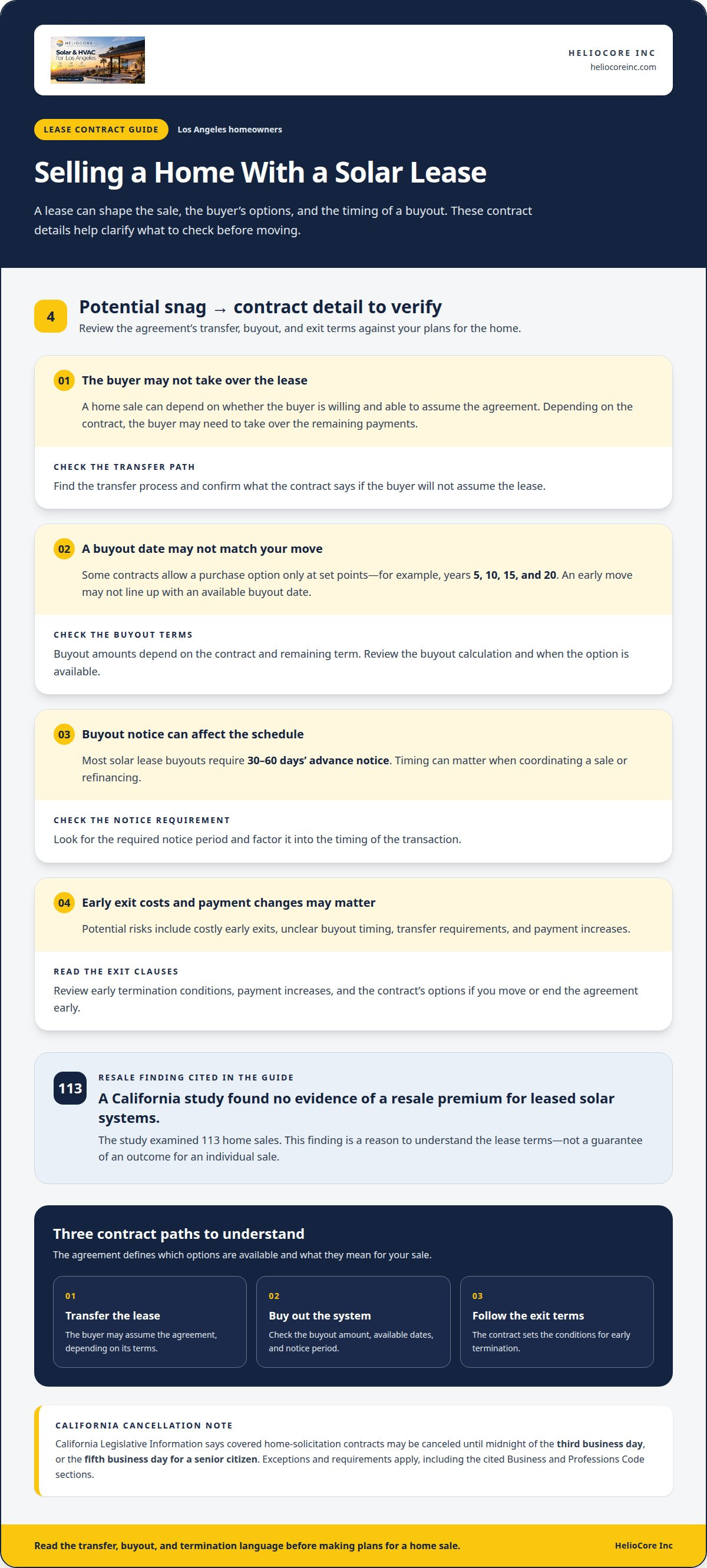
Some contracts allow a purchase option only at set points, such as years 5, 10, 15, and 20. That means an early move may not line up with an available buyout date. Most solar lease buyouts require 30-60 days’ advance notice, so timing can matter when coordinating a sale or refinancing.
A home sale involving a solar lease can depend on whether the buyer is willing and able to take over the agreement. A buyer’s willingness and ability to assume the contract can therefore affect negotiations. A California study of 113 home sales found no evidence of a resale premium for leased solar systems.
Read the contract for the transfer process, early termination conditions, buyout calculation, and any payment increases. Check what happens if a buyer won’t assume the agreement. These clauses define your options: transfer the lease, buy out the system, or follow the contract’s exit terms.
California Legislative Information says covered home-solicitation contracts may be canceled until midnight of the third business day, or the fifth business day for a senior citizen. Exceptions include contracts written under Sections 7151.2 or 7159.10 of the Business and Professions Code, and the agreement must comply with Section 1689.7.
For a lease, compare the transfer and buyout language with your likely plans for the home. Explore solar leasing as one way to structure your solar agreement.
Lease transfers and buyouts when selling a home
A solar lease ties the panels to an ongoing contract, so moving can affect more than the home’s electric bill. For Los Angeles homeowners, the main options are transferring the agreement or arranging a buyout.
Lease Transfers When Selling
With a leased system, selling the home usually means addressing the remaining agreement as part of the sale. When a home with a solar lease is sold, the buyer may need to take over the payments, depending on the agreement. That differs from buying out the system, which resolves the lease rather than transferring its remaining payment schedule to the buyer.
Moving or refinancing alone doesn’t determine what happens to the lease. The contract’s transfer, payment, and early-exit clauses set out the relevant obligations. During a sale, include the lease terms in the home’s transaction details, alongside other financing commitments.
If a buyer won’t assume the agreement, a transfer may not work for that sale. Buying out the lease is another possible path, but the contract controls its timing and calculation. A homeowner planning a move within 10 to 15 years should weigh that possibility when choosing solar financing.
Solar Leases and Home Resale Value
A lease and an owned system can affect a sale differently. Owned solar systems can increase home resale value by 5% to 10% compared with homes without solar. That estimate does not mean every sale achieves the same increase, and leased equipment should not be treated as homeowner-owned value.
Berkeley Lab’s study of 113 California home sales found no evidence of a resale premium for leased solar systems. A lease may continue to provide solar power, while its payment obligations can affect a buyer. Make the agreement’s transfer terms clear during the sale process, rather than assuming the panels will add value like an owned system.
For a practical sale plan, identify the lease balance and buyout options, then consider whether a buyer can assume the agreement. If buying out the lease, include the contract-defined amount in your sale calculations. If transferring it, account for the new owner’s payments when discussing the home’s monthly costs.
If the solar company stops operating, the lease doesn’t disappear from the transaction. The written agreement governs payment, servicing, and assignment obligations. Review its clauses to understand who handles the system and payments, including during a sale or refinance.
Typical lease length and annual escalators
Solar leases in Los Angeles typically run for 20 years, while agreements more broadly often span 20 to 25 years. Payment escalators can change the monthly obligation over that long term.
Lease Length
A lease term sets how long payments continue and how long the homeowner uses a system without owning it. Los Angeles leases typically run for 20 years; the broader typical range is 20 to 25 years. That difference matters when comparing an offer with plans to move, refinance, or keep the home through the full agreement.
Use the lease document to identify the start date, end date, and payment schedule. Then compare the term with your expected time in the home. A contract lasting 20 to 25 years can extend beyond a homeowner’s planned move, making transfer or buyout clauses relevant alongside the monthly payment.
Lease Payment Escalators
An escalator is the stated annual increase in a lease payment. California solar lease contract escalators are typically 1% to 3% per year, while many leases and power purchase agreements have annual escalators of 1% to 4%. A lower starting payment can therefore rise over the contract, so review each year’s scheduled amount.
To compare offers, begin with the first-year payment and follow the document’s escalation schedule through the full term. A lease or PPA escalator of 1% or less annually is a useful comparison target. Check whether the increase applies each year and how it changes total payments, not only the initial monthly amount.
Lease and PPA Escalator Rates
Leases and power purchase agreements both can include annual increases, but their payment structures differ. A lease charges for use of the solar system; a PPA charges for the electricity it produces. Solar lease escalators in California typically range from 1% to 3% yearly, while PPA escalators typically raise payments by 2% to 3% annually.
Compare the rate and payment basis in each contract. A PPA payment is tied to purchased solar power, while a lease payment follows its agreement terms. The escalator alone doesn’t show the full cost: consider the contract term, expected energy use, and how payments change over time.
For a clear comparison, place the term, first-year payment, annual escalator, and total scheduled payments side by side. A 20-year Los Angeles lease and a 25-year agreement should not be compared using only their opening monthly payments. The shorter term may end earlier, while the longer agreement keeps its payment terms in effect longer.
Before choosing, read the payment schedule as part of the full financing document. Note any annual increase, how long it applies, and the agreement’s end date. These details show how payments may change and help distinguish a low initial payment from a lower long-term commitment.
Solar leases and power purchase agreements
A solar lease and a power purchase agreement (PPA) both let Los Angeles homeowners use solar power without owning the system. The key difference is what the agreement charges for: a lease covers use of the equipment, while a PPA charges for the electricity it produces.
With a lease, the system owner retains ownership and the homeowner makes contract payments. Lease rates and terms can depend on system type, local utility power rates, and sometimes the customer’s credit. Lease payments provide a fixed rate for power and can help households plan around changes in utility rates.
A PPA sets a price for solar electricity instead of a payment to use the panels. PPA agreements typically let customers buy power at a discount for 20 to 25 years. The monthly payment can therefore reflect the amount of electric power the system produces and the contract’s rate, rather than simply equipment use.
Neither arrangement gives the homeowner ownership of the system during the agreement. Maintenance and monitoring may be included, depending on the contract. A lease may also include system performance terms, but coverage and service responsibilities vary. Read the agreement to understand who handles system issues.
Compare the agreement’s full payment structure with the utility bill. A lease payment and an electric bill are separate obligations, while a PPA payment is tied to solar electricity purchased. The value of either option depends on the system, utility rates, household energy use, and any payment escalator in the contract.
California’s property-tax exclusion for solar applies whether the system is leased or owned. That doesn’t make lease and PPA agreements identical: ownership, service responsibilities, payment calculations, and transfer terms still differ. Read the contract sections on maintenance, output, rate changes, and what happens when the home is sold.
For a clear comparison, line up the payment basis, contract term, service coverage, and end-of-agreement options. A lease may suit homeowners who prioritize using the equipment and value included services; a PPA may fit those who prefer paying for solar electricity. Neither is automatically more affordable without comparing its terms with utility costs.
Explore solar leasing options to see how a lease can fit into a residential solar plan.
HelioCore
HelioCore Inc helps Los Angeles homeowners weigh solar ownership and leasing against their household needs. The team manages residential solar projects from consultation and system design through permitting, installation, inspections, and utility permission to operate.
Bring your priorities into the decision: whether you prefer owning the panels, want lease payments, or are considering battery storage. HelioCore Inc offers solar panel installation and leasing to fit different home energy plans, without treating one option as right for every homeowner. HVAC and air-conditioning solutions are also available for broader home energy needs.
Contact HelioCore Inc to discuss which solar path fits your home and plans.
Choose a solar plan that fits your next chapter
Choosing solar lease versus purchase in Los Angeles also means deciding how you want to manage your home’s energy over time. Consider whether ownership, contract payments, or flexibility around a future move matters most to your household. Let that priority guide your next step.
For your solar lease-versus-purchase decision in Los Angeles, HelioCore can help you consider residential solar alongside broader home energy needs, including high-efficiency solar panels, battery storage, and HVAC. Contact HelioCore to discuss which approach fits your plans.
Talk with HelioCore about your solar options and move forward with a clearer sense of what suits your home.
Frequently Asked Questions
Do equipment warranties transfer when I buy out my lease?
A buyout doesn’t automatically transfer or extend equipment warranties; the manufacturer’s warranty terms govern coverage. Check how the warranty defines an eligible owner and whether a claim requires proof of purchase or system records. Workmanship coverage follows the service agreement and may differ from equipment warranty coverage. HelioCore can assist with manufacturer warranty claims, but the manufacturer remains responsible for warranty performance.
What Are the Terms and Benefits of Leasing Solar in Los Angeles?
Qualification uses a soft credit check that doesn’t affect the homeowner’s credit score. HelioCore serves homeowners in Los Angeles, Inglewood, South Los Angeles, Crenshaw, Leimert Park, Baldwin Hills, Westchester, Van Nuys, North Hollywood, Reseda, Northridge, Woodland Hills, and San Pedro.
How much does a solar system cost to buy in Los Angeles in 2026?
There isn’t one purchase price that applies to every Los Angeles home. The total depends on system design, equipment, site conditions, and installation requirements. HelioCore quotes are estimates based on project information and may change after a site assessment, equipment availability, or local requirements. A quote is valid for 30 days unless otherwise stated, and requesting one doesn’t obligate you to buy.
What are typical solar lease and PPA prices in Los Angeles?
Lease and PPA payments depend on the agreement’s rate structure, system design, expected production, and any payment escalator. A lease charges for use of the system; a PPA charges for solar electricity produced. Compare scheduled payments and contract terms, not just the initial monthly amount. Your utility bill remains separate, and solar doesn’t automatically eliminate it.
What federal, California, and Los Angeles incentives are available for purchased solar systems in 2026?
For systems placed in service after December 31, 2025, the federal homeowner clean-energy credit doesn’t apply, according to the Internal Revenue Service. California’s property-tax exclusion for solar applies whether a system is leased or owned. Tax treatment differs from utility billing credits or local programs, so separate those benefits when estimating a purchase’s overall value.
Who is responsible for solar panel maintenance, repairs, insurance, and inverter replacement under a lease versus purchase?
Under a lease, the contract defines maintenance and repair responsibilities. Some agreements include covered service, while optional cleaning or roof work may cost extra. With a purchase, the homeowner generally arranges service outside applicable warranties. Insurance depends on the agreement and the homeowner’s policy. Inverter replacement also depends on warranty coverage and contract terms, so it isn’t automatically included.
How does a solar lease or PPA affect selling a home or transferring the agreement in California?
A solar agreement can add a transfer step to a California home sale. HelioCore’s solar agreement may be transferred to a qualified buyer, subject to approval; purchase or prepayment may also be available under its terms. A PPA’s assignment and payment obligations depend on that agreement. Keep the documents available for the sale so the buyer can understand the remaining responsibilities before taking ownership.