
Solar
Solar Panel Financing in Los Angeles: Costs and Bill Savings

Yes, you can go solar without buying panels upfront: a solar lease or power purchase agreement (PPA) lets a third party own the system while you make payments or pay for its electricity. These solar panel financing options in Los Angeles commonly run 20 to 25 years. A solar loan or cash purchase lets you own the system instead.
Lower upfront costs can make a lease or PPA appealing, while ownership may suit homeowners who want to build long-term value. The details matter: some agreements increase payments over time, and your utility rates affect how solar may change your bill.
This guide compares leases, PPAs, loans, and cash purchases in plain terms. You’ll see how payment structures, utility rates, and household electricity use affect the trade-offs, helping you weigh each option against your budget and plans for your home.
Key Takeaways
- Compare leasing, a PPA, a solar loan, and cash by weighing upfront commitment, ownership, and how payments may change over time.
- Look beyond a loan’s advertised rate: fees, repayment length, and whether the loan is secured all affect its total cost.
- Estimate payback using your household’s electricity use and utility rate, not a generic bill-savings claim.
- Consider how much electricity solar exports to the grid, since exported power can be valued differently from electricity you use at home.
- Review cash purchase savings alongside the full cost of financing to see which option best fits your budget and plans for your home.
Table of Contents
Is a solar lease or PPA the smart move in California now?
In Los Angeles, leases and PPAs leave system ownership with a third party, while a solar loan lets you finance a system you own. LADWP interconnection connects a system to the utility grid, and net billing accounts for electricity sent back. LADWP’s Feed-in Tariff Plus pilot supports local solar and storage that can dispatch power to nearby load centers when it benefits the grid.
Lease and PPA Payment Structures
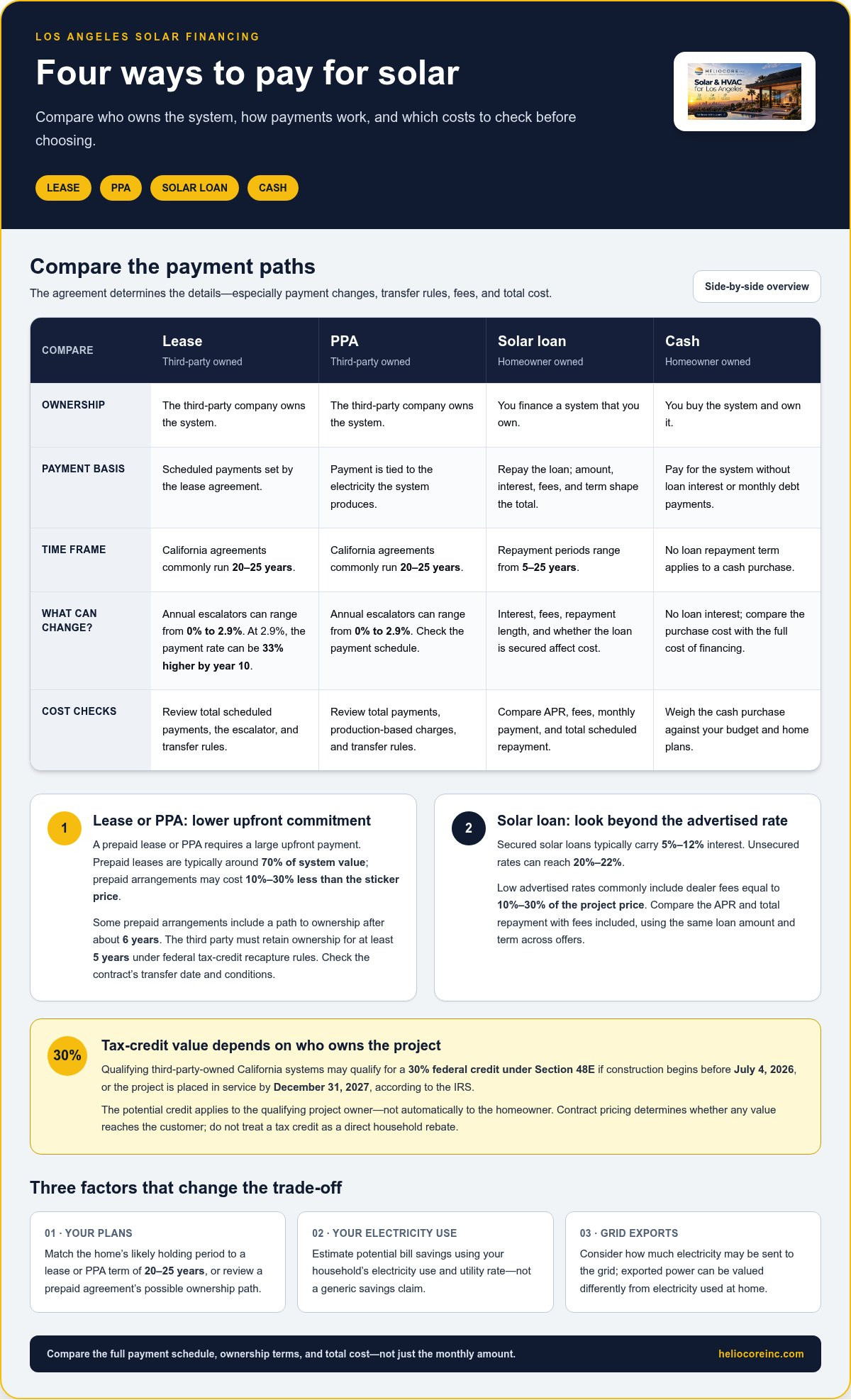
A monthly lease sets payments under an agreement, while a PPA charges for the electricity the system produces. California leases and PPAs commonly run 20 to 25 years, so compare the full term, payment schedule, and transfer rules before signing.
Annual escalators can range from 0% to 2.9%. At 2.9%, a payment rate can be 33% higher by year 10; a 0% escalator keeps the scheduled rate level. A prepaid lease or PPA instead requires a large upfront payment, typically around 70% of system value for prepaid leases.
Prepaid arrangements may cost 10% to 30% less than the sticker price. They often include a path to ownership after about six years, but the third-party company must retain ownership for at least five years under federal tax-credit recapture rules. Read the agreement for the transfer date and conditions.
Comparing Leases, PPAs, and Loans
For Los Angeles homeowners, a lease means scheduled payments without system ownership, while a PPA ties payments to the solar electricity produced. A solar loan finances a system the homeowner owns. The loan amount, interest, fees, and repayment term determine the total paid.
Third-party-owned California solar systems may qualify for a 30% federal credit under Section 48E if construction begins before July 4, 2026, or the project is placed in service by December 31, 2027, according to the Internal Revenue Service. That potential credit applies to the qualifying project owner, not automatically to the homeowner; contract pricing determines whether any value reaches the customer.
LADWP’s Self-Generation Incentive Program provides financial incentives to qualified residential customers installing solar and battery storage. For its remaining SGIP rebate budget, the income-qualified pathway requires household income at or below 80% of area median income, according to the California Public Utilities Commission.
Sale-Leaseback and Conventional Financing
In a sale-leaseback, a company owns the installed system and leases it back for use at the home. This differs from a conventional solar loan, where the homeowner borrows money and owns the equipment. The agreement determines who receives any eligible project tax benefits.
California’s third-party-owned systems may have a different tax-credit route from homeowner-owned systems. For a sale-leaseback or lease, compare the payment escalator, transfer terms, and ownership timeline. Don’t treat a tax credit as a direct household rebate.
Before choosing, line up the figures in each offer: total scheduled lease or PPA payments, prepaid amount, loan repayment, and any planned transfer date. Then consider whether the home’s likely holding period fits a 20-to-25-year agreement or a prepaid lease’s possible ownership path after about six years.
Participating lenders and loan terms
In Los Angeles, secured solar loans typically carry 5%-12% interest, while unsecured rates can reach 20-22%. Repayment periods range from 5 to 25 years, and monthly payments depend on the loan amount, APR, and term.
Participating Lenders
A solar loan is an agreement between you and a lender. PG&E, SDG&E, SCE, and SoCalGas don’t review or approve financing applications. Your utility bill and loan are separate obligations, even if solar changes how much electricity you buy from the grid.
First, identify the lender named in the offer and read its terms alongside the project scope. A system with battery storage may require a different loan amount than panels alone. Compare the lender’s APR, fees, payment schedule, and credit requirements before choosing.
Loan Amounts and Repayment Terms
The loan amount should match the work covered by the project agreement. Check whether it includes panels, installation, and battery storage, if applicable. If the financed scope and project agreement don’t match, comparing offers fairly can be difficult.
Solar-loan repayment periods range from 5 to 25 years. A shorter term means payments are spread over less time; a longer term spreads them further. Compare the monthly amount with the total scheduled repayment, since a manageable payment alone doesn’t show the full borrowing cost.
APR and Dealer Fees
Look beyond an advertised APR. California solar loans with low advertised interest rates commonly include dealer fees equal to 10% to 30% of the project price. These fees can increase the amount financed, so compare the APR and total repayment with the fee included.
Secured solar loans typically have interest rates of 5%-12%; unsecured rates can reach 20-22%. These ranges describe different loan structures, not interchangeable offers. Compare the same loan amount and repayment period across proposals to see how interest and fees change the payment and total cost.
Loan Approval Timing
Approval timing depends on the lender’s application and credit-review process. The steps are straightforward: submit the application, provide requested project details, review the lender’s decision, and compare the final terms before accepting.
Keep the financing documents and installation agreement aligned. Confirm that the approved loan amount matches the project scope, and note when payments begin under the loan contract. The lender sets its review process; the utilities listed above don’t approve the loan or determine its terms.
Cash purchases and solar loans
A cash purchase avoids loan interest and monthly debt payments but requires homeowners to pay upfront. A solar loan spreads the expense across scheduled payments while allowing the homeowner to own the system. The better fit depends on available savings, loan terms, and how long the household expects to stay in the home.
For a cash purchase, compare the upfront commitment with expected bill savings over time. California cash solar systems typically pay back in 7 to 10 years without the federal residential tax credit. EnergySage cites an average solar payback period of 10 years. These are estimates, not a household-specific calculation: electricity rates, system performance, energy use, and incentives affect the result.
Homeowners who borrow should compare secured and unsecured offers. Secured solar loans typically have rates of 5%-12%, while unsecured rates can reach 20-22%. As outlined in the lender comparison, the interest rate is only one part of the cost. Review the APR, fees, repayment period, and total payments before choosing.
Loan length affects the balance between monthly payments and total interest. A longer repayment schedule may lower the monthly payment, but interest accrues throughout the term. A shorter schedule may mean higher monthly payments but less time in repayment. Compare offers using the same loan amount and term, then see how each payment fits alongside the remaining utility bill.
Tax treatment also affects the purchase calculation. The federal residential clean energy credit under Section 25D fell to 0% on January 1, 2026. That change matters to homeowners purchasing or financing their systems, because the expected return should not rely on that residential credit. Keep the cash price, financing cost, and projected bill savings separate in your comparison.
Use this sequence to compare options. First, decide how much you can pay upfront without depleting household reserves. Next, compare that amount with the loan’s APR and total scheduled repayment. Then assess how much electricity the system may serve at home, considering utility rates and household use. Finally, compare the likely payback period with how long you plan to keep the home. This puts solar in a long-term context, rather than making the decision on the monthly payment alone.
For example, compare the cash outlay with the loan’s full repayment, then consider each alongside potential bill reductions. A cash purchase avoids borrowing costs; a loan preserves more money upfront but adds interest. Compare the total household impact, including the remaining utility bill, rather than looking at the loan payment alone.
California utility rates and solar payback
California utility rates shape how much a home saves by using solar power instead of buying electricity. As of March 1, 2026, average residential rates were 33.7 cents per kWh at PG&E, 34.5 cents at SCE, and 45.7 cents at SDG&E. Your utility matters, but your household’s usage pattern matters too.
California net billing, often called NEM 3.0, credits solar exports at lower rates than many homes pay for grid electricity. Most exports are valued at roughly 5 to 8 cents per kWh. Using solar power at home can therefore have greater bill value than sending the same electricity to the grid.
How much solar electricity a home uses as it is produced affects the savings calculation. Using more solar power at home can offset more retail-rate electricity purchases. Electricity exported to the grid may receive smaller bill credits. Compare expected production with daytime use, evening demand, and any battery storage in the plan.
Payback estimates provide a starting point, not a personal forecast. California cash systems typically pay back in 7 to 10 years without the federal residential tax credit. Across U.S. homes, estimated payback ranges from 6 to 12 years, depending on electricity rates, system performance, energy use, and available incentives. A 10-year estimate can help frame a comparison, but local rates and usage affect the result.
Compare savings with the full financing schedule. A loan payment may continue for 20 years, while the utility bill changes as solar offsets purchases and exports earn credits. Put the monthly loan payment beside the remaining utility bill, rather than treating either figure alone as the household’s energy cost. For a lease or PPA, include its scheduled payments and any annual escalator in the same comparison.
California rates have also changed over time. Between 2016 and March 2026, residential rates rose 69% at PG&E, 101% at SCE, and 98% at SDG&E. Those figures describe past increases, not a guarantee of future rates. They do show why a payback estimate should use the applicable utility rate and distinguish electricity used at home from electricity exported.
To compare options, identify your utility, estimate the share of solar power used at home, and account for exported energy at the applicable net-billing value. Then compare expected bill savings with loan payments, lease charges, or PPA payments over the relevant term. A 10-year payback estimate and a 20-year financing schedule answer different questions: one concerns recovery of system costs, the other the duration of payments.
Cash purchases and electricity-bill savings
A cash purchase turns an upfront payment into a long-term source of household solar energy. To assess the value, consider the amount paid, electricity not bought from the grid, credits for exported power, and utility charges that remain. The bill may fall, but the result depends on how much generated electricity the household uses directly.
Treat that figure as a comparison point, not a personal forecast. Utility rates, household use, system performance, and the value of exported electricity all affect actual savings. A home that uses more solar power as it is produced may buy less electricity from the grid.
Consider a household with a $200 monthly electric bill. Accounting for inflation, that household would spend about $117,378 over the next 25 years. This example shows the long horizon behind a cash purchase. It does not mean solar removes every bill charge; the remaining amount depends on the home’s utility service and electricity use.
California net billing also affects the value of a system’s output. Most exported solar power is valued at roughly 5 to 8 cents per kWh, while electricity purchased from the utility can cost more. Compare when the household uses power with when the system generates it. That difference helps explain why annual production alone doesn’t show likely bill savings.
A prepaid solar lease typically requires around 70% of system value upfront. That payment differs from a cash purchase because a third party retains ownership. Comparing both approaches means looking at the upfront commitment, who owns the equipment, and how payments or bill credits work across the agreement.
For a practical estimate, gather a full year of electric bills and note seasonal changes. Compare usage with expected solar production, then separate electricity used at home from exports. Finally, compare projected utility-bill reductions with the upfront payment. This ties the estimate to household demand instead of a broad average.
A cash purchase can suit homeowners who have funds available and prefer to avoid loan interest. The trade-off is committing more money at the start. Compare that commitment with the expected savings over the system’s useful period, and account for ongoing utility charges. A 25-year savings estimate is most useful when its assumptions reflect the home’s rates and consumption.
Ready to assess how a solar system could fit your home’s energy use? Explore a solar installation plan and compare the projected bill impact with your household’s current electricity costs.
HelioCore: High-Efficiency Solar Panels
HelioCore Inc. helps Los Angeles homeowners connect financing decisions with the practical details of a solar project. Its High-Efficiency Solar Panels and installation service give you a way to discuss system needs alongside household energy use and bill-saving goals. If you’re weighing a lease, loan, or cash purchase, consider how ownership and payment structure fit your plans.
Battery storage may also be worth considering if you want to use solar power beyond daylight hours. A clear project scope makes it easier to compare financing terms with the system you plan to install.
To discuss your home’s solar needs, contact HelioCore Inc..
Choose a Solar Plan That Fits Your Next Chapter
Your financing choice should fit more than this month’s budget. Consider how long you expect to stay in your home, how you prefer to manage payments, and whether your energy needs may change. This perspective can help you choose a structure that remains workable after installation.
Choosing among solar panel financing options in Los Angeles is also a chance to consider the home as a whole. HelioCore offers High-Efficiency Solar Panels, HVAC, and Battery Storage. A conversation about your home’s energy use can help clarify which project details matter as you weigh ownership, financing, and household priorities.
When you’re ready to explore a solar project, contact HelioCore about solar financing. Bring your questions and your goals for the home. A clear next step can make a major upgrade easier to consider.
Frequently Asked Questions
Can you rent solar panels?
Yes. A solar lease lets you use panels owned by a third party in exchange for scheduled payments. California leases commonly last 20 to 25 years, and some agreements increase payments annually. A PPA is another third-party-owned option: you pay for the electricity the system produces. Before signing, review payment changes, maintenance responsibilities, and what happens to the agreement if you sell your home.
How much does a solar loan really cost in 2026?
The total cost depends on the amount borrowed, interest, fees, and repayment term, not just the advertised rate. Secured solar loan rates typically range from 5% to 12%; unsecured rates can reach 20% to 22%. Repayment periods range from 5 to 25 years. Compare total scheduled payments and the APR, including any dealer fee, to understand the full borrowing cost.
Does paying cash still make sense without the tax credit?
It can, if the upfront payment fits your finances and expected bill savings justify the investment. California cash solar systems typically pay back in 7 to 10 years without the federal residential tax credit. That estimate varies with electricity rates, household use, and system performance. Compare the cash outlay with the total cost of financing, while keeping utility charges and export credits in the calculation.
How do solar incentives work with different financing options?
Incentive eligibility can depend on who owns the system and which program applies. The residential clean energy credit under Section 25D fell to 0% on January 1, 2026. Third-party-owned California systems may qualify for a 30% federal credit under Section 48E if they meet the stated construction or in-service deadlines, according to the Internal Revenue Service. Contract terms determine how any project benefits affect customer payments.
What solar panel financing options are available to Los Angeles homeowners?
Solar panel financing options in Los Angeles include cash purchases, secured or unsecured loans, monthly leases or PPAs, and prepaid agreements. These differ in ownership, payment structure, and transfer terms. Homeowners may also want to compare property-linked financing options and consider how they could affect the home. Compare the terms with your budget and plans for the property.
Are federal, California, or Los Angeles solar tax credits and rebates available in 2026?
The federal residential credit under Section 25D is 0% in 2026. Third-party-owned systems may qualify under Section 48E if they meet applicable deadlines. California’s general-market SGIP battery rebate program closed on December 31, 2025. Its remaining income-qualified pathway requires household income at or below 80% of area median income, according to the California Public Utilities Commission. LADWP also describes incentives for qualified residential solar and battery customers.
How can homeowners compare solar financing offers and identify dealer fees or hidden costs?
Compare Los Angeles solar financing offers using the same project scope and loan amount. Review APR, total scheduled payments, repayment term, escalators, transfer conditions, and equipment ownership. California solar loans with low advertised rates commonly include dealer fees of 10% to 30% of the project price. Read the written breakdown and compare total repayment, since a low monthly payment alone can obscure fees or a longer term.
What happens to solar loan, lease, or PPA payments when selling a home in California?
The agreement determines what happens when you sell. A loan remains a separate financing obligation, while a lease or PPA may require a transfer or another arrangement under its contract. Read the transfer, payoff, and buyer-approval terms before listing the home. If equipment is leased, understand the remaining payment schedule and explain the agreement to prospective buyers early in the sale process.