
Solar
Whole House Fan Installation in Los Angeles: Costs and CFM
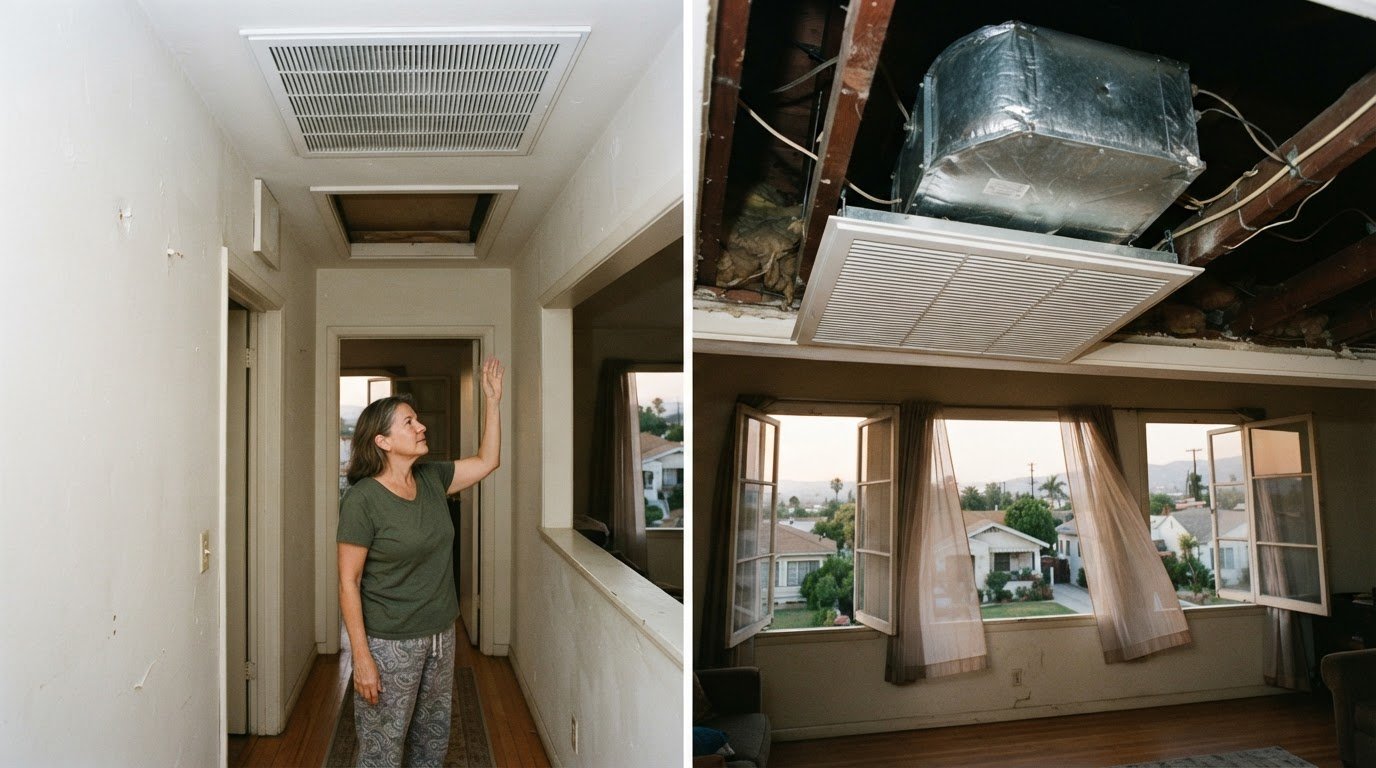
Which whole-house fan mount is quieter, ceiling or roof? Neither mounting style alone guarantees less noise; fan design, airflow, and installation all shape how the system sounds. For whole house fan installation in Los Angeles, a common sizing guide is 2 to 3 CFM of airflow per square foot of living space.
Choosing whole-house fan installation in Los Angeles means weighing comfort, sound, and your home’s layout. This guide explains how whole-house fans move air, what to consider when comparing ceiling and roof mounts, and how CFM relates to living space. You’ll also learn what affects installation scope and operating costs, and why professional planning should account for the fan, airflow path, and attic ventilation together. These factors help you decide what questions to ask and whether a whole-house fan suits your home.
Key Takeaways
- Compare ceiling and roof mounts by considering how fan design, airflow, and installation affect sound in your home.
- Use living-space area as a starting point for sizing: a general guide is 2 to 3 CFM of airflow per square foot.
- Account for attic vent capacity and open-window airflow when assessing whether a fan can move air effectively.
- Look beyond the fan itself when planning a project; installation details, controls, and electrical work can shape the overall scope.
- Choose operating times around cooler outdoor air to help draw fresh air through the home.
Table of Contents
What is a whole house fan, and how does it work?
A whole-house fan moves air from the living space into the attic, usually through a ceiling opening. With windows open, it draws cooler outdoor air into the home and pushes warm indoor air into the attic, where attic vents let the air escape. Unlike an air conditioner, it ventilates with outdoor air rather than cooling and recirculating indoor air. In California, it is most useful when the outdoor air is cooler than the rooms you want to ventilate.
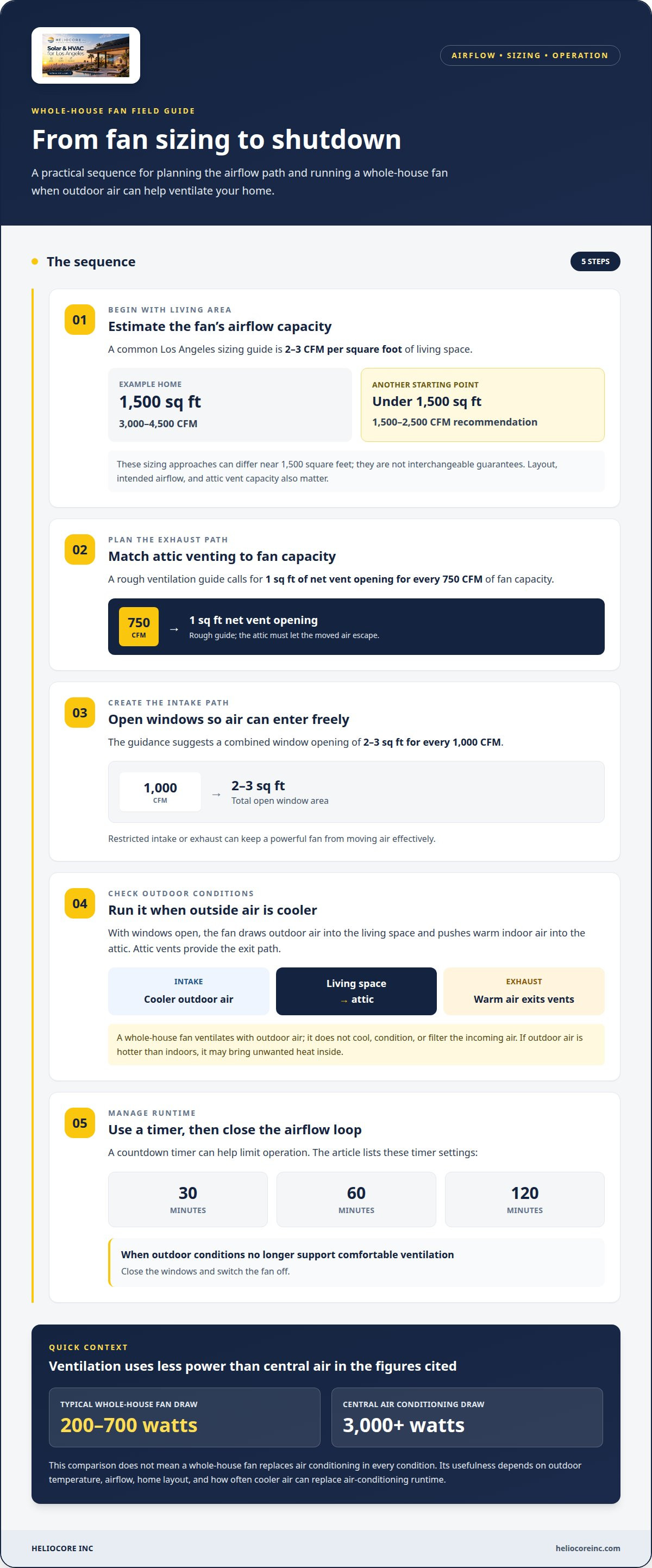
The sequence is straightforward: open windows, run the fan, and let the warm air leave through attic vents. A rough ventilation guide calls for 1 square foot of net vent opening for every 750 CFM of fan capacity. Windows also need to admit air freely. The guidance suggests opening windows totaling 2-3 square feet for every 1,000 CFM. These airflow openings matter because a powerful fan cannot move air effectively through a restricted path.
Ventilation can also refresh indoor air. The U.S. Environmental Protection Agency states that indoor air quality may be 2-5 times more polluted than outdoor air quality. A whole-house fan can exchange indoor air with outdoor air, but it does not filter or condition that incoming air. Outdoor temperature and air quality therefore matter. For example, drawing in cooler evening air can help clear warm, stale indoor air; running the fan while outdoor air is hotter may bring unwanted heat inside.
Energy use differs from air conditioning. A typical whole-house fan draws about 200 to 700 watts, while central air conditioning can draw 3,000 watts or more. That difference can make fan ventilation a lower-energy way to cool a home when outside air is comfortable. It does not mean the fan replaces air conditioning in every condition. During a hot afternoon, or when outdoor air is warmer than indoor air, air conditioning may still be needed to control indoor temperature.
Potential savings depend on how often the fan can replace air-conditioning runtime. The fan’s capacity, home layout, open-window airflow, attic vent area, and local weather all affect that opportunity. A fan may make a home feel fresh again in about 15 minutes, but that describes a possible comfort effect, not a guaranteed cooling time. Trapped attic air can reach 130°F, so moving warm air out of the living space and attic is part of the system’s purpose.
A whole-house fan is a ventilation upgrade with a specific purpose: it uses cooler outdoor air to help remove indoor heat. In suitable conditions, it may reduce reliance on air conditioning. It cannot cool the incoming air, however, and does not provide the same controlled cooling as an air conditioner. Choosing when to run each system is key to using them appropriately.
Installation costs and operating expenses
Installation scope depends on the home and the work involved. A quote is based on factors such as fan capacity, access to the ceiling and attic, attic ventilation, wiring requirements, and any adjustments needed for installation. Since these details vary from one Los Angeles home to another, a single price would not represent every project.
Most single-fan installations take 2-4 hours. The time can vary with the fan location, the route for electrical wiring, and how easily the installer can work in the attic. A straightforward installation has a different scope from a home that needs additional ventilation or more involved electrical work. Those conditions affect both the work plan and the final quote.
Operating costs are a separate budget consideration. The actual expense depends on the fan’s power use and how often it runs. When comparing energy use, consider more than the fan’s operating cost: cooler outdoor air may also let you run air conditioning less often, depending on conditions and how you use both systems.
Operation follows a simple routine. Open windows to provide an air path, then run the fan when outdoor air is cooler than the air inside. A countdown timer can be set for 30, 60, or 120 minutes, helping limit runtime without relying on memory. Close the windows and switch the fan off when outdoor conditions no longer support comfortable ventilation.
Electrical setup is another cost consideration. Most whole-house fans run on a standard 120-volt circuit, and a mid-size fan can fit on an existing 15- or 20-amp line. The installer considers the chosen fan and the home’s electrical setup when planning the work. The fan’s switch or timer also needs suitable wiring, and that work forms part of the installation scope.
To keep the estimate clear, separate the main cost drivers: the fan and its capacity, access and installation complexity, electrical work, and any attic ventilation changes. The price depends on the home and is provided after a quote request. A professional assessment of HVAC installation planning can help connect those factors to the right scope for the house.
How professionals size whole-house fans and select CFM models
CFM means cubic feet per minute, the volume of air a fan moves. Professionals use it to match fan capacity with a home’s living area and ventilation path. A general Los Angeles sizing guide calls for 2 to 3 CFM per square foot. For example, a 1,500-square-foot home points to a 3,000 to 4,500 CFM range under that method.
Other sizing guidance uses different starting points. For homes under 1,500 square feet, one recommendation is a 1,500 to 2,500 CFM fan. That differs from the square-foot calculation near 1,500 square feet. These figures are not interchangeable guarantees. A contractor considers the home’s layout, the intended airflow, and whether attic vents can handle the selected fan’s output.
Air exchanges offer another way to assess performance. A rough target is 15-20 full air exchanges per hour. This describes how often the home’s air volume passes through the ventilation system, not a promise of uniform cooling in every room. Room arrangement, open pathways, and the supply of outdoor air all influence how evenly air moves.
Vent capacity must support the fan. A rough guide calls for 1 square foot of net vent opening for every 750 CFM. Window openings also help air enter the home. The suggested opening area is 2-3 square feet for every 1,000 CFM of fan capacity. If these airflow paths are restricted, a larger fan alone may not improve comfort.
A professional assessment considers the home as a whole. The installer measures the living area, reviews attic vent openings, and considers how air will travel through the rooms. A two-story layout, enclosed spaces, or limited attic ventilation can affect performance. These factors help determine whether one fan is suitable or a different configuration is needed.
CFM is only one factor in choosing a model. The fan needs to move enough air for the intended ventilation while working with the home’s available vent area and electrical setup. Selecting a unit by square footage alone can overlook practical constraints, such as insufficient attic ventilation. Matching capacity to the complete airflow path helps the system perform as intended.
Before recommending a model, the contractor connects three checks: living-space measurements, airflow openings, and the expected air-exchange target. For instance, a 1,500-square-foot home may land in different CFM ranges under different sizing methods. The professional weighs the home’s actual layout and vent capacity to select a system that supports steady air movement, rather than relying on one number alone.
What are the best whole house fan installers in Los Angeles?
For whole-house fan installation in Los Angeles, choose an installer who assesses the complete airflow path, not just the fan. That includes the proposed location, attic ventilation, electrical work, and how air will move through occupied rooms. Recommendations should connect these details to your home’s layout and intended use. Choosing a model without a clear installation plan can leave important project details unresolved.
Start with the assessment process. The installer should explain where the fan will go, what the work involves for the ceiling or roof, and how warm air will exit the attic. They should also consider existing vents and the electrical setup. For example, a home with closed-off rooms may need a different airflow plan from one with an open living area.
Discuss sound specifically. Ask how the proposed fan location and installation method may affect noise in the rooms below. Ceiling and roof mounts place equipment differently, but the mounting style alone does not determine how quiet the system will seem. Fan design, airflow, and installation quality also affect sound. A useful recommendation considers all of these factors together.
Ask about the work sequence, too. A professional should explain how they will assess the site, prepare the area, install the fan and damper, complete wiring, and test the system. This helps you understand what work takes place in the house and attic, and how access and finishing may affect installation and operation.
Use these points to assess whether an installer’s plan is specific to your home:
- Airflow: The proposed fan capacity and attic vent path make sense together.
- Placement: The installer explains the chosen location and its effect on the rooms below.
- Electrical work: The plan addresses the switch or timer and the home’s existing setup.
- Testing: The final step includes checking operation and airflow after installation.
For Los Angeles homeowners, a good fit is a professional who explains trade-offs clearly and connects each recommendation to a condition in your home. A walkthrough should address access, mounting, airflow, and testing before work begins. This makes the proposed scope and expected operation easier to understand without relying on broad claims about every home or installation.
Look for a professional who assesses airflow, attic ventilation, electrical setup, room layout, and sound, then explains how these factors shape the installation plan. The installer should also outline the work sequence and test the system’s operation and airflow when the job is complete.
When is the best time to run a whole house fan in Los Angeles?
In Los Angeles, the best time is when outdoor air is cooler than the air inside. Summer nights can bring a temperature drop of 20 degrees after sunset while homes remain warm. That gap gives the fan a chance to replace accumulated indoor heat with cooler air. The clock alone is not the deciding factor. Conditions around the home matter more than a fixed schedule.
Use outdoor conditions as your first guide. If the evening air is cooler than the rooms, running the fan may help cool the home overnight. If outdoor air is still warm, bringing it inside may not improve comfort. A whole-house fan moves outdoor air; it does not cool that air before it enters. The difference between indoor and outdoor temperatures helps you decide when operation makes sense.
Conditions vary from evening to evening across Los Angeles. Compare the outdoor air with the warmth inside, then decide whether to run the fan. For instance, after a sunny afternoon, a home that remains warm may benefit when the air cools after sunset. If the evening stays hot, the fan may provide less cooling benefit.
Duration should follow the home’s response, not a single rule for every night. A countdown timer can be set for 30, 60, or 120 minutes. Those settings provide defined operating periods, but the right choice depends on how quickly the home feels comfortable and how outdoor conditions change. A shorter cycle may suit a mild evening; a longer setting can keep air moving while the home releases stored warmth.
Room layout affects how the system feels. Air needs a path to the spaces that are warm, so closed doors or isolated rooms can limit how evenly the home responds. A professional can account for the layout when planning the system. Your operating routine can then follow the home’s airflow path instead of relying on the temperature in just one room.
Keep these timing cues in mind:
- After sunset: Compare outdoor air with the warmest rooms before starting the fan.
- During a cooler evening: Use ventilation to help remove lingering indoor warmth.
- As conditions change: Stop operation if outdoor air no longer supports comfortable cooling.
For a Los Angeles home, a 20-degree nighttime drop can create a useful cooling window, but timing depends on the evening’s actual conditions. A consistent check of outdoor temperature, indoor comfort, and room airflow makes the schedule easier to adjust. Plan your home’s cooling approach around how the house responds after sunset.
HelioCore
HelioCore Inc. helps Los Angeles homeowners plan practical solutions for home comfort and cooling. If you’re considering whole-house ventilation alongside air conditioning, the right approach depends on your layout, airflow, and daily cooling needs. HelioCore Inc. provides HVAC solutions, including air conditioning installation and repair, for homeowners planning their broader cooling needs.
Talk with HelioCore Inc. about how air conditioning could fit into your home comfort plan. A discussion of your needs can help you understand the available HVAC options and decide what may suit your household.
Contact HelioCore Inc. to discuss your home’s cooling needs.
Make a confident next move
Planning whole-house fan installation in Los Angeles is an opportunity to consider more than one piece of equipment. Think about how ventilation, air conditioning, and your home’s energy needs fit together. HelioCore offers HVAC solutions, high-efficiency solar panels, and battery storage to support different parts of home comfort and energy planning.
Start with a conversation about your home and what you want to improve. Tell HelioCore about your comfort concerns, which rooms feel warm, and how you currently use cooling. This context helps focus the discussion on practical options for your household rather than assuming every home needs the same solution.
Contact HelioCore about installation to discuss your home’s needs. A considered plan can make the path forward feel simpler, clearer, and well matched to your home.
Frequently Asked Questions
Ceiling mount or roof mount: which one is quieter?
Neither mount is automatically quieter. Sound depends on the fan and its installation. A ceiling-mounted unit sits closer to living areas, making vibration isolation and careful fitting important. A roof-mounted setup places the equipment elsewhere, but motor and airflow noise can still be heard. Ask how the proposed location, mounting, and airflow design may affect sound in the rooms you use most.
How do professionals wire a whole-house fan switch or timer?
A professional connects the fan’s controls to its electrical supply, then tests switching and operation. Most whole-house fans use a standard 120-volt circuit, and a mid-size fan may fit an existing 15- or 20-amp line. The installer considers the selected fan and the home’s wiring before completing the connection. A timer can provide a set runtime, while a switch gives direct manual control.
How long does installation take?
A typical single-fan installation takes 2-4 hours, though the work varies by home. Access, ceiling construction, wiring routes, and attic conditions shape the schedule. For example, a clear attic and accessible ceiling can simplify the installation, while added electrical work or difficult access can extend it. The installer can explain the sequence and expected work window after assessing the location and project scope.
How much does whole house fan installation cost in Los Angeles?
The price depends on the home and is provided after a quote request. Factors include fan capacity, mounting location, ceiling or attic access, electrical work, and whether attic ventilation needs adjustment. A project that requires additional work has a different scope from one with straightforward access and compatible existing conditions. The estimate should explain the work included, not just name the equipment.
What permits or building codes apply to whole house fan installation in Los Angeles?
Permit and code requirements depend on the project scope and jurisdiction. The installation plan should consider the fan location, electrical work, and any changes to the ceiling or roof. Those details determine which requirements apply to your home. Before work begins, the installer should identify applicable requirements and account for them in the planned process.
How does a professional choose the right whole-house fan size for a home?
A professional considers living-area square footage, the home’s layout, and the airflow available through windows and attic vents. A general guide is 2 to 3 CFM per square foot; a 1,500-square-foot home therefore points to about 3,000 to 4,500 CFM under that method. The installer also checks whether the ventilation path can support the selected capacity, rather than sizing by floor area alone.
How long does whole house fan installation take, and what does the process involve?
A single-fan installation typically takes 2-4 hours. The professional assesses the location, prepares the ceiling opening, sets the fan and damper, completes wiring, and tests operation. One project breakdown allows about 1 hour for cutting the opening, 1 to 2 hours for setting the fan and damper, about 1 hour for wiring, and time for walkthrough, testing, and cleanup. Site conditions affect the sequence.
Whole house fan vs. air conditioning: which is better for Los Angeles homes?
Neither option is best in every situation. A whole-house fan ventilates the home with cooler outdoor air, while air conditioning cools without depending on outdoor air being cooler. A Los Angeles evening may suit fan operation, for example, while a hot afternoon may call for air conditioning. The right choice depends on outdoor conditions, your comfort needs, and how the home’s ventilation and cooling systems work together.